










EAAA has Rs 20,000-25,000 crore dry powder to add fee-paying AUM
Key highlights
- EAAA said Rs 20,000 crore to Rs 25,000 crore of dry powder was available for investment.
- EAAA reported Rs 95,000 crore of total AUM and Rs 49,164 crore of fee-paying AUM.
- Fee-paying AUM rose 28% from nearly Rs 38,500 crore in Q2 FY26 to nearly Rs 49,100 crore.
- Management fees increased 23% from nearly Rs 136 crore to nearly Rs 166 crore over the period cited by management.
powered by IRIS
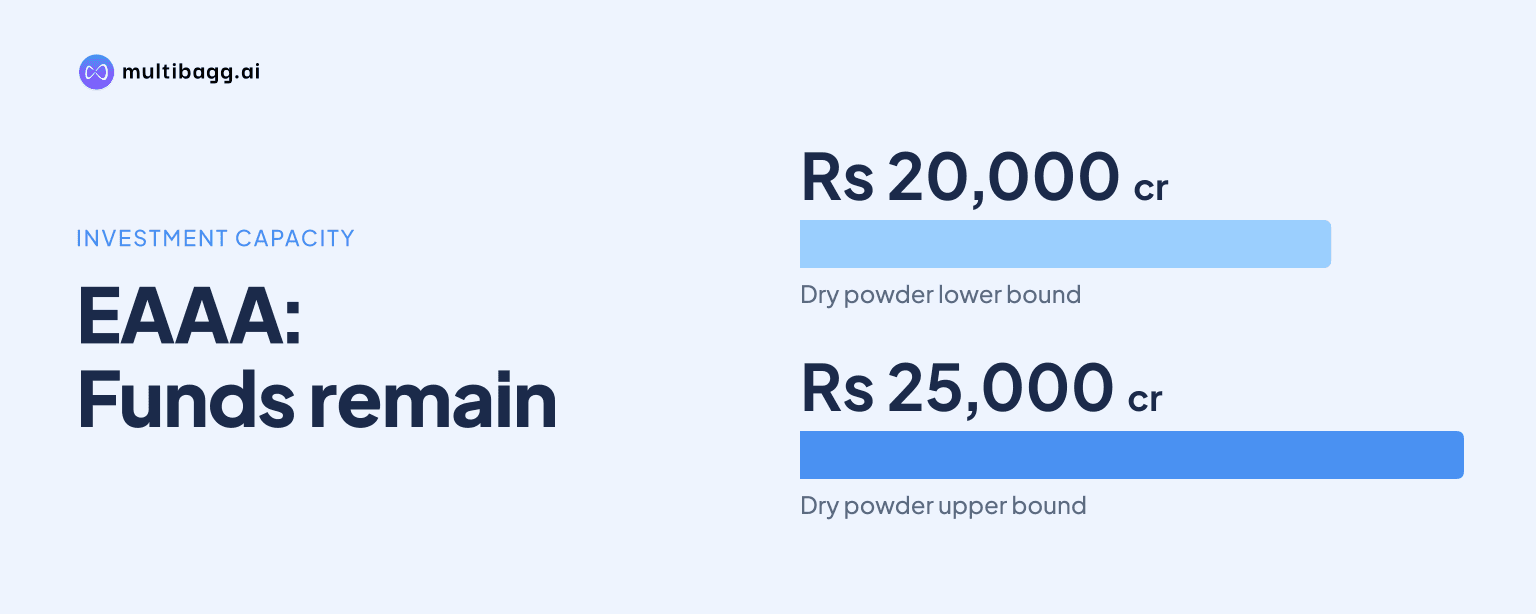
EAAA India Alternatives said Rs 20,000 crore to Rs 25,000 crore of dry powder could move into fee-paying assets under management, or AUM, as it is invested over coming quarters and years. The estimate compares with Rs 49,164 crore of fee-paying AUM and Rs 95,000 crore of total AUM reported on the call.
Know EAAA India Alternatives inside out
Results, valuation, peers and who's buying, in one view.
How much dry powder does EAAA have?
EAAA said dry powder was closer to Rs 20,000 crore to Rs 25,000 crore when management was asked to quantify the gap between total AUM and fee-paying AUM. Management described the amount as capital available for investment, while adding that its finance team could provide a more detailed figure separately.
The company reported Rs 95,000 crore of total AUM and Rs 49,164 crore of fee-paying AUM, creating an arithmetic difference of Rs 45,836 crore. Management said this difference is not solely dry powder: it also includes capital repaid from live funds, which remains relevant to variable additional return, or VAR, calculations.
Management did not disclose how the Rs 20,000 crore to Rs 25,000 crore was divided among private credit, infrastructure, commercial real estate or private equity. In response to a question on the Rs 20,000 crore raised through funds during FY26 and the first half of FY27, it said the capital was spread across strategies and that a break-up could be supplied later.
How does EAAA convert dry powder into fee-paying AUM?
EAAA said dry powder will enter fee-paying AUM as the capital is invested, so deployment is the mechanism that converts committed or available capital into the base on which management fees are earned. Management referred to investment occurring over coming quarters and years, but did not provide a quarterly deployment target or a deadline for the Rs 20,000 crore to Rs 25,000 crore range.
Management fees are calculated on fee-paying AUM according to the actual number of days, EAAA said. That means capital from a recent fundraise does not generate a full period of fees immediately, and the income effect of new funds emerges over several quarters as capital is raised, deployed and exits occur across fund vintages.
Infrastructure Fund 1 illustrates the effect of exits on this process. EAAA said the fund fully exited in the first quarter of FY27 before the end of its planned fund life, removing its AUM from fee-paying AUM while newer capital was still accruing fees. The early exit also caused future distribution costs to be recognised in the first quarter rather than amortised over the remaining fund period.
Distribution arrangements affect the economics attached to fund deployment. EAAA said 49% of AUM came from institutional clients approached directly, while 51% from high-net-worth individuals, ultra-high-net-worth individuals and family offices was distributor led. Average distribution cost was about 30 basis points, with one basis point equal to one-hundredth of a percentage point, and management said the cost recognised in the profit and loss account was 60 basis points given the roughly 50-50 client mix.
Got a follow-up? Ask IRIS
Why did EAAA management-fee growth trail fee-paying AUM growth?
EAAA said fee-paying AUM rose 28% from nearly Rs 38,500 crore in Q2 FY26 to nearly Rs 49,100 crore at the time of the call, while management fees increased 23% from nearly Rs 136 crore to nearly Rs 166 crore. Management attributed the difference to day-based fee calculations, recent capital raises contributing for only part of the period, and the Infrastructure Fund 1 exit in Q1 FY27.
EAAA said the management-fee growth rate should track fee-paying AUM growth as newer assets accrue fees and the effect of fund exits passes through the revenue base. This was management's view, not a disclosed annual management-fee target, and the call did not provide fund-level fee rates that would permit calculation of future income from the dry-powder range.
Management also said fee-paying AUM had increased from nearly Rs 26,000 crore to nearly Rs 49,000 crore over the previous three years. It said it believed fee-paying AUM could grow at a 23% compound annual growth rate, or CAGR, on a rolling three-year basis, but did not specify annual milestones or a timetable for converting the estimated Rs 20,000 crore to Rs 25,000 crore of dry powder.
Which fundraises could expand EAAA's deployment pipeline?
EAAA said it raised nearly Rs 31,000 crore during FY26 and the first half of FY27, including around Rs 11,000 crore through listed infrastructure investment trust, or InvIT, strategies and Rs 20,000 crore through funds. Management said most of this Rs 31,000 crore would be available as dry powder, linking recent fundraising to the capital awaiting deployment.
The company said its Special Situations Fund, Infrastructure Yield Fund and second Commercial Real Estate Fund vintage would each be fundraising over the next few quarters. These vehicles could add to available capital, but EAAA did not disclose fundraising targets, closing dates, fee levels or expected deployment schedules for any of the three strategies.
EAAA also said Private Equity Fund 2 could be nearly three times the size of its first private equity fund, following performance of Fund 1 that management described as attractive. That was a management expectation rather than a stated commitment amount, and the transcript did not say whether the second fund would have a fee structure different from EAAA's income-and-yield strategies.
Management said it seeks similar unit economics across private-market special situations, infrastructure and commercial real estate strategies, even when gross yields differ. It cited Infrastructure Fund 1's 19.3% gross internal rate of return, or IRR, but that investor-return figure does not establish the management-fee yield that EAAA receives from infrastructure assets.
Conclusion
EAAA's Rs 20,000 crore to Rs 25,000 crore dry-powder estimate identifies the portion of its Rs 45,836 crore gap between total AUM and fee-paying AUM that management says is available for investment. The comparison between 28% fee-paying AUM growth and 23% management-fee growth shows that deployment timing, day-based fee accrual and fund exits can affect reported fee income.
The next disclosures to watch are deployment of the Rs 31,000 crore raised in FY26 and the first half of FY27, progress in fundraising for the three flagship funds, and any detailed dry-powder split from EAAA's finance team. Management's stated 23% rolling three-year fee-paying AUM CAGR expectation remains dependent on investment of available capital and the timing of future fund exits.