










EIT's Rs 6,452 crore debt begins maturing in March 2027
Key highlights
- EIT's disclosed PIL NCD profile totals Rs 6,452 crore across three series maturing from March 2027 to March 2029.
- EIT has Rs 1,000 crore of Series 1 NCDs maturing in March 2027.
- EIT reported a 44.2% debt-to-AUM ratio on September 30, 2026, versus 45.1% in FY 25-26.
- EIT discloses a 7.96% annual interest rate on the PIL NCD profile, payable quarterly.
powered by IRIS
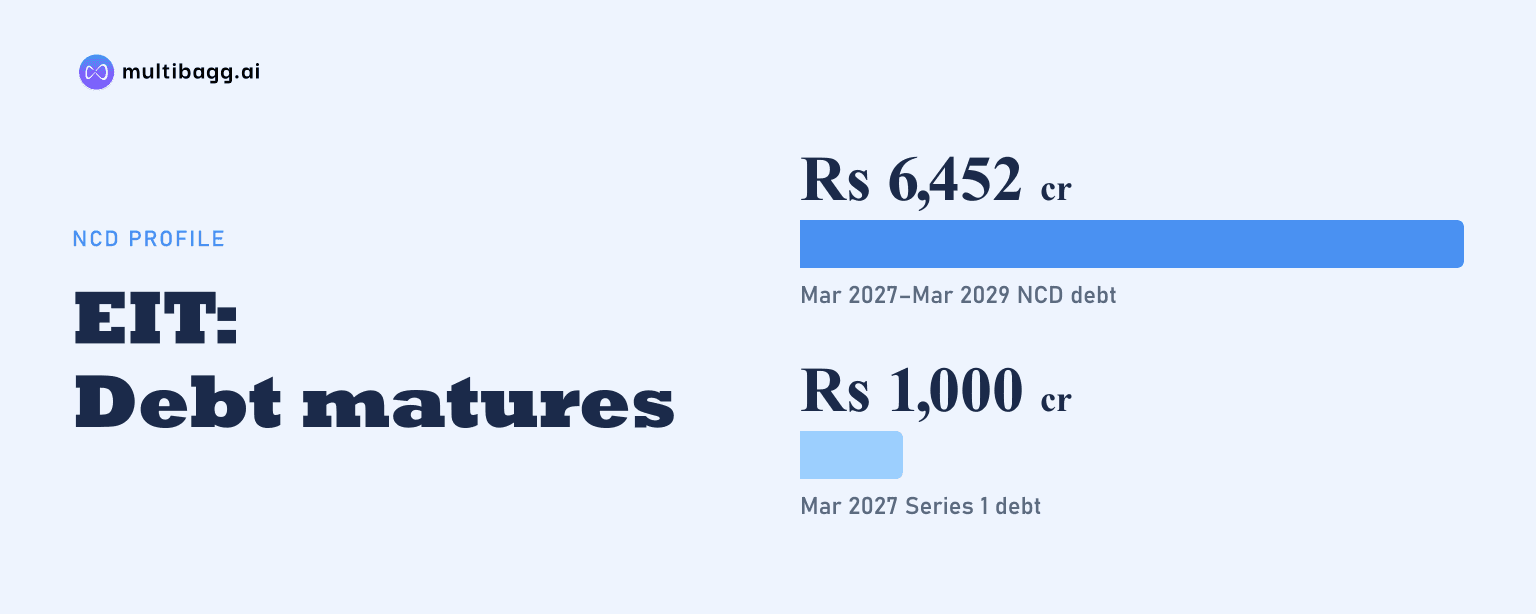
Energy Infra Trust (EIT) has Rs 6,452 crore of listed secured non-convertible debentures, with Rs 1,000 crore first due in March 2027 and Rs 4,452 crore due in March 2029; its debt-to-assets-under-management ratio was 44.2% on September 30, 2026, compared with 45.1% in FY 25-26.
Know Energy Infrastructure Trust inside out
Results, valuation, peers and who's buying, in one view.
When do EIT's NCDs mature?
EIT's Rs 6,452 crore non-convertible debenture, or NCD, profile matures across March 2027, March 2028 and March 2029. The presentation describes the PIL debt instruments as listed, rated, secured and redeemable NCDs. Series 1, valued at Rs 1,000 crore, is due in March 2027, making it the first disclosed maturity in the schedule.
Series 2, also worth Rs 1,000 crore, matures in March 2028, followed by Series 3 of Rs 4,452 crore in March 2029. The first two series total Rs 2,000 crore, whereas the March 2029 series alone represents about two-thirds of the disclosed Rs 6,452 crore stack. The presentation allocates the full stated NCD total to these three series.
How concentrated is EIT's debt maturity schedule?
EIT's maturity schedule is concentrated in March 2029, when Rs 4,452 crore is scheduled to fall due. That series is Rs 3,452 crore larger than either the March 2027 or March 2028 maturity, each of which is Rs 1,000 crore. It is also more than double the Rs 2,000 crore combined amount maturing in the preceding two March dates.
The presentation does not disclose a repayment, refinancing or replacement-borrowing plan for any of the three maturity dates. It says debt is to be sized in future years to maintain the net debt-to-assets-under-management, or AUM, ratio, ensure regulatory compliance and maintain a stable credit rating. That statement sets out EIT's stated debt-sizing framework rather than a committed funding arrangement for the March 2027 maturity.
The scheduled dates are one year apart, but the disclosed amounts are not evenly spread. The Rs 1,000 crore due in March 2027 is followed by another Rs 1,000 crore in March 2028 before the Rs 4,452 crore March 2029 maturity. No additional PIL NCD series is shown on the debt-profile page beyond these three instruments.
How has EIT's debt-to-AUM ratio changed?
EIT reported a debt-to-AUM ratio of 44.2% as of September 30, 2026, down 0.9 percentage points from 45.1% in FY 25-26. The presentation labels the latest period as FY 26-27 Q2, while separately dating the reported 44.2% figure to September 30, 2026. The measure had been 44.5% in FY 24-25.
Across the eight periods presented, EIT's reported debt-to-AUM ratio ranged from 44.2% to 48.7%. It was 44.3% in FY 19-20, rose to 48.7% in both FY 21-22 and FY 22-23, then declined to 46.7% in FY 23-24. The September 2026 reading was therefore 4.5 percentage points below the 48.7% level recorded in the two earlier years.
EIT does not disclose a numerical target for its future leverage ratio. Its historical table refers to debt to AUM, while its forward-looking debt-sizing statement refers to net debt to AUM. The distinction means the 44.2% reported for September 30, 2026 should not be treated as a disclosed future net-debt target.
Got a follow-up? Ask IRIS
What interest rate and ratings does EIT disclose?
EIT discloses a 7.96% annual interest rate for the Rs 6,452 crore PIL NCD profile, with interest payable quarterly. The presentation does not provide separate coupon rates for Series 1, Series 2 and Series 3. It also does not state the rupee amount of each quarterly interest payment.
The PIL debt profile is shown with CRISIL AAA/Stable and CARE AAA/Stable ratings. EIT says future debt sizing is intended to support regulatory compliance and a stable credit rating. The material does not provide rating-agency commentary, financial covenants, security details beyond the instruments being described as secured, or maturity-specific funding commitments.
The 7.96% annual rate is presented beside the September 30, 2026 debt-to-AUM ratio of 44.2%, rather than as a series-by-series pricing schedule. Consequently, the disclosure identifies the stated interest rate and payment frequency but does not show whether the March 2027, March 2028 and March 2029 series carry differing terms.
What do EIT's H1 FY27 cash and distribution figures show?
EIT reported Rs 514.3 crore of cashflow to EIT and Rs 515.1 crore of total distribution in H1 FY27, the April to September 2026 period. Net distributable cash flow at EIT was Rs 515.6 crore, and the stated payout was 99.9% of that amount. These are six-month financial figures, not a disclosed funding forecast for the March 2027 NCD maturity.
Total income was Rs 2,184.4 crore in H1 FY27, while operating expenses excluding depreciation and amortisation were Rs 1,398.4 crore. For FY2026, the full-year figures were Rs 3,899.1 crore of total income and Rs 2,325.2 crore of operating expenses. The periods differ, so the H1 FY27 results are not directly comparable with the full-year FY2026 results without annualising or other adjustments, neither of which EIT provides.
EIT's H1 FY27 distribution included Rs 284.1 crore of return of capital and Rs 231 crore of return on capital. The presentation does not connect these distributions, the Rs 514.3 crore cashflow to EIT, or the Rs 515.6 crore net distributable cash flow to a specified plan for the Rs 1,000 crore due in March 2027.
Conclusion
EIT's disclosed debt profile places its first Rs 1,000 crore NCD maturity in March 2027, followed by an equal amount in March 2028 and a much larger Rs 4,452 crore maturity in March 2029. Its reported debt-to-AUM ratio of 44.2% at September 30, 2026 was below the 45.1% shown for FY 25-26 and below the 48.7% recorded in FY 21-22 and FY 22-23.
The next scheduled event disclosed is the March 2027 redemption of Series 1, valued at Rs 1,000 crore. EIT has stated that future debt will be sized to maintain net debt to AUM, regulatory compliance and stable credit ratings, but it has not disclosed a refinancing method, repayment source or numerical leverage target for that maturity.