










EMI North sales rise 45%, but margin remains below South
Key highlights
- EMI’s North cluster sales rose 45% year on year to Rs 168 crore in Q2 FY27.
- North cluster H1 FY27 store-level EBITDA margin was 3.4%, versus 9.3% in the South.
- Delhi NCR multi-brand outlet revenue rose 46% to Rs 166 crore in Q2 FY27.
- EMI’s mature stores recorded a 9.7% EBITDA margin, compared with 6.4% for non-mature stores.
powered by IRIS
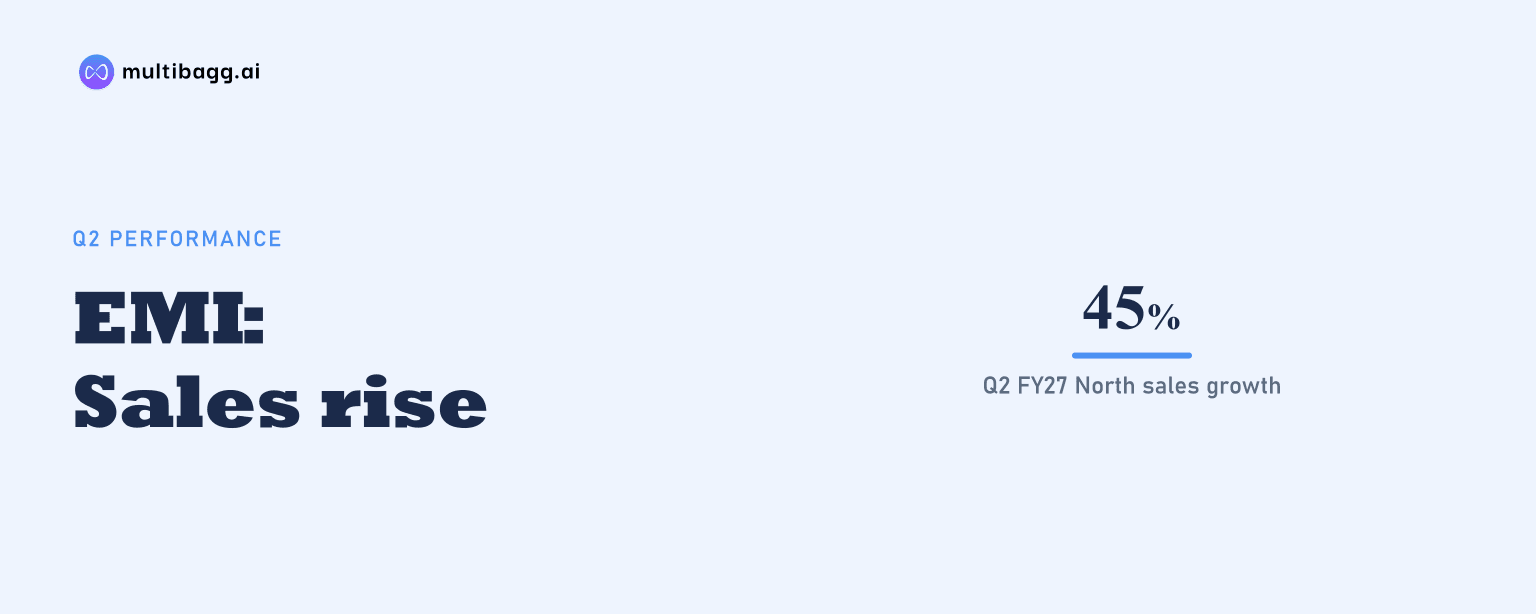
Electronics Mart India Limited’s North cluster recorded 45% sales growth to Rs 168 crore in Q2 FY27, compared with 16% growth in the South, but its H1 FY27 store-level EBITDA margin was 3.4% against 9.3% in the South. EMI began North operations in 2022 and is expanding the newer network.
Know Electronics Mart India inside out
Results, valuation, peers and who's buying, in one view.
How fast is EMI’s North cluster growing?
EMI’s North cluster sales increased to Rs 168 crore in Q2 FY27 from Rs 116 crore in Q2 FY26, while South cluster sales rose to Rs 1,638 crore from Rs 1,408 crore. The North grew faster in percentage terms at 45% versus 16%, although South sales remained nearly 10 times the North sales base.
North quarterly sales were Rs 166 crore in Q3 FY26, Rs 151 crore in Q4 FY26 and Rs 209 crore in Q1 FY27 before falling to Rs 168 crore in Q2 FY27. South sales followed a similar quarterly pattern at a much larger scale, moving from Rs 1,697 crore in Q3 FY26 to Rs 1,677 crore in Q4 FY26, Rs 2,095 crore in Q1 FY27 and Rs 1,638 crore in Q2 FY27.
Delhi NCR, the North market separately disclosed by EMI, recorded multi-brand outlet revenue of Rs 166 crore in Q2 FY27, up 46% from Rs 114 crore a year earlier. Its H1 FY27 revenue rose 36% to Rs 372 crore from Rs 273 crore, while same-store sales growth, or SSSG, was 32.4% in Q2 and 25.2% in H1. These NCR figures cover only multi-brand outlets, unlike the broader North cluster figures, which combine exclusive-brand outlets and multi-brand outlets.
Why is EMI’s North margin below the South?
EMI reported a 3.4% North store-level EBITDA margin for H1 FY27, 5.9 percentage points below the South cluster’s 9.3%. EBITDA means earnings before interest, tax, depreciation and amortisation. Both cluster margins are calculated before corporate and warehouse expenses and on a pre-Ind AS 116 basis.
The presentation does not disclose North and South gross profit, employee cost, rent or other operating-cost lines, so it does not quantify the cause of the 5.9-percentage-point margin difference. It does show that South generated Rs 1,638 crore of Q2 FY27 sales against North’s Rs 168 crore, leaving the South with a substantially larger sales base alongside its higher H1 store-level margin.
EMI says it began North cluster operations in 2022 and is applying the strategy used in the South while building its presence. Management expects store productivity and margins to align with South benchmarks as scale builds, but the presentation gives no dated margin target for the North cluster.
EMI listed 36 multi-brand outlets and one exclusive-brand outlet in five NCR cities. By comparison, Andhra Pradesh had 74 multi-brand outlets and six exclusive-brand outlets across 54 cities, while Telangana had six exclusive-brand outlets across 42 cities. The disclosed footprint places the NCR network in fewer cities than the established southern markets.
Got a follow-up? Ask IRIS
Are EMI’s newer stores less profitable?
Yes. EMI reported a 6.4% EBITDA margin for 127 non-mature stores, defined as stores less than four years old, compared with 9.7% for 102 mature stores that are more than four years old. The 3.3-percentage-point difference is consistent with management’s view that profitability can improve as stores gain throughput, though the presentation does not disclose the store-age mix by cluster.
Mature stores generated Rs 2,975 crore of retail product revenue and Rs 289 crore of EBITDA, compared with Rs 1,136 crore of revenue and Rs 72 crore of EBITDA for non-mature stores. These figures include exclusive-brand outlets and multi-brand outlets, are net of rent expense, and exclude corporate and warehouse expenses.
EMI said a significant part of its network remains in early stages and expects profitability to improve as more stores mature and operating leverage develops. The presentation does not state how many of the 127 non-mature stores are in NCR, when individual North stores will cross the four-year mark, or the expected financial effect of maturation.
Which markets are supporting EMI’s wider sales growth?
Andhra Pradesh posted the fastest H1 FY27 revenue growth among the four separately reported markets, with revenue increasing 45% to Rs 747 crore from Rs 517 crore. Its H1 SSSG was 38.6%, above Telangana HYD City’s 24.8%, Telangana UP Country’s 29.6% and Delhi NCR’s 25.2%.
Telangana HYD City remained the largest separately reported market, producing Rs 2,357 crore of H1 FY27 revenue, up 25% from Rs 1,881 crore. Telangana UP Country contributed Rs 608 crore, up 33% from Rs 459 crore. In Q2 FY27, HYD City revenue rose 16% to Rs 1,065 crore and UP Country revenue increased 17% to Rs 264 crore.
Andhra Pradesh’s Q2 FY27 revenue rose 24% to Rs 301 crore from Rs 242 crore, with 17.7% SSSG. Delhi NCR’s growth rates were higher, at 46% revenue growth and 32.4% SSSG, but its Q2 revenue base was Rs 166 crore. This comparison shows that North expansion is occurring alongside growth in longer-established southern markets.
At the company level, EMI reported H1 FY27 revenue of Rs 4,318.7 crore, up 29.7%, and reported EBITDA of Rs 369.5 crore, up 93.4%. Reported EBITDA margin rose to 8.6% from 5.7%, while H1 FY26 included a net exceptional gain of Rs 7.02 crore from an insurance settlement and store-sale gain, partly offset by a godown-fire loss.
Conclusion
EMI’s figures show that North expansion is producing faster sales growth than the South, but not equivalent store-level profitability. The North’s 45% Q2 FY27 sales growth came from a Rs 168 crore base, while its 3.4% H1 margin remained 5.9 percentage points below the South’s 9.3%; the mature-store analysis provides a relevant, but not conclusive, explanation for that gap.
The key disclosed issue to watch is management’s plan for North store productivity and margins to move toward South benchmarks as scale builds. Subsequent NCR revenue and SSSG, changes in the network of 36 multi-brand outlets and one exclusive-brand outlet, and the progression of stores beyond four years of age will show whether that stated expectation is being realised.