










Energy Infra Trust sees KG Basin fill spare pipeline capacity
Key highlights
- EIT reports PIL utilisation of 44%, leaving 56% spare capacity.
- PIL transports about 89% of KG Basin gas production, according to EIT.
- EIT expects KG Basin domestic-gas volumes to grow at about 26% annually.
- EIT expects the 10 mmscmd Ennore pipeline connection to be commissioned by FY30.
powered by IRIS
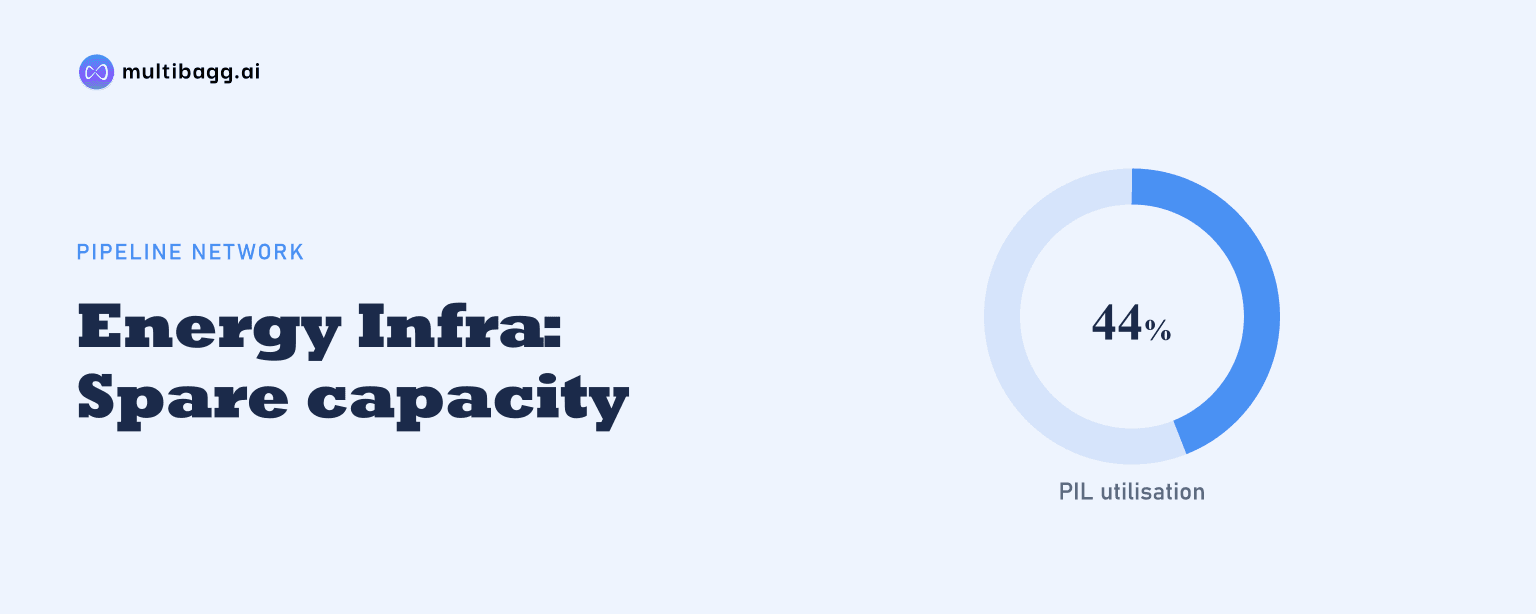
Energy Infra Trust (EIT) says Pipeline Infrastructure Limited (PIL) has 56% spare capacity because its pipeline is 44% utilised, and it identifies rising Krishna-Godavari (KG) Basin gas output plus new liquefied natural gas (LNG) links as potential routes to increase volumes. PIL already transports about 89% of KG Basin gas production, according to EIT.
Know Energy Infrastructure Trust inside out
Results, valuation, peers and who's buying, in one view.
How much spare pipeline capacity does EIT report?
EIT reports that PIL is 44% utilised, leaving 56% of its pipeline capacity available for additional gas volumes. The presentation describes PIL as the only alternative for transporting gas produced in the KG Basin to key demand centres in western India.
The 56% figure represents unused capacity rather than a committed throughput increase. EIT does not disclose PIL's total pipeline capacity in million metric standard cubic metres per day (mmscmd), so the presentation does not quantify the absolute volume represented by the available capacity.
PIL transports about 89% of KG Basin gas production because transport alternatives are limited, EIT says. Western India accounts for 45% of India's natural-gas demand, while the presentation assigns 41% of the reserves transported by PIL to that region, linking eastern supply with western consumption.
EIT also cites KG Basin reserves of 139 billion cubic metres (bcm), equal to about 30% of India's 461 bcm total reserves. The presentation's geographic case is that further supply from the basin can use PIL's existing route toward major consumption centres rather than requiring a separately identified pipeline expansion.
Why does EIT expect KG Basin volumes to increase?
EIT expects domestic-gas volumes from the KG Basin to grow at a compound annual growth rate of about 26%, which it says could directly increase PIL revenue. It attributes this prospective growth to drilling activity and commissioning of new wells in known reserves, rather than to a disclosed tariff increase.
The D6 field holds 83 bcm of the 139 bcm reserve total listed by EIT, while ONGC's KG-DWN-98/2 holds 43 bcm. Together, those two areas account for 126 bcm, or roughly 98% of the listed total, making their development central to the volume case presented for PIL.
EIT reports that PIL has a 100% share of gas from the Reliance Industries Limited and BP-operated D6 field. It also reports a 100% share upon production start for ONGC's Cluster I and Cluster III and a 100% ongoing share for Cluster II, all within KG-DWN-98/2; by comparison, its share of legacy ONGC fields is about 30% because those fields also supply local consumption.
ONGC plans to drill 50 identified new wells by 2028, according to EIT, while an upcoming offshore gas-processing platform is intended to bring more wells online. EIT also identifies investment by Reliance Industries Limited and BP, KG-DWN-98/2 reserves and exploration by Cairn Oil & Gas as potential supply contributors, but it does not provide committed future PIL throughput volumes.
Got a follow-up? Ask IRIS
Which LNG links could add volumes to EIT's network?
EIT identifies an under-development pipeline to the Ennore LNG terminal with 10 mmscmd capacity and expected commissioning by FY30. This is the clearest dated connectivity project in the presentation, although EIT does not state how much of that capacity will become PIL throughput.
PIL is already connected to Shell's Hazira LNG terminal and, through Gujarat State Petronet Limited, to Petronet's Dahej terminal and Hindustan Petroleum Corporation Limited's Chhara terminal. Dahej has 18 million metric tonnes per annum (mmtpa) capacity, compared with 5 mmtpa each at Hazira and Chhara.
EIT lists Ennore at 5 mmtpa and says it is operational but not yet connected to PIL. It also identifies a planned 7.2 mmtpa offshore regasification terminal at Kakinada, equivalent to about 25 mmscmd, but says Kakinada is not yet operationalised and not yet connected.
The Ennore and Kakinada projects therefore differ in maturity. EIT provides an FY30 commissioning expectation for the 10 mmscmd Ennore pipeline, whereas it gives no commissioning date or disclosed construction status for a PIL connection to Kakinada's approximately 25 mmscmd terminal.
What demand outlook does EIT use for higher throughput?
EIT cites Indian natural-gas demand rising from 195 mmscmd in FY25 to 255 mmscmd in FY30E and 476 mmscmd in FY40E. It also cites a projected increase in natural gas's share of India's energy mix from 6% in FY25 to 15% in FY30E.
The presentation divides national demand across regions, with western India at 45%, northern India at 27%, eastern India at 12%, southern India at 10% and central India at 6%. This distribution supports EIT's contention that a pipeline carrying KG Basin supply toward western markets could benefit from broader gas consumption growth.
EIT identifies domestic production and regasified LNG as two separate potential sources of additional volumes. Domestic supply depends on drilling, well commissioning and offshore processing, while LNG-related volumes depend on terminal activity, physical connectivity and regasification flows; the presentation provides no forecast for future PIL utilisation, revenue or distributions.
Conclusion
EIT's stated growth route rests on the combination of PIL's 56% spare capacity and its transport of about 89% of KG Basin production. The trust identifies concentrated reserves in D6 and KG-DWN-98/2, existing access to Dahej, Hazira and Chhara, and new LNG connectivity as potential mechanisms for increasing pipeline volumes.
The disclosed milestones to watch are the expected FY30 commissioning of the 10 mmscmd Ennore pipeline, ONGC's plan to drill 50 wells by 2028 and progress at the 7.2 mmtpa Kakinada terminal. These developments would need to translate into actual gas supply and flows into PIL before they increase reported utilisation.