










Energy Mission defers capex as capacity supports Rs 275 crore
Key highlights
- Energy Mission said it has no immediate capex plan until its 1,500-machine capacity is better utilised.
- Management estimated that existing capacity can support about Rs 275 crore of revenue.
- Energy Mission retained three-year turnover growth guidance of 18% to 20% CAGR.
- About 97% of Energy Mission's order book was domestic, while repeat orders represented around 35% of volume.
powered by IRIS
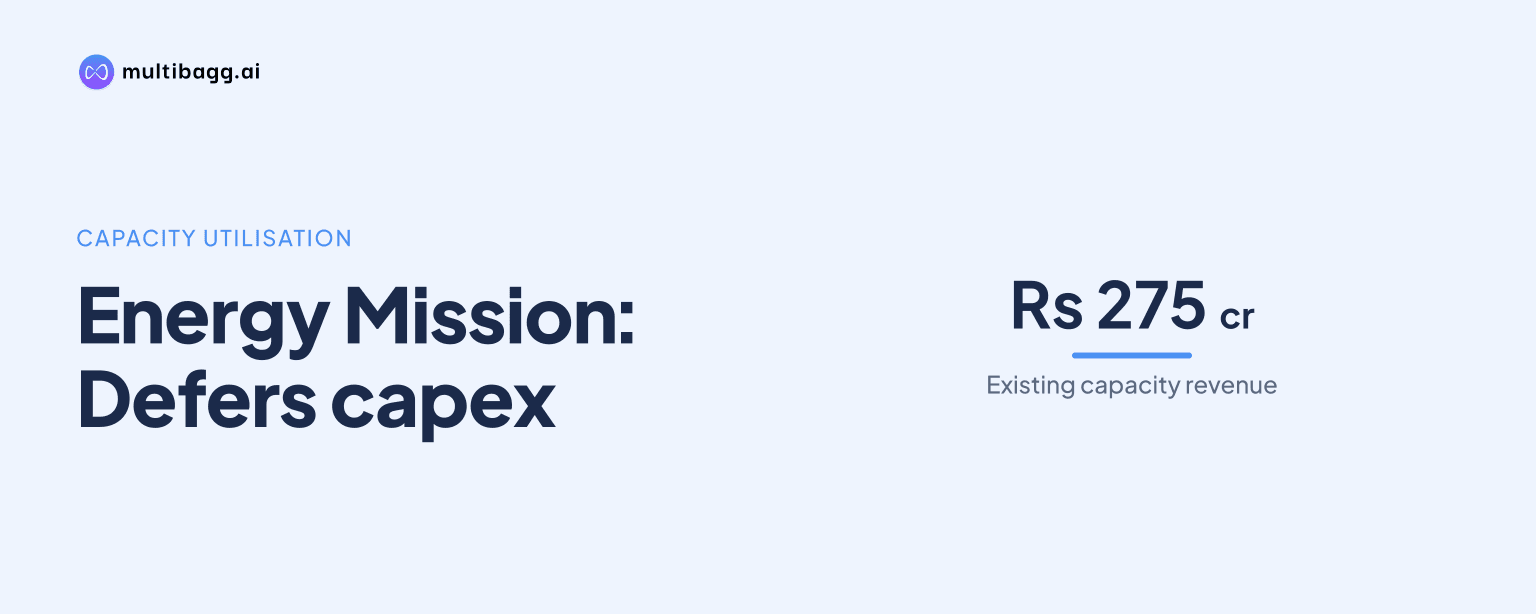
Energy Mission said it has no immediate capital-expenditure plan because its existing 1,500-machine capacity must be utilised first, with management estimating that capacity could support about Rs 275 crore of revenue. The estimate compares with a Rs 160 crore current-revenue level cited by an analyst during the call, indicating capacity headroom of about Rs 115 crore.
Know Energy-Mission Machineries (India) inside out
Results, valuation, peers and who's buying, in one view.
Why is Energy Mission deferring further capital expenditure?
Energy Mission is deferring further capital expenditure because management wants to raise utilisation of the current 1,500-machine capacity before considering another expansion. When asked about capital-expenditure plans over the next two to three years, management said it had no immediate guidance and would first need to utilise the capacity already installed.
The company did not disclose a budget, location or timetable for another project. Management's sequence is to convert orders and improve factory utilisation before approving further capital expenditure, rather than expanding capacity in anticipation of demand.
An analyst referred to capacity having been doubled at the parent company and to the addition of backward integration. Management did not dispute the 1,500-machine capacity cited in the question and put the associated optimum revenue potential at around Rs 275 crore.
How much revenue can Energy Mission's present capacity support?
Energy Mission said the current 1,500-machine capacity can support around Rs 275 crore of revenue. This was management's answer on optimum revenue potential at installed capacity, rather than a revised annual turnover forecast or a commitment to reach that level in a specified period.
The analyst who raised the question referred to current revenue of Rs 160 crore. On that basis, the difference between the cited revenue level and management's Rs 275 crore capacity potential is about Rs 115 crore, although actual revenue will depend on orders, product mix, manufacturing and customer delivery readiness.
Energy Mission retained its guidance for turnover growth of 18% to 20% compound annual growth rate, or CAGR, over the next three years. Management said that outlook was based on past growth, market study and development activities aimed at new markets, rather than on the full utilisation of capacity alone.
Why is Energy Mission guiding for 18% to 20% growth?
Energy Mission said 18% to 20% CAGR is its practical guidance for a machine-building business because growth requires sales coverage, manpower, service and customer references alongside factory capacity. Management said it would welcome faster growth if it converted sufficient orders, but it would not forecast 40% growth without visibility.
Management said Energy Mission operates across 20 Indian states, but a materially faster expansion rate would require entry into additional territories. It said capital-equipment customers assess service and references alongside machine performance, meaning new-region expansion requires more than adding production capacity.
The United States is one example of that gradual market-building process. Energy Mission said its US subsidiary began two years ago, has one major distributor and is seeking sub-dealers in eastern and western regions; it has also started Canada, where sample orders have been received, but management gave no firm revenue forecast for either market.
Got a follow-up? Ask IRIS
What could determine Energy Mission's capacity utilisation?
Energy Mission's utilisation will depend on managing a product range of more than 600 variants and the inventory needed to produce them. Management said a machine can contain more than 600 to 700 components, including controllers, hydraulics, electrical systems and sensors, which increases planning requirements across different product series.
Management said a standard, regular-running series machine takes about three months to manufacture, correcting an earlier reference to three weeks on the call. Dispatches can take longer because customer financing and readiness affect delivery timing even after production is complete.
Energy Mission said 30% to 35% of inventory is directly or indirectly imported, including high-end sensors, hydraulics and electronics. It is using supplier-alignment methods, SAP planning software, artificial-intelligence tools and greater standardisation across machine series to seek higher turnover without a proportionate increase in inventory.
Order composition also affects factory loading. Management said approximately 97% of the order book was domestic and 3% was export business spanning Nepal, the United Arab Emirates and the US, while repeat orders represented around 35% of total volume and the rest came from new customers.
What margins has Energy Mission indicated during this expansion?
Energy Mission guided for earnings before interest, tax, depreciation and amortisation, or EBITDA, margin of around 13% to 15% for this year and profit after tax, or PAT, margin of around 6% to 8%. Management did not provide a margin target specifically tied to the Rs 275 crore capacity-revenue potential.
On consolidated margin movement, management cited utilisation at EM Press Form Solutions and said it expects the subsidiary to expand business in the second half, or H2. Management also said additional US orders following an exhibition could help the US subsidiary, although these were expectations rather than reported orders.
Management said input costs rose by around 8% from November to March 2026 and by a further 8% to 10% from April to September. It said about Rs 47 crore of orders were supplied through March at previously committed prices, before Energy Mission increased sales prices by 5% from April.
Conclusion
Energy Mission's decision to hold back fresh capital expenditure is based on management's estimate that the existing 1,500-machine base can support around Rs 275 crore of revenue. The gap versus the Rs 160 crore revenue level cited by an analyst makes order conversion, regional service coverage, inventory management and delivery execution more immediate issues than a new factory project.
The next measures to watch are delivery against the 18% to 20% three-year CAGR guidance, the expected H2 business expansion at EM Press Form Solutions and conversion of US and Canadian distribution activity into orders. Management has also identified SAP implementation, supplier alignment and standardisation as mechanisms to manage inventory, while maintaining that no immediate capital-expenditure plan is in place.