










Energy Mission targets 40% gross margin within six months
Key highlights
- Energy Mission targets a 40% gross margin within the next six months, versus about 35% in H1 FY27.
- Energy Mission said input costs rose around 8% between November and March 2026 and another 8% to 10% from April to September.
- Energy Mission raised sales-product prices by 5% from April after supplying about Rs 47 crore of earlier orders at committed prices.
- Energy Mission reported an H1 FY27 order book of Rs 62.30 crore and said it could consider around Rs 110 crore in the next second half.
powered by IRIS
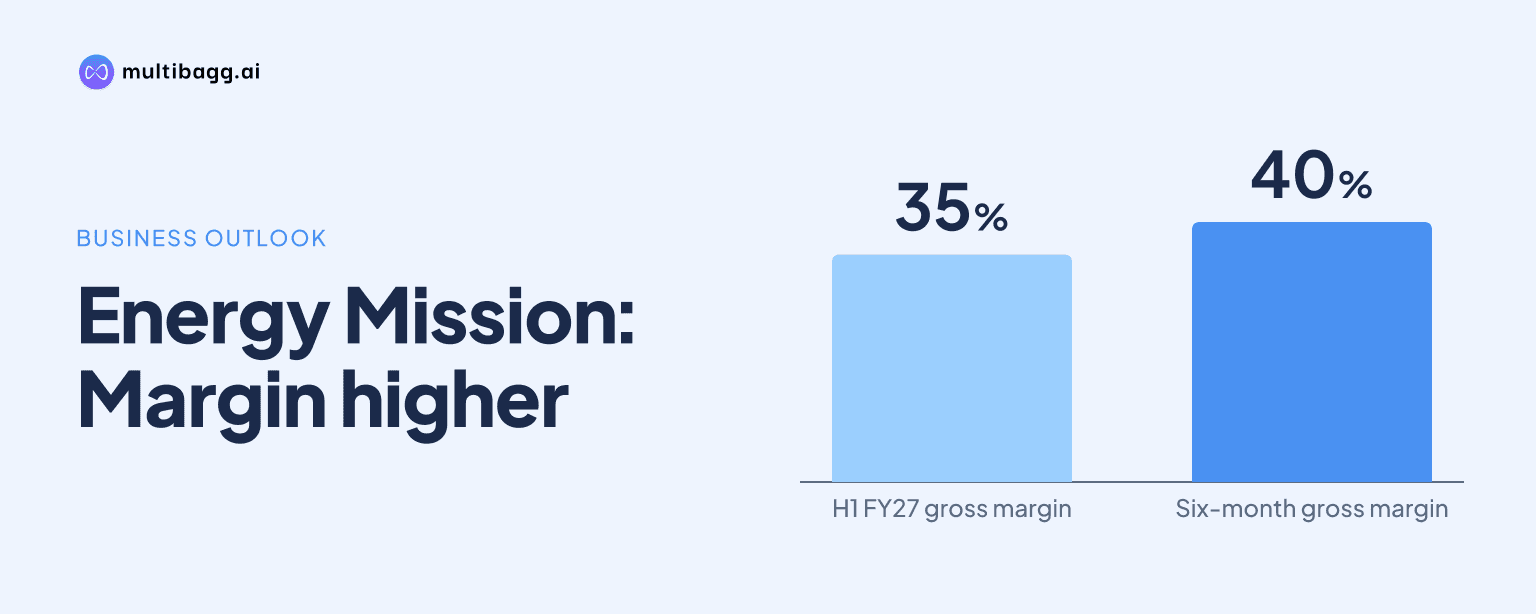
Energy Mission expects gross margin to return to 40% within the next six months, from about 35% in H1 FY27 and about 41% in FY23. Management said sharply higher material, logistics and foreign-exchange costs affected orders supplied at earlier committed prices, while a 5% price increase from April and internal cost reductions should aid recovery.
Know Energy-Mission Machineries (India) inside out
Results, valuation, peers and who's buying, in one view.
Why did Energy Mission's gross margin decline?
Energy Mission said gross margin declined because input costs rose before it could change prices on previously committed orders. Management said input costs increased by around 8% between November and March 2026, followed by another 8% to 10% rise from April to September. It also cited higher logistics costs and foreign-exchange costs as factors affecting H1 FY27 margin.
The timing of the order book was central to the pressure. Energy Mission said it supplied about Rs 47 crore of orders booked up to March at previously committed prices, despite the intervening increase in material and related costs. Management did not provide a cost-of-materials split or quantify separately the effect of logistics and foreign exchange.
The comparison shows a decline of roughly 6 percentage points between FY23 and H1 FY27. Management did not call FY23's approximately 41% margin a one-off result. Instead, it linked the decline to inflation in procurement-related costs while customer pricing on earlier orders remained fixed.
How will Energy Mission seek to restore a 40% gross margin?
Energy Mission plans to seek a 40% gross margin through a 5% increase in sales-product prices from April and continuing cost-reduction measures. Management said the benefit of revised pricing should be reflected gradually in H2 FY27 as shipments are made under the new prices. It said the combined pricing and cost actions support its six-month target.
The internal measures include lower job-work costs, operational efficiencies and control over other expenses. Energy Mission did not disclose a rupee value for expected savings or say how much of the expected movement from about 35% to 40% would come from the 5% price increase rather than internal actions.
The outcome depends on the cost base and shipment mix after April. Management identified material, logistics and foreign-exchange costs as the causes of the earlier decline, but did not say whether these costs had fallen, stabilised or continued to rise after September. The 40% figure is management's target rather than a reported H2 FY27 result.
When does Energy Mission expect margin recovery?
Energy Mission expects to reach a 40% gross margin within the next six months. When an analyst asked whether the target was for FY28, management answered that the timeframe was the next six months. Management also said the effect of the April price increase would emerge gradually in H2 FY27.
Energy Mission did not provide quarterly gross-margin guidance, a monthly recovery schedule or an H2 FY27 margin floor. The disclosed benchmark is therefore the six-month period, against which the company’s reported margin can be compared. The source does not state the precise date of the earnings call.
The target comes as Energy Mission expects higher second-half order activity. It reported an H1 FY27 order book of Rs 62.30 crore after receiving Rs 91.55 crore of orders and executing around Rs 76 crore during the first half. Management said it could consider around Rs 110 crore in the next second half, subject to order conversion and execution.
Got a follow-up? Ask IRIS
What could affect Energy Mission's margin-recovery plan?
Energy Mission's recovery plan could be affected by additional changes in material, logistics and foreign-exchange costs because management named all three as drivers of the H1 FY27 decline. The company raised prices by 5%, but did not state that this fully offsets the cost rises of around 8% and a further 8% to 10% across all inputs, machines or customer contracts.
Product complexity also shapes inventory and sourcing requirements. Energy Mission said it has more than 600 machine variants, while a particular machine can contain more than 600 to 700 components. It said 30% to 35% of inventory is directly or indirectly imported, including high-end sensors, hydraulics and electronics, for which lead times can be longer.
Energy Mission said it has begun supplier-alignment practices and is shifting to SAP, a planning software system, from its earlier enterprise resource planning system. Management also cited specific artificial-intelligence tools and standardisation across five machine series. It aims to make 40% to 50% of items standard for use across series, but gave no implementation date or quantified saving.
What does Energy Mission's order outlook mean for margins?
Energy Mission's order outlook could increase the volume of shipments carrying the April price increase, but management did not say it guarantees the 40% margin target. The company said its usual annual pattern is a 40:60 ratio between the first and second half. It estimated around Rs 110 crore of orders in the next second half after an H1 FY27 order book of Rs 62.30 crore.
Management retained a 20% growth outlook despite an analyst’s suggestion that available capacity could allow faster growth. It said machine building requires manpower, servicing, brand building and regional support before expansion can accelerate. Energy Mission said it operates across 20 Indian states and has been developing the US market for three years.
Dispatch timing can also affect when revised pricing is reflected. Energy Mission said a standard, regularly produced machine takes around three months on average to manufacture, correcting a three-week statement made earlier on the call. Customer readiness and bank-finance clearance can further extend the time a machine remains on the factory floor.
Conclusion
Energy Mission attributes the movement from about 41% gross margin in FY23 to about 35% in H1 FY27 to costs rising ahead of revised prices on earlier committed orders. Its stated response combines a 5% price increase from April with lower job-work costs, operating efficiencies and expense control, targeting a return to 40% within six months.
The next disclosures to watch are H2 FY27 gross margin, the share of dispatches carrying revised prices and trends in material, logistics and foreign-exchange costs. Management also expects around Rs 110 crore of orders in the next second half and is implementing SAP, supplier practices and standardisation intended to increase turnover without a large rise in inventory.