










Energy Mission reserves 60% fabrication capacity externally
Key highlights
- Energy Mission can allocate 60% of EM Press Form Solution capacity to external customers and 40% to internal backward integration.
- The 5,000-square-metre EM Press Form Solution facility began operations in July 2026.
- Job-work expense fell 27% to Rs 2.85 crore in H1 FY27 from Rs 3.89 crore in H2 FY26.
- Energy Mission’s September 2026 order book was about Rs 62.27 crore, up 31.8% from the start of FY27.
powered by IRIS
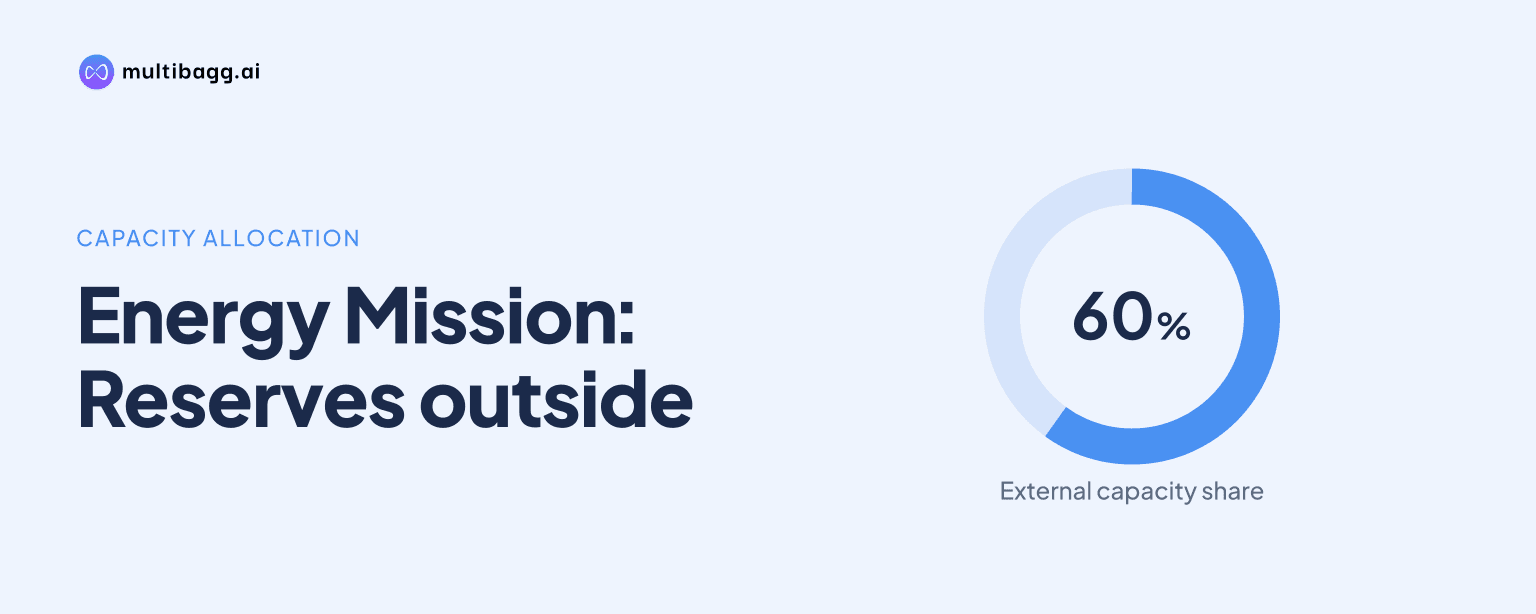
Energy Mission Machineries (India) Limited has reserved 60% of its new fabrication subsidiary’s capacity for external customers, with 40% intended for internal backward integration. The 5,000-square-metre facility began operations in July 2026, and management expects greater utilisation in H2 FY27, although it gave no external-fabrication revenue target.
Know Energy-Mission Machineries (India) inside out
Results, valuation, peers and who's buying, in one view.
How will Energy Mission use the new fabrication facility?
Energy Mission will use about 40% of EM Press Form Solution’s capacity for its own operations and can deploy the remaining 60% for external customers. Management described the subsidiary as a backward-integration operation that makes control-panel boxes, electrical controllers and fabricated covers that were previously procured from outside vendors.
The facility operates from a 5,000-square-metre factory that commenced operations in July 2026. It has metal-cutting, bending, surface-coating and in-house powder-coating capabilities. These processes can support component production for Energy Mission’s machinery business as well as fabrication work for third parties.
Management said the subsidiary would work with some larger outside customers in H2 FY27. However, the November 18, 2026 earnings call did not identify those customers, disclose signed external orders, specify approval stages or provide a current utilisation percentage for the 60% capacity earmarked for external work.
Has Energy Mission set a revenue target for outside fabrication work?
Energy Mission has not disclosed an annual revenue target for external fabrication work, including a target of Rs 12 crore to Rs 15 crore. Management said it expects good business from outside customers and plans to engage larger customers during H2 FY27, but it did not give subsidiary-specific revenue, margin, order-book or utilisation guidance.
The company did disclose broader three-year management objectives of 18% to 20% compounded annual revenue growth, an earnings before interest, tax, depreciation and amortisation, or EBITDA, margin of 13% to 15%, and a profit after tax, or PAT, margin of 6% to 8%. These objectives apply to the wider business rather than specifically to third-party fabrication sales.
Management linked the subsidiary’s ramp-up to consolidated profitability. In response to an analyst’s question, it said lower subsidiary utilisation had affected consolidated margins and that expanded EM Press Form Solution activity in H2 FY27 would help. That is a disclosed operating plan, rather than a forecast of contract values or external fabrication revenue.
What evidence is there that backward integration is reducing costs?
Energy Mission reported job-work expense of Rs 2.85 crore in H1 FY27, down 27% from Rs 3.89 crore in H2 FY26. Job-work expense as a share of revenue declined to 3.5% from 4.6%, which management attributed to greater in-house work through its CNC machine fleet and fabrication initiative.
The cost reduction occurred while management cited higher prices for electrical components, imported items, logistics and currency-linked procurement. Energy Mission said it completed opening orders at committed prices despite those inputs, then took price revisions from March and April 2026. Lower external processing costs therefore partly offset, rather than removed, the stated cost pressure.
Other expenses also declined half on half. Employee expense fell 15.3%, manpower-services expense declined 52%, and service-travel expense decreased 25.7%. Management said it aims to reduce job-work expense by about 16% to 18% in absolute terms against FY26, without setting a separate expense target for the fabrication subsidiary.
Got a follow-up? Ask IRIS
How does the subsidiary fit into Energy Mission’s H1 FY27 performance?
Energy Mission reported consolidated revenue of Rs 80.86 crore in H1 FY27, up 6.6% year on year, with EBITDA of Rs 9.90 crore and a 12.36% margin. Consolidated PAT was Rs 4.49 crore. Management separately cited standalone EBITDA of Rs 10.65 crore, up 7.1% half on half, with margin improving to 13.27% from 11.88%.
The difference between standalone and consolidated measures is relevant because management cited subsidiary utilisation as a factor in consolidated-margin movement. Higher production at EM Press Form Solution could affect results through two channels: replacing external fabrication and job work for internal machinery output, and generating revenue from the 60% capacity available to outside customers.
CNC press brakes remained the principal product line, contributing about 73% of product revenue in H1 FY27. Hydraulic shearing machines accounted for around 15%, while plate-rolling machines reached 4%, compared with 3% previously. Control panels, electrical controllers and fabricated covers made by the subsidiary can support these machinery lines rather than representing a disclosed standalone end market.
Energy Mission entered H2 FY27 with a September closing order book of about Rs 62.27 crore, up 31.8% from the start of the financial year. Order inflow was Rs 91.50 crore in the first six months, up 15.6% year on year and 28% versus the preceding six months. Management said order delivery and conversion into collections were priorities.
What could affect external fabrication utilisation?
Energy Mission’s ability to convert the available 60% capacity into third-party sales depends on customer development and production ramp-up. The plant had operated only since July 2026 when management spoke on November 18, and it did not provide data on current output, external-customer approvals, repeat orders or contracted fabrication volumes.
Working capital is also a disclosed execution issue as the company handles the larger order book. Working-capital days rose to 120 in September 2026 from 112 in March 2026, while receivable days increased to 37 from 30. Management said both inventory and receivables were higher than in March and that collections would remain essential.
Energy Mission has annual manufacturing capacity of around 1,500 machines and more than 7,500 installations across India. Its service network and direct customer relationships could support commercial outreach, but management did not say that existing machinery customers would become fabrication customers. Export sales were around 3% of total revenue, leaving domestic markets as the main reported sales base.
Conclusion
Energy Mission’s fabrication subsidiary has a dual role: it brings selected components in-house while keeping 60% of capacity available for third-party work. The reported financial evidence so far is job-work expense falling to Rs 2.85 crore in H1 FY27 from Rs 3.89 crore in H2 FY26; external fabrication revenue remains an unquantified management opportunity.
The next point to watch is H2 FY27, when management expects higher subsidiary utilisation and engagement with larger external customers. Investors can assess progress through any disclosure on signed customer business, plant utilisation, fabrication sales and consolidated margins, while monitoring collections after working-capital days rose to 120 in September from 112 in March.