










Energy Mission says exports deliver 5-8% better margins
Key highlights
- Energy Mission said export margins and realizations are 5% to 8% above domestic sales, depending on product.
- Energy Mission has capacity for around 1,500 machines and is currently making more than 900 machines.
- Management estimates Rs 275 crore to Rs 325 crore of revenue at present pricing and average product mix when capacity is used.
- Management said service and spares are high-margin businesses and expects service activity to grow annually.
powered by IRIS
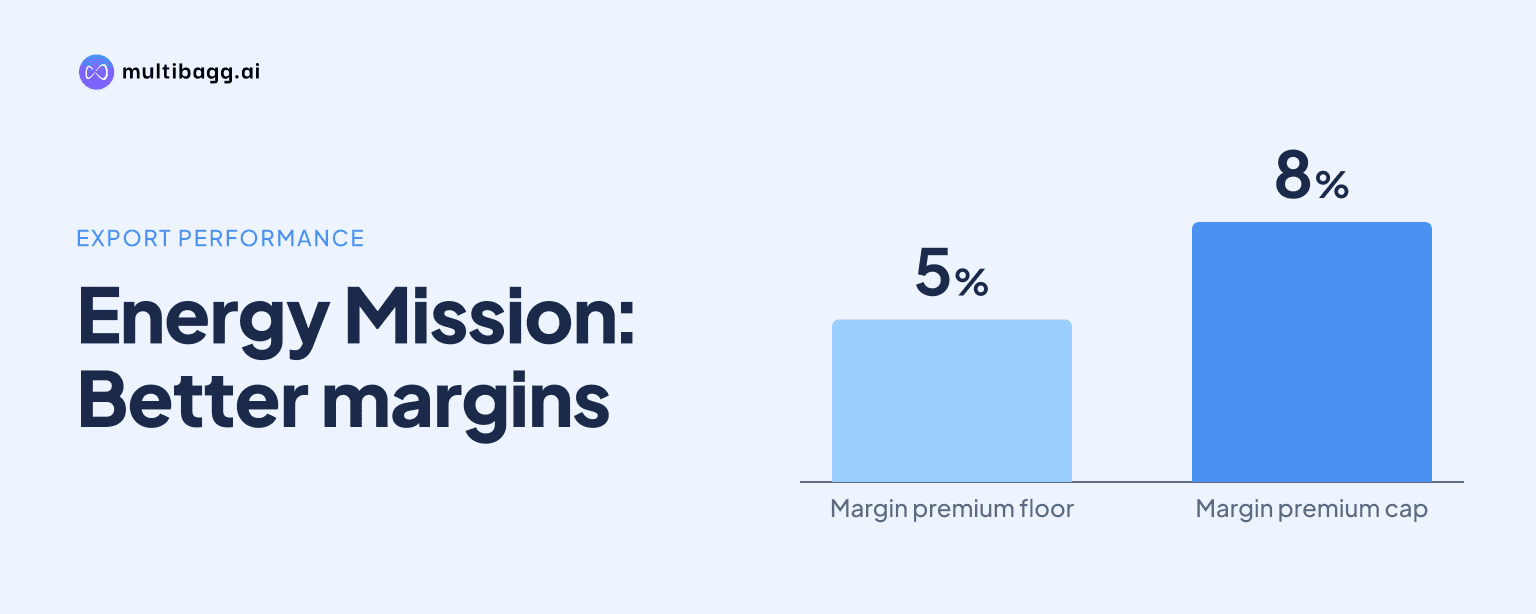
At its November 18, 2026 H1 FY27 earnings call, Energy Mission Machineries (India) Limited said export sales generate margins and realizations 5% to 8% above domestic sales, depending on the product. Energy Mission did not disclose export revenue, export volume or absolute export margin, so the premium is the available measure of the overseas opportunity.
Know Energy-Mission Machineries (India) inside out
Results, valuation, peers and who's buying, in one view.
How much better are Energy Mission's export margins?
Energy Mission said export margins and realizations are approximately 5% to 8% better than domestic sales, with the exact difference depending on the product. Gaurav Shastri initially described export margins as better by about 5% and said realizations were similarly higher, before clarifying that the range could extend to 8% by product. The company gave this comparison during its H1 FY27 post-earnings call on November 18, 2026.
The disclosure covers two separate measures: margin and realization. Realization is the price received per machine or sale, while margin refers to the profit retained from that sale. A 5% to 8% premium therefore indicates that exports can produce both higher selling prices and higher profitability than comparable domestic business, although Energy Mission did not provide a base domestic realization, an absolute margin percentage, or a country-wise export split.
What determines Energy Mission's export premium?
Energy Mission said the 5% to 8% export advantage depends on the product, rather than setting one fixed premium for every machine. This is consistent with its domestic product range, where machines sell from about Rs 5 lakh to more than Rs 60 lakh. The mix of machines sold can materially alter the company’s average realization in a period.
Management illustrated this product-mix effect with tandem machines, which combine two machines into one product and can have an average selling price above Rs 50 lakh. Energy Mission said such customised requirements cannot be projected in advance. Its capacity-revenue outlook is therefore based on the mix of regularly sold machines rather than assuming a larger contribution from higher-priced customised products or from exports carrying the 5% to 8% premium.
How much capacity does Energy Mission have to support export growth?
Energy Mission has capacity for around 1,500 machines and is currently making more than 900 machines, leaving available capacity before it needs another capital-expenditure programme. Management said the present capacity could support revenue of Rs 275 crore to Rs 325 crore at the current pricing structure, depending on the product mix. That range is not export guidance and does not identify what share would be sold overseas.
The capacity plan matters because management said it does not intend to undertake capital expenditure for the next two to three years until existing capacity is fully used. Fixed assets stood at Rs 57 crore as of the call. If capacity is exceeded, management said an expansion in the vicinity through a new facility was under consideration, but it did not provide a date, cost, land decision or machine-capacity target for that project.
Got a follow-up? Ask IRIS
How does product mix affect Energy Mission's realizations?
Energy Mission said average realization does not necessarily decline when volumes rise because the selling mix changes between lower-priced and higher-priced machines. Management estimated potential revenue of Rs 275 crore to Rs 325 crore from 1,500 machines under the average product mix that has the larger share of sales. It said the range reflects expected normal sales mix, not a reduction in selling prices.
In the preceding discussion, an analyst cited 344 machines sold at an average price of Rs 23.5 lakh. Management responded that machines span roughly Rs 5 lakh to more than Rs 60 lakh, and that higher-priced products can lift the average realization in a given year. The export premium should therefore be read alongside this mix effect: overseas sales may earn 5% to 8% more, but the reported average will also depend on the types of machines shipped.
Can service revenue also lift Energy Mission's margins?
Energy Mission said it is working seriously to increase service revenue. An analyst on the call described the service component as around 3% to 4% of revenue and asked whether it could move closer to a double-digit share over three to five years. Management said service and spares are a high-margin business and that a larger contribution would improve the company’s overall margin, without confirming a revenue target or timetable.
The company’s service focus is limited to its own installed base rather than third-party machines. Management called that installed base large and said the service business should grow every year under a concentrated and focused approach. This gives Energy Mission a second stated margin lever alongside exports, but the call did not quantify the installed base, spending on service expansion, or the annual increase expected from the analyst-cited 3% to 4% share.
Conclusion
Energy Mission’s H1 FY27 call established that export sales can carry a 5% to 8% advantage in both margins and realizations over domestic sales, depending on product. That premium sits within a broader machine portfolio ranging from about Rs 5 lakh to more than Rs 60 lakh, where customised tandem machines can exceed Rs 50 lakh and alter the average realization independently of geography.
The next operating marker is whether Energy Mission can raise output from more than 900 machines toward its 1,500-machine capacity while retaining its stated product mix and expanding exports. Management plans no capital expenditure for the next two to three years before fully using existing capacity, while also pursuing yearly growth in service revenue. A future facility near its existing operations remains under consideration rather than approved.