










Energy Mission US expansion slowed by tariff uncertainty
Key highlights
- Energy Mission said tariff uncertainty slowed orders at its two-year-old US subsidiary.
- Exports represent about 3% of Energy Mission's order book, versus 97% from domestic customers.
- Energy Mission has received sample orders through a separate Canadian distribution engagement.
- Management estimates 1,500-machine parent-company capacity could support about Rs 275 crore of revenue.
powered by IRIS
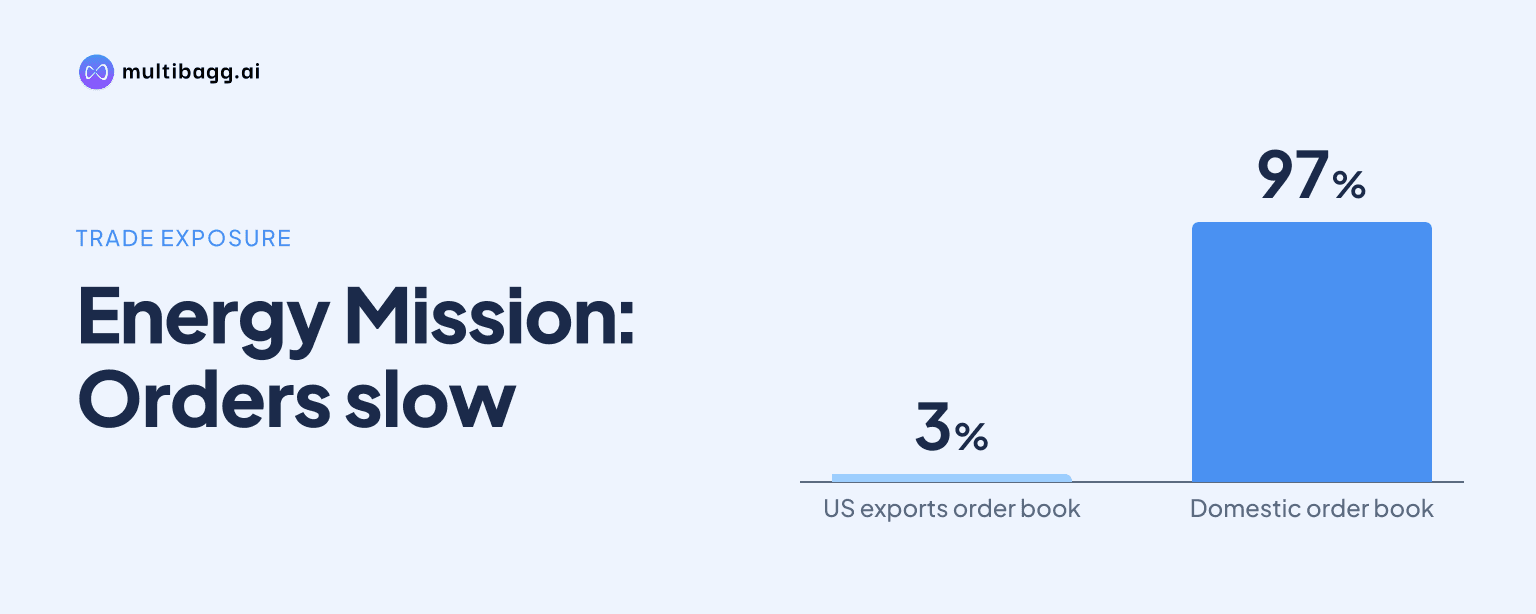
Energy Mission said its two-year-old US subsidiary has progressed slowly because tariff changes made customers uncertain about eventual order costs, while it is pursuing East and West regional dealers and has received sample orders in Canada. Exports account for about 3% of its current order book, compared with 97% from domestic customers.
Know Energy-Mission Machineries (India) inside out
Results, valuation, peers and who's buying, in one view.
Why has Energy Mission's US expansion moved slowly?
Energy Mission said tariff variations and related uncertainty made US customers reluctant to commit to machinery orders. Management said buyers feared that an order placed at one cost could become more expensive by the time material reached the market, creating caution despite the US subsidiary having operated for two years.
Energy Mission currently has one distributor and one major US partner, according to management. The company said there has been progress but described it as slow, and it did not disclose US revenue, a current-year US sales target or confirmed orders from the exhibition it attended.
The issue matters because Energy Mission sells capital equipment rather than standardised consumables. Management said machinery customers assess installed references, service response and spare-parts availability, and that a supplier entering a market where some competitors have operated for 50 years must establish confidence over time.
How is Energy Mission changing its North American sales network?
Energy Mission has asked its existing US partner to appoint sub-dealers in different regions, including the East and West, to expand jointly. The intended mechanism is to shift from reliance on one distribution relationship towards broader regional coverage across the mainland US market.
Energy Mission has also started a separate distribution engagement in Canada, where management said sample orders have already been received. The call did not disclose the value, product category, shipment schedule or expected conversion rate for those orders, so the samples show early commercial activity rather than recurring Canadian revenue.
Management linked the distribution effort to discussions held before and during an exhibition. It expects the exhibition to support additional US orders, but it gave no number for leads, converted orders or delivery timing and said it was too early to provide final figures.
How small are Energy Mission's exports within its order book?
Energy Mission's order book is approximately 97% domestic and 3% export, with Nepal, the United Arab Emirates and the US named as export markets. The comparison shows that North American development remains small relative to the domestic business, even as Canada adds another overseas distribution route.
About 35% of total order-book volume comes from repeat customers, while 65% comes from newly added customers. Management did not split those customer measures between domestic and export markets, so the transcript does not show whether US or Canadian demand is mainly from existing relationships or first-time buyers.
Energy Mission said its domestic presence spans 20 states, where management described the brand as established. By contrast, it said overseas expansion requires sales, local service, customer references and installations, which is why the current US plan centres on adding regional dealers rather than forecasting immediate rapid growth.
Got a follow-up? Ask IRIS
What is Energy Mission's export sales proposition?
Energy Mission said it offers more than 600 product variants, including five series in its computer numerical control, or CNC, range. Management said each machine can contain more than 600 to 700 components, including controllers, hydraulics, electrical systems and sensors, making technical support part of the sales proposition.
Management said its technology is broadly comparable with products from Europe and Turkey, and that its pricing is lower than European, Turkish and high-end Chinese suppliers. These are management statements rather than independently verified price or performance comparisons, and the call gave no percentage price differential or third-party test data.
Energy Mission identified service and spare-parts support as central to converting machinery customers into references for later orders. Management said a customer satisfied with machine performance, price and manufacturer response can influence other buyers, a mechanism it expects to apply as it builds more overseas installations.
Can Energy Mission meet higher export demand with existing capacity?
Energy Mission said it has no immediate capital-expenditure, or CapEx, guidance because it intends to utilise its present capacity before considering further investment. Management estimated that doubled parent-company capacity of 1,500 machines could support about Rs 275 crore of revenue, without specifying the period required or the export contribution to that amount.
EM Press Form Solution began operations at its new facility in July, and management expects higher utilisation in the second half. It said around 40% of that subsidiary's capacity would be used for Energy Mission and 60% could serve external customers; lower subsidiary utilisation was one reason cited for the quarter-on-quarter decline in consolidated margin.
Management has guided for turnover compound annual growth rate, or CAGR, of 18% to 20% over the next three years, based on past growth, market study and development work in new markets. It also said it expects earnings before interest, tax, depreciation and amortisation, or EBITDA, margin of about 13% to 15% and profit after tax, or PAT, of about 6% to 8% this year; these are management expectations rather than reported results.
Conclusion
Energy Mission's US business remains in an early build-out phase: tariff uncertainty slowed customer decisions, its current US structure has one distributor and one major partner, and exports account for only 3% of the order book against 97% domestically. Canada sample orders and the proposed East and West sub-dealer network provide a more defined route to broaden overseas coverage.
The next developments to watch are appointments of US sub-dealers, conversion of Canadian sample orders and utilisation at the July-started EM Press Form Solution facility in the second half. Management's disclosed plan is to use existing 1,500-machine capacity, estimated to support about Rs 275 crore of revenue, before considering further CapEx.