










Enviro Infra Debt Hits Rs 704 Crore, Targets 0.6 Debt-Equity
Key highlights
- Enviro Infra’s consolidated gross debt was cited at Rs 704 crore, up from Rs 422 crore.
- Management put debt-to-equity at about 0.53 and targets no more than 0.6 by the financial-year close.
- A Rs 57 crore rise in service concession agreement receivables affected first-half operating cash flow.
- Management expects specified UBR to be almost nil by March and OCF to turn positive in Q4.
powered by IRIS
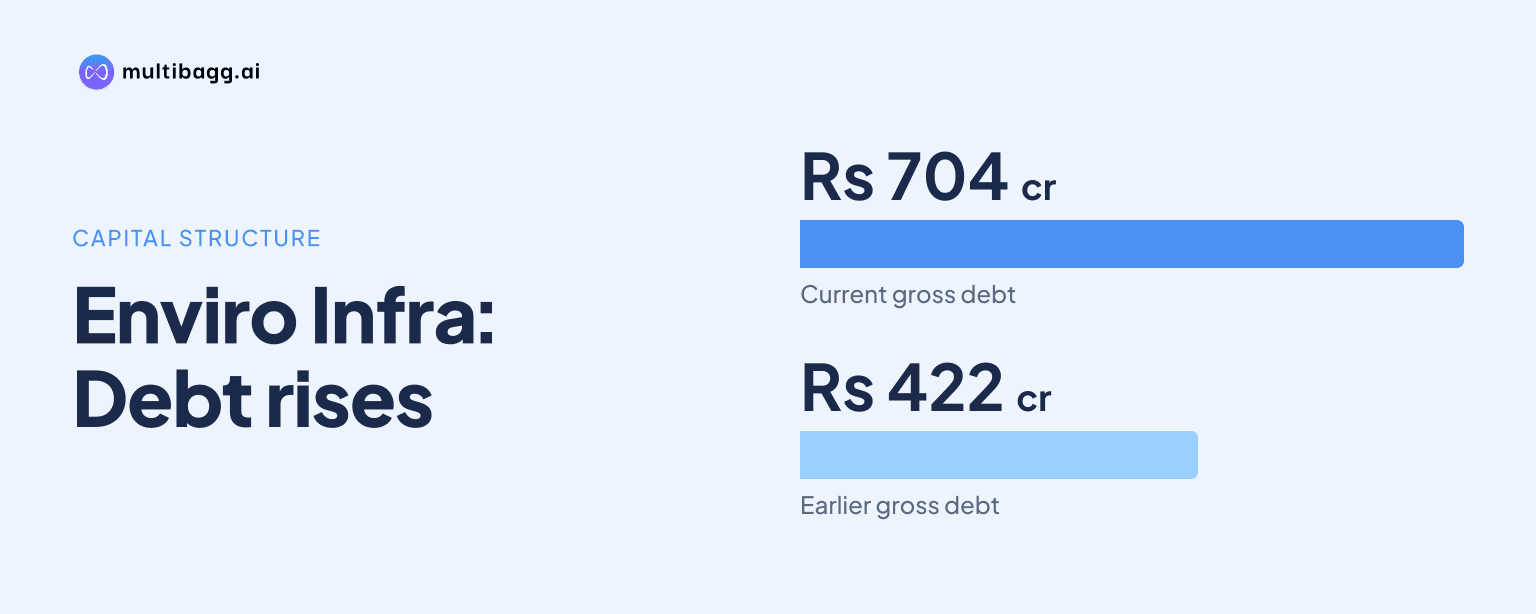
Enviro Infra Engineers Limited reported gross debt of Rs 704 crore, up from Rs 422 crore, as hybrid annuity model water projects and renewable independent power producer assets required funding; management said debt-to-equity was about 0.53 and expects it to be no more than 0.6 at the financial-year close.
Know Enviro Infra Engineers inside out
Results, valuation, peers and who's buying, in one view.
Why did Enviro Infra’s debt rise to Rs 704 crore?
Enviro Infra’s debt rose because term loans increased for two hybrid annuity model, or HAM, water projects and renewable independent power producer, or IPP, projects. An analyst cited consolidated gross debt of Rs 704 crore against Rs 422 crore earlier, while management separately described borrowings increasing from about Rs 423 crore in Q1 to around Rs 700 crore.
Management identified the Mathura and Saharanpur HAM projects as contributors to the higher term-loan balance. It said construction at Mathura had reached completion, while Saharanpur was moving towards its fourth milestone. These projects require funding during execution, and management linked the increase in debt specifically to their progress rather than providing a project-by-project borrowing split.
Renewable IPP projects also increased term loans, according to management. It said assets are being created in those projects and future income from them is expected to meet interest costs associated with the relevant debt. Management therefore expects term loans to rise further, though moderately, while declining to specify a peak gross-debt amount.
What debt-to-equity level is Enviro Infra targeting?
Enviro Infra is targeting debt-to-equity of no more than 0.6 at the close of the current financial year, management said. It put the current ratio at about 0.53, but did not give an exact gross-debt ceiling because the final debt level will depend on project funding and the working-capital cycle.
The company expects short-term borrowing to reduce as cash flows ease. Management referred to cash-credit limits and working-capital demand loans, or WCDL, used in part to make payments to micro, small and medium enterprises, or MSME, vendors. It said these facilities should decline as the cash cycle improves, unlike project term loans attached to HAM and IPP assets.
The funding requirement sits alongside an order book an analyst described as more than Rs 6,700 crore. Management maintained sales guidance of Rs 2,000 crore for the current financial year after reporting Rs 700 crore of revenue in the first half, leaving Rs 1,300 crore expected in Q3 and Q4. It said this revenue guidance was based on the order book already in hand.
When does Enviro Infra expect operating cash flow to turn positive?
Enviro Infra expects operating cash flow, or OCF, to turn positive in Q4, according to management. This is an outlook rather than a reported result, and management linked it to receivable collection and the normalisation of supplier-payment timing rather than to an immediate reduction in all borrowings.
A Rs 57 crore increase in service concession agreement receivables affected first-half OCF, management said. The company expects this amount to be received over 15 years, making it a long-duration receivable. Management also said it reduced trade-payable days to 63 from 93 days, producing a cash outgo of Rs 102 crore during the period.
Management said OCF could have been positive had it slowed payments to trade creditors, but it chose not to do so. Its Q4 expectation rests on an easing cash-flow cycle while project execution continues. The debt discussion therefore combines long-term project borrowing with shorter-term working-capital movements, including receivables and vendor payments.
Got a follow-up? Ask IRIS
Will Enviro Infra’s unbilled receivables fall by March?
Enviro Infra expects unbilled receivables, or UBR, linked to Madhya Pradesh Jal Nigam and Har Ghar Jal projects to be almost nil by March, apart from smaller residual balances. Management said the balance had already reduced significantly and was around Rs 100 crore or potentially below Rs 100 crore.
The company did not say total receivables would fall by the same amount. Management said the overall receivable value could remain around Rs 600 crore even as the working-capital cycle improves, because sales are expected to increase. Its expectation is that UBR days and receivables as a percentage of sales should decline substantially.
Management said UBR had already come down compared with Q1 and described the current level as a peak. The distinction between absolute receivables and receivable days is important in its plan: a balance of around Rs 600 crore could persist while a higher sales base reduces the relative cash-flow burden.
How are HAM and renewable projects affecting Enviro Infra’s profit?
Enviro Infra said finance cost, depreciation and employee cost increased as percentages of sales in the first half as HAM and IPP assets expanded. Management said revenue rose by almost 60% and earnings before interest, tax, depreciation and amortisation, or EBITDA, was around 20%, while higher depreciation reflected the additional project assets.
The renewable business also has consolidation effects. Management said Suyog Urja was acquired for Rs 311 crore, of which a first tranche of Rs 111 crore had been paid and Rs 200 crore remained payable over the next two years. It said interest costs related to this arrangement were included as an expense in the consolidated accounts.
Management also said profit on engineering, procurement and construction work carried out for group IPP special-purpose vehicles, or SPVs, is reversed on consolidation. It expects renewable profitability to improve in Q3 and Q4 as engineering, procurement and construction activity on battery energy storage system and wind projects increases and IPP income starts after execution. Management guided for EBITDA margins of 21% in water and wastewater, 15% to 18% in renewable, and 19% to 20% on a consolidated basis.
Conclusion
Enviro Infra’s Rs 704 crore gross-debt figure reflects management’s stated funding of HAM water projects and renewable IPP assets, while the current debt-to-equity ratio of about 0.53 remains below its year-end ceiling of 0.6. The balance-sheet outcome will depend on whether project assets begin generating the expected cash flows and whether short-term working-capital facilities decline.
The next disclosures to watch are management’s expected Q4 OCF-positive outcome, the financial-year debt-to-equity result, and its March target for near-elimination of specified Madhya Pradesh Jal Nigam and Har Ghar Jal UBR. Progress at Saharanpur’s fourth milestone, along with renewable engineering, procurement and construction execution and subsequent IPP income, is also part of management’s stated plan.