










Enviro Infra Guides 19%-20% Consolidated EBITDA Margin
Key highlights
- Enviro Infra guided for a 19%-20% consolidated EBITDA margin, versus 21% for water and wastewater and 15%-18% for renewables.
- Enviro Infra acquired Suyog Urja for Rs 311 crore, paying Rs 111 crore initially and scheduling Rs 200 crore over two years.
- Enviro Infra reported Rs 700 crore of FY27 first-half revenue and retained its Rs 2,000 crore full-year sales target.
- Enviro Infra’s consolidated borrowings rose to about Rs 703.9 crore in September 2026 from Rs 422.3 crore in March 2026.
powered by IRIS
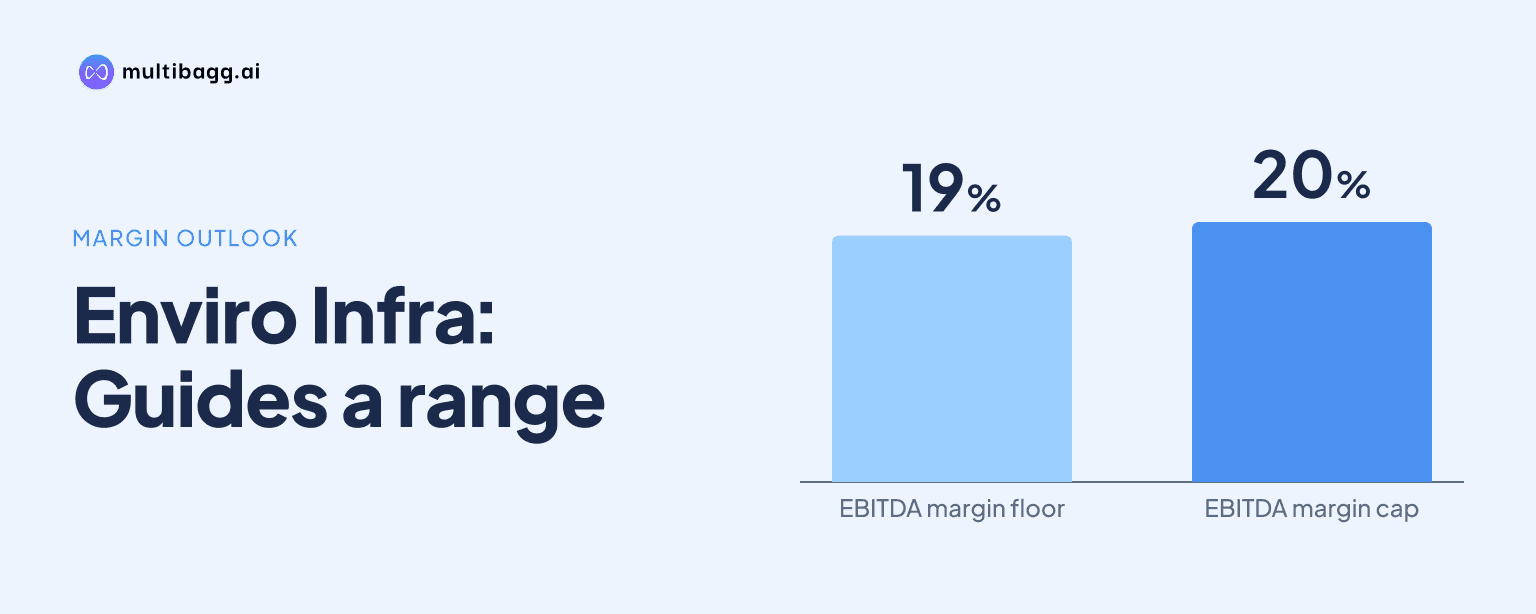
Enviro Infra Engineers Limited said first-half FY27 consolidated profitability was affected by Suyog Urja acquisition accounting and independent power producer profit reversals, and management guided for a 19%-20% consolidated EBITDA margin as renewable engineering work rises in the second half. The range compares with management’s 21% water-and-wastewater margin guidance and 15%-18% renewable range.
Know Enviro Infra Engineers inside out
Results, valuation, peers and who's buying, in one view.
Why did Enviro Infra’s consolidated margin decline?
Enviro Infra said consolidated margin moderation partly resulted from accounting for its Rs 311 crore acquisition of Suyog Urja Limited and from reversing profits on engineering, procurement and construction work for group independent power producer projects. The company paid a first Rs 111 crore tranche and said the remaining Rs 200 crore is due over the next two years, creating an interest-cost expense linked to deferred payments.
Enviro Infra also said profit on engineering, procurement and construction, or EPC, work for independent power producer, or IPP, assets must be reversed in consolidated accounts when the asset is transferred to a group special-purpose vehicle, or SPV. Management said the renewable business performs the EPC work while the SPV holds the asset, requiring elimination of the intra-group profit at the consolidated level.
Management said IPP profitability should be reflected after a project is completed and starts earning IPP revenue, rather than while it is under construction. An investor described the year-on-year margin reduction in the quarter and first half as about 800-900 basis points, while management cited higher finance cost and depreciation associated with IPP and hybrid annuity model, or HAM, projects.
The reported revenue increase was almost 60%, according to management, but employee cost, finance cost and depreciation rose as a percentage of sales in the first half. Management said the accounting effects and project-stage costs made consolidated profitability appear lower even as execution expanded across water, wastewater and renewable projects.
What EBITDA margin does Enviro Infra expect?
Enviro Infra expects a consolidated earnings before interest, tax, depreciation and amortisation, or EBITDA, margin of about 19%-20% as water and renewable activities contribute roughly equally to its order book. Management gave this range in response to a question about the longer-term blended margin profile.
Management maintained FY27 EBITDA-margin guidance of 21% for water and wastewater treatment and indicated a 15%-18% range for renewables. It said the water guidance had been reduced because the continuing West Asia and Middle East conflict had increased input prices substantially.
The segment ranges explain why the consolidated guide is below the water target. The 19%-20% blended range falls between the 21% water-and-wastewater guide and the 15%-18% renewable range, reflecting the growing contribution from lower-margin renewable EPC and IPP activities.
On a standalone basis, Enviro Infra reported about Rs 264 crore of revenue in the current quarter, a 24% EBITDA margin and a profit after tax, or PAT, margin of about 14%. Management said the standalone result was above its water-segment guidance, while the consolidated result included the renewable accounting and project-execution effects.
What costs are included in Enviro Infra’s construction expense line?
Enviro Infra said other construction and operating expenses are direct project-execution costs and are not the Rs 111 crore Suyog Urja payment. Management said the line includes manpower, wages, civil-construction labour and job-work costs, while purchase costs are recorded separately.
An investor noted that other construction and operating expenses had increased from Rs 46 crore in the prior-year period to Rs 178 crore in Q2, alongside Rs 248 crore of total main expenses. Management advised adding purchase costs to other construction and operating costs when assessing movements in production costs.
The call did not provide a numerical split within the Rs 178 crore line. However, management distinguished it from the Suyog Urja accounting impact: the acquisition-related charge was described as interest expense on deferred consideration, whereas construction and operating expenses represent costs incurred in executing EPC projects.
Got a follow-up? Ask IRIS
What could improve Enviro Infra’s renewable profitability?
Enviro Infra expects higher renewable profitability from Q3 onwards as EPC execution on battery energy storage system, or BESS, and wind projects increases substantially. Management said there had not yet been substantial EPC execution on these projects, limiting the contribution visible in the first-half consolidated result.
The company has a 930 megawatt-hour BESS order book from NTPC and one acquired Bihar IPP project. Management said both projects were under execution and that a major part of them was expected to be completed by June, while it also seeks to increase BESS orders selectively in both EPC and IPP formats.
Management said EPC profit should arise as renewable construction work progresses, whereas IPP income should begin only after assets are completed and generating operating revenue. It cited standalone PAT of Rs 37 crore against consolidated profitability of Rs 39.5 crore to illustrate that the renewable portfolio had not yet delivered the expected scale of earnings contribution.
Can Enviro Infra meet its FY27 sales and cash-flow plans?
Enviro Infra retained FY27 sales guidance of Rs 2,000 crore after reporting Rs 700 crore of revenue in the first two quarters, leaving Rs 1,300 crore to be delivered in Q3 and Q4. Management said the sales target is based only on the order book already in hand and maintained its Rs 240 crore-Rs 250 crore FY27 bottom-line expectation.
Management expects operating cash flow, or OCF, to turn positive by Q4. It attributed negative first-half OCF partly to a Rs 57 crore increase in service-concession-agreement receivables, which it said will be received over 15 years, and a Rs 102 crore outflow as trade-payable days declined to 63 from 93.
Working-capital and funding demands increased during the period. Consolidated trade receivables were about Rs 321.8 crore at September 2026, compared with Rs 155.3 crore at March 2026, while total borrowings rose to about Rs 703.9 crore from Rs 422.3 crore over the same period.
Management linked the debt increase mainly to HAM construction and renewable IPP financing. It expects FY27 debt-to-equity to close at no more than 0.6, versus about 0.53 at the time of the call, while seeking improved milestone certification, billing and collections.
Conclusion
Enviro Infra’s 19%-20% consolidated EBITDA-margin outlook reflects a business mix in which renewable activity carries a lower 15%-18% margin range than the 21% guided for water and wastewater. Management attributed first-half reported pressure to interest accounting on the Rs 311 crore Suyog Urja acquisition, elimination of intra-group IPP EPC profit, and higher project-related finance cost and depreciation.
The next measures to watch are the planned Q3 and Q4 increase in BESS and wind EPC execution, delivery of the remaining Rs 1,300 crore required for FY27 sales guidance, and management’s stated aim of OCF positivity by Q4. Management also expects a major part of the 930 megawatt-hour NTPC BESS work to be completed by June, which could affect the timing of renewable earnings recognition.