










Enviro Infra Retains Rs 2,500 Crore FY27 Water Order Target
Key highlights
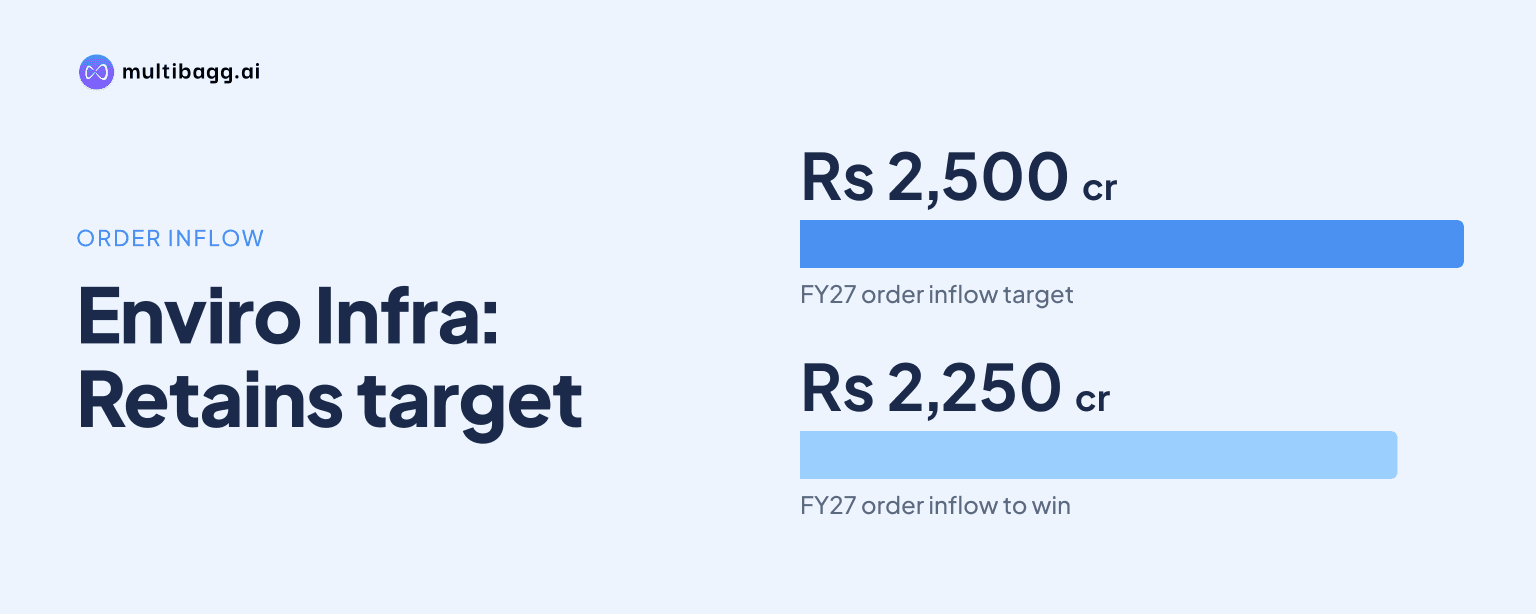
- Enviro Infra retained its Rs 2,500 crore FY27 water and wastewater order-inflow target.
- Enviro Infra had secured about Rs 250 crore through two HAM projects, leaving about Rs 2,250 crore to be won.
- Management guided for a 21% EBITDA margin in water and wastewater, versus 15% to 18% in renewables.
- Enviro Infra reported Rs 700 crore of revenue in the first two quarters against Rs 2,000 crore FY27 sales guidance.
powered by IRIS
Enviro Infra Engineers Limited has retained its Rs 2,500 crore FY27 water and wastewater order-inflow target despite securing about Rs 250 crore so far, saying it will wait for hybrid annuity model, reuse and zero liquid discharge projects that meet its profitability expectations amid increased competition.
Know Enviro Infra Engineers inside out
Results, valuation, peers and who's buying, in one view.
What is Enviro Infra's FY27 water-order target?
Enviro Infra has maintained its Rs 2,500 crore order-inflow guidance for the water and wastewater treatment segment in FY27. Management said orders obtained so far in the financial year comprise two hybrid annuity model (HAM) projects valued at about Rs 250 crore, leaving around Rs 2,250 crore of the target to be filled during the balance of FY27.
The current pace means roughly 10% of the stated target had been secured at the time of the call. Management nevertheless said it expected to obtain the remaining Rs 2,250 crore during the current financial year and described the Rs 2,500 crore guidance as intact. This is an order-inflow goal, distinct from the company’s FY27 sales-turnover guidance of Rs 2,000 crore.
Management said the Rs 2,000 crore sales target rests on the order book already in hand, rather than on future awards needed to meet the Rs 2,500 crore water-order target. Enviro Infra reported Rs 700 crore of revenue in the first two quarters and said it expected the remaining Rs 1,300 crore in the third and fourth quarters to reach its FY27 sales guidance.
Why is Enviro Infra willing to wait for orders?
Enviro Infra said it is unwilling to lower its project-level profitability expectations merely to win more contracts. Management said competition had increased during the preceding five to six months, but the company had not reduced its profitability guidance while bidding. Its existing order book for the current financial year gives it scope, in management’s view, to wait for suitable opportunities.
The preferred opportunities are larger or more specialised water and wastewater projects, including wastewater treatment systems, zero liquid discharge (ZLD) projects and water-reuse projects. These categories form the basis of Enviro Infra’s selective bidding approach, rather than a shift away from water and wastewater treatment, which management described as its core business of the past 35 years.
Margin guidance helps explain that selection. Management guided for a 21% earnings before interest, tax, depreciation and amortisation (EBITDA) margin in water and wastewater treatment, compared with 15% to 18% in renewable projects. The consolidated blended EBITDA margin is expected at 19% to 20%, so the mix and commercial terms of future water orders can affect the company’s stated profitability profile.
Enviro Infra also said it achieved a 24% standalone EBITDA margin in the second quarter, above the 21% water and wastewater guidance. Management noted that price-escalation clauses in tenders and agreements do not pass through all cost increases, and said some inflation must still be absorbed. It said water and wastewater guidance had been lowered to 21%, while project bidding continued to avoid lower-profitability contracts.
Got a follow-up? Ask IRIS
Which projects could fill Enviro Infra's remaining Rs 2,250 crore target?
Enviro Infra identified a pipeline across HAM, effluent treatment and government-backed water programmes that management believes can fill the remaining Rs 2,250 crore. The company cited HAM opportunities in Delhi, effluent treatment plant (ETP) projects in Uttar Pradesh, and projects in Jharkhand, Bihar, Madhya Pradesh and Karnataka.
Management also pointed to opportunities under Namami Gange, especially in states containing the Ganga or its tributaries, as well as projects under AMRUT and the Urban Challenge Fund. It did not assign values, tender dates or award probabilities to these opportunities. Consequently, the pipeline supports management’s outlook but does not establish how much of the Rs 2,250 crore balance will convert into awarded contracts.
Overseas work is another potential contributor, although it remains uncertain. Enviro Infra said it had submitted bids for projects outside India and was looking for one or two of those projects to enter its order book. Management did not disclose the value, country or expected award timing of the overseas bids.
The strategy therefore contrasts order quality with immediate volume. In the previous year, management said, the company had been concerned about building its order book; in FY27, it said the book was sufficiently healthy to be selective. The changed position is reflected in the decision to seek HAM, ZLD, reuse and other specialised work while maintaining the same Rs 2,500 crore annual target.
How does the water strategy fit Enviro Infra's wider business mix?
Enviro Infra said water and wastewater will remain its parent and core business even as renewable orders have accounted for much of the order intake over the last six to nine months. Management said the renewable business, entered only in the previous year, has a fast execution cycle but a lower expected EBITDA margin of 15% to 18%, compared with 21% for water and wastewater.
Water-sector growth drivers cited by management include new sewage treatment plants, upgrades to existing plants, sewage reuse, ETPs, common effluent treatment plants, ZLD systems and desalination. The company said common effluent treatment and ZLD opportunities can come from industrial development corporations or trusts, while desalination projects can arise from industrial bodies.
HAM execution is already affecting the balance sheet and links the order strategy to funding needs. Gross debt rose from Rs 423 crore in the first quarter to about Rs 700 crore, which management attributed partly to two HAM projects, Mathura and Saharanpur. Management said Mathura had reached construction completion and Saharanpur was approaching its fourth milestone.
Management expects debt to equity to close the financial year at no more than 0.6, compared with about 0.53 at the time of the call. It said term loans could rise moderately because of HAM and renewable independent power producer projects, but associated assets are expected to generate income over time. The company did not provide a peak-debt figure.
Conclusion
Enviro Infra’s unchanged Rs 2,500 crore FY27 water and wastewater order target relies on securing about Rs 2,250 crore after winning about Rs 250 crore of HAM work. Management’s central message is that higher competition will not prompt it to reduce project-level profitability expectations, with water and wastewater EBITDA guidance at 21% versus 15% to 18% for renewable projects.
The next indicators are whether Delhi HAM, Uttar Pradesh ETP, Namami Gange, AMRUT, Urban Challenge Fund and overseas bids translate into awards during FY27. Investors can also watch delivery of the Rs 2,000 crore FY27 sales target after Rs 700 crore in the first two quarters, and management’s expectation that debt to equity will not exceed 0.6 at year-end.