










ESDS expects US$4-5 million monthly profit at Sydney AI factory
Key highlights
- ESDS expects US$30 million in monthly Sydney customer billing from January 2027.
- ESDS estimates Sydney AI factory profit after tax at US$4-5 million per month, or a 14-17% revenue margin.
- ESDS will pay Sharon AI about US$21 million monthly under a US$1.26 billion, 60-month commitment.
- All 8,208 NVIDIA B300 GPUs were installed and in final testing as of November 21, 2026.
powered by IRIS
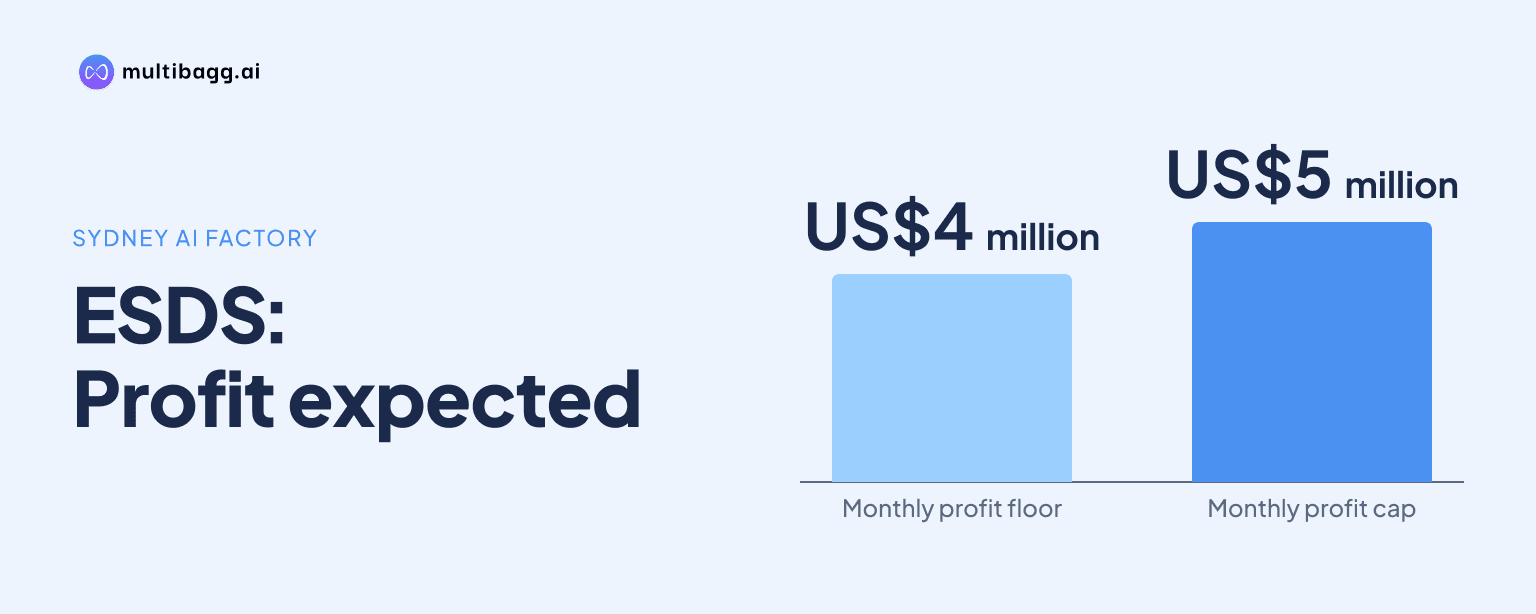
ESDS Software Solution Limited expects its Sydney AI factory to generate post-tax profit of about US$4-5 million a month after billing starts in January 2027, based on about US$30 million of monthly customer billing and about US$21 million payable to Sharon AI. ESDS estimates a 14-17% margin on project revenue.
Know ESDS Software Solution inside out
Results, valuation, peers and who's buying, in one view.
What revenue and profit does ESDS expect from Sydney?
ESDS expects about US$30 million in monthly customer payments from the Sydney AI factory and estimates post-tax profit of about US$4-5 million a month. The company said the contractual economics leave about US$9 million a month before operating costs and tax after its payment obligation to Sharon AI, with estimated net margin of about 14-17% of revenue.
The US$4-5 million post-tax figure clarifies approximate remarks made during ESDS's earnings call on November 2, 2026. In its November 21, 2026 disclosure, ESDS said the current estimate is based on contractual economics, while cautioning that timelines and profit figures are expectations rather than guarantees.
How does customer billing compare with ESDS's Sharon AI cost?
ESDS expects customer billing of about US$30 million a month, compared with about US$21 million a month payable to Sharon AI, creating a US$9 million monthly difference before operating costs and tax. The US$21 million cost is fixed at a per graphics processing unit, or GPU, per-hour rate for the full agreement term, ESDS said.
ESDS's commitment to Sharon AI is approximately US$1.26 billion over 60 months, equal to about US$21 million a month and about Rs 2,400 crore a year using the company's disclosed approximate conversion. This is below the approximately Rs 3,000 crore annual figure mentioned on the November 2, 2026 earnings call, which ESDS described as an approximation made during the discussion.
The US$30 million customer-billing estimate exceeds the US$21 million supplier charge by US$9 million each month before operating costs and tax. That difference is not post-tax profit, because ESDS expects operating costs and tax to reduce it to the US$4-5 million monthly profit estimate.
When will ESDS begin Sydney AI factory billing?
ESDS expects handover of the Sydney AI factory in mid-December 2026 and says customer billing will start in January 2027. All 8,208 NVIDIA B300 GPUs had been installed and the cluster was in final testing when ESDS made its November 21, 2026 disclosure.
The delivery timetable was revised by mutual agreement with Sharon AI, and ESDS said customers had been informed of that change. The revised timeline was in line with the schedule Sharon AI published with quarterly results declared on November 16, 2026, while ESDS said it chose to complete full cluster testing before accepting handover.
Charges payable by ESDS to Sharon AI and payments due from customers to ESDS start only after cluster acceptance. ESDS therefore said the revised handover schedule does not add to its costs because payment obligations on both sides begin together rather than during the final-testing period.
Got a follow-up? Ask IRIS
How are customer commitments matched to the Sydney contract?
ESDS says all Sydney capacity is contracted with customers on a take-or-pay basis, meaning customers must pay for the full contracted capacity whether or not they use it. The company said customer contracts mirror the term and exit provisions in its Sharon AI agreement.
This arrangement ties ESDS's stated US$30 million monthly billing expectation to the full factory capacity rather than a utilisation assumption. ESDS specifically said the matched contract structure protects it against the risk of low utilisation, while customer names remain confidential under the relevant contracts.
Customers also committed funds before the cluster goes live, according to the November 21, 2026 disclosure. ESDS did not identify the customers or disclose individual contract values, but said the full capacity is contracted and customer contract terms will be disclosed to the extent required by listing regulations.
What is ESDS's deposit and operating role in Sydney?
ESDS placed a US$140 million cash deposit, equivalent to about Rs 1,336 crore, with Sharon AI in May 2026 instead of using letters of credit. The deposit was funded by a US$140 million advance received from customers, so ESDS said it did not draw on its own cash for this payment.
The US$140 million deposit will be adjusted against service fees over the contract term and is recorded as an advance to vendor. ESDS said no letter of credit or bank guarantee is outstanding or needed in addition, and that the deposit is refundable if Sharon AI does not deliver under the contract.
Sharon AI owns the hardware and data-centre capacity, while ESDS provides the managed service sold to customers under one contract. The service includes cluster operations, a 24x7 network and security operations centre, model training and GPU-as-a-Service, enabling ESDS to add capacity without heavy investment in land, buildings or GPU hardware.
Conclusion
ESDS has set out Sydney AI factory economics of about US$30 million in monthly customer billing, about US$21 million in monthly Sharon AI cost and estimated post-tax profit of US$4-5 million a month. The contractual gap is about US$9 million before operating costs and tax, and ESDS's disclosed net-margin expectation is about 14-17%.
The next disclosed milestones are handover expected in mid-December 2026, billing from January 2027 and an exchange intimation when the factory goes live. ESDS also said revenue, cost and profit streams are denominated in US dollars, meaning exchange-rate movements can change reported rupee values without changing the US-dollar margin.