










Exide Raises Vehicle Battery Prices Up to 10% Since January
Key highlights
- Exide said four-wheeler vehicular-battery prices rose about 9%-10% from January to October.
- Exide said two-wheeler battery prices increased about 5% from January to October.
- Exide raised prices for OEMs, tubular batteries and inverter batteries to offset input-cost increases.
- Exide has commissioned two NMC lithium-ion cell lines of 1.5 GWh each.
powered by IRIS
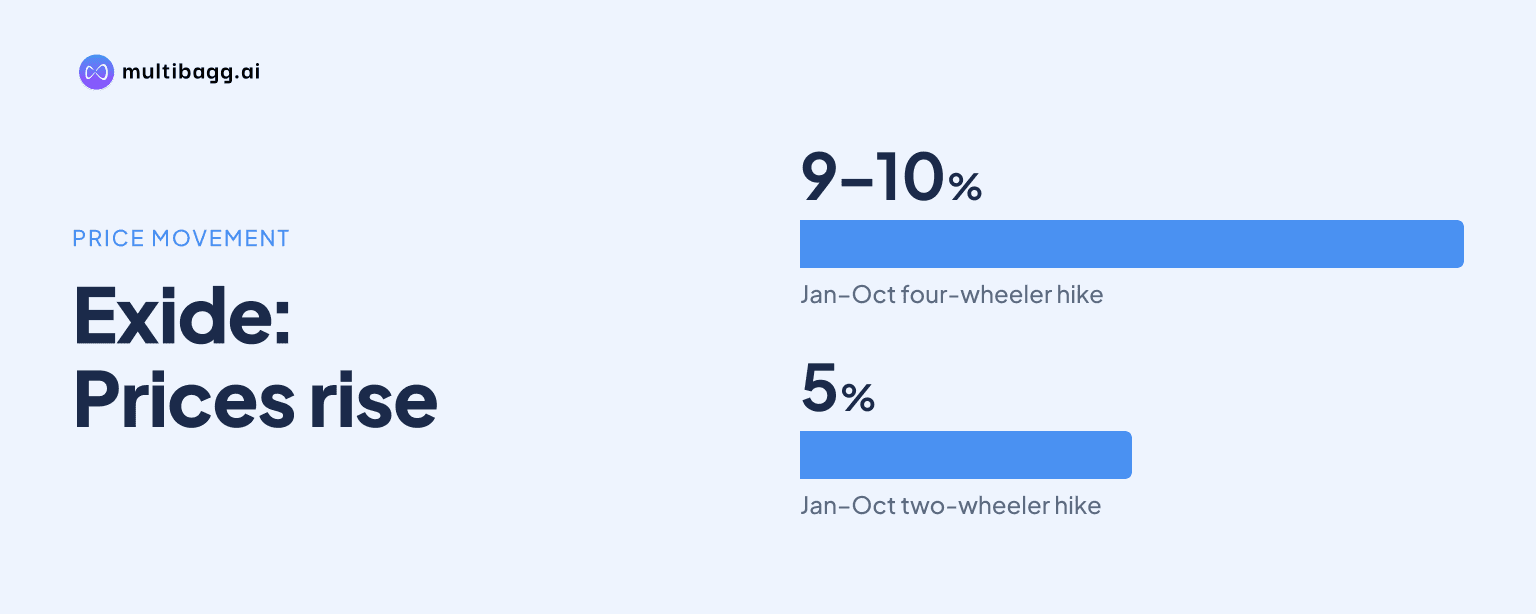
Exide raised four-wheeler vehicular-battery prices by about 9%-10% between January and October, including an October round, to offset higher input costs, while two-wheeler prices increased about 5%. Management said the increases also covered original equipment manufacturer customers, tubular batteries and inverter batteries as it adjusted pricing across uses.
Know Exide Industries inside out
Results, valuation, peers and who's buying, in one view.
How much did Exide raise battery prices?
Exide raised four-wheeler vehicular-battery prices by about 9%-10% from January to October, while two-wheeler battery prices rose about 5%, management said. It described the aggregate January-to-October action as more than 10%, but separately identified the year-on-year effect in four-wheelers as 9%-10% and said an additional round was taken in October.
The difference between the two vehicle segments was explicit: the stated 5% increase for two-wheelers was below the 9%-10% increase for four-wheelers. Management did not disclose a separate percentage for every product line, so the four-wheeler and two-wheeler ranges should not be read as a uniform price change across Exide's battery portfolio.
Exide said its approach contrasted with the previous year's third quarter, when it did not take a price increase after the announcement of Goods and Services Tax, or GST, 2.0. Management said it deliberately passed the entire GST benefit to end consumers at that time, then began step-by-step increases after input costs started rising from January.
Why did Exide increase prices beyond vehicle batteries?
Exide said the purpose of the increases was to offset rising input costs, and the action extended beyond retail vehicle batteries. It also increased prices for original equipment manufacturers, or OEMs, outside the lead-price formula, with management saying it was forced to take those increases as cost pressure intensified.
The company also raised prices for tubular batteries and inverter batteries, although it gave no product-specific percentage for either category. This means the disclosed 9%-10% four-wheeler range and 5% two-wheeler range cannot be applied directly to Exide's inverter and tubular products, which were subject to separately calibrated revisions.
Tubular batteries have a broader role than inverter backup, according to management. Exide said the technology also serves solar and multiple other applications, while describing the inverter-linked portion as seasonal. The pricing action therefore reached products used in automotive, backup power and other industrial or energy-related applications rather than a single end market.
Will Exide's lead-acid battery business continue to evolve?
Exide expects internal-combustion, or IC, engine vehicles to remain a market for flat-plate batteries over the next three to five years, management said. It based that view on the existing vehicle parc and conventional-vehicle investments announced by the top three automotive OEMs, while cautioning that the standard flooded starter-battery format is likely to change.
Management expects automotive products to move from standard flooded batteries toward enhanced flooded batteries, or EFBs, and absorbent glass mat, or AGM, batteries. Exide said it has both technologies in its portfolio, sells them to OEMs and exports them. It also said EFB sales have picked up substantially in the aftermarket, indicating a technology shift within lead-acid products rather than an exit from the category.
For tubular batteries, Exide said the technology should remain relevant in Indian conditions requiring longer life and longer backup. Management described Exide as the largest tubular-battery manufacturer and said India is the largest tubular-battery manufacturing market globally. Its stated case for continued demand rests on applications including inverters and solar, not solely on automotive replacement demand.
Got a follow-up? Ask IRIS
What does Exide expect in telecom and lithium-ion batteries?
Exide said Indian telecom operators shifted from AGM and valve-regulated lead-acid, or VRLA, batteries to lithium-ion batteries in roughly one year, but management said operators are still on a learning curve. In the tower configuration described on the call, operators removed diesel-generator, or DG, backup from base transceiver station, or BTS, towers and rely more heavily on the lithium-ion battery.
Management did not confirm market reports that telecom operators or industrial customers could move back to tubular lead-acid batteries because of lithium-ion insurance costs or fire concerns. It said it had heard similar commentary but could not determine whether it was correct. Its understanding was that lithium-ion economics in telecom towers work without a DG set; if a DG set is restored, management said those economics become less attractive.
Alongside its lead-acid portfolio, Exide has commissioned two nickel manganese cobalt, or NMC, cell-production lines of 1.5 gigawatt-hours, or GWh, each. Management said it will first utilise the initial 1.5 GWh line before moving to the second line, making the near-term production sequence dependent on filling the first line rather than immediately using both.
Exide said its locally made lithium-ion cells still have a 5%-10% landed-cost gap versus imported Chinese cells, depending on form factor and chemistry. Management said OEMs may nevertheless value the strategic benefit of a local or second supplier. It also said lithium-ion pricing is indexed, with the landed price from China acting as the current reference point.
Exide has acquired land and installed utilities for 12 GWh, but management has not announced a phase-two decision. The chief executive said it was his personal view that the company should consider phase two at about 80% utilisation because the second phase would have a shorter lead time than the greenfield first phase. Management's plan is to make the 6 GWh lithium-ion operation cash neutral in two to three years, subject to operational execution.
Conclusion
Exide's January-to-October pricing actions show a differentiated response to raw-material inflation: about 9%-10% for four-wheeler batteries and about 5% for two-wheelers, with additional increases for OEMs, tubular batteries and inverter batteries. Management's product strategy also retains lead-acid technology across several applications while anticipating a move in automotive batteries from conventional flooded designs toward EFB and AGM products.
The next issues to watch are input costs after the October increase, demand for EFB and AGM products, and the lithium-ion plant ramp-up. Management has set a two-to-three-year cash-neutral objective for the 6 GWh operation, while its stated 80% utilisation threshold could inform a phase-two decision for the 12 GWh-ready campus.