










EXIDE targets 50%-60% local lithium-cell BOM within three years
Key highlights
- EXIDE targets 50%-60% lithium-cell BOM localisation in India within two to three years.
- EXIDE is working with more than 20 Indian suppliers, with some already at the performance-check stage.
- EXIDE reported a 5%-10% landed-cost gap against imported Chinese lithium-ion cells.
- EXIDE has commissioned two NMC lines with 1.5 GWh capacity each.
powered by IRIS
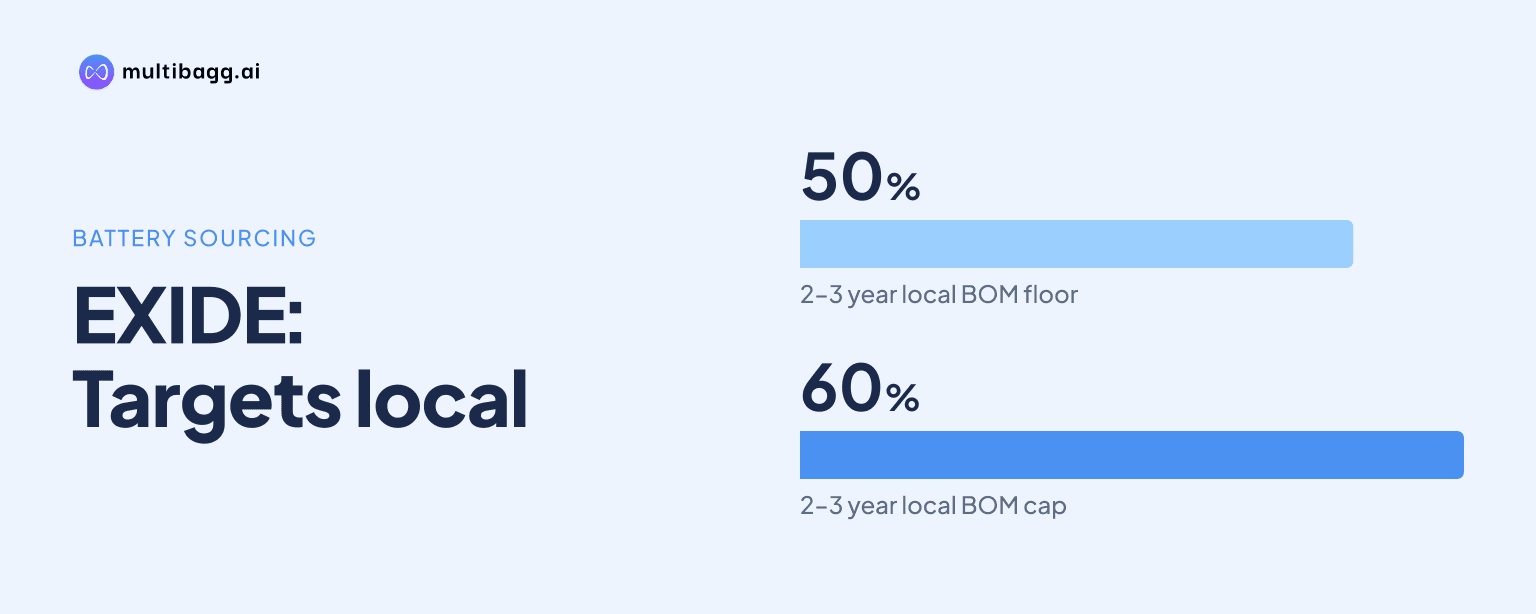
EXIDE is targeting 50%-60% localisation of its lithium-ion cell bill of materials within two to three years, while working with more than 20 Indian suppliers and reporting a 5%-10% landed-cost gap against Chinese imports. Management said supplier qualification currently ranges from early material tests to performance checks.
Know Exide Industries inside out
Results, valuation, peers and who's buying, in one view.
What is EXIDE's lithium-cell localisation target?
EXIDE's target is to localise 50%-60% of the lithium-ion cell bill of materials, or BOM, in India within two to three years. Management described this as a supply-chain roadmap rather than an immediate sourcing shift, as the company first seeks to establish consistent production of the five licensed advanced-chemistry cell products.
The target does not mean that every cell input will be made locally. EXIDE said it will prioritise materials using three criteria: technical criticality, contribution to the total BOM cost and shelf life. A high-cost input, for example, may be treated differently from a low-value component that can be imported and stocked without creating a technical issue.
How is EXIDE developing Indian cell-material suppliers?
EXIDE is working with more than 20 Indian suppliers, although they are at different points in a five-stage qualification process. The process starts with material testing, followed by specification checks in coin cells, prototype-cell manufacturing, performance checks and final cell validation.
Some suppliers have reached the performance-check stage, while others remain at the first stage, according to management. EXIDE is providing inputs during these pilots, but suppliers will still need to establish large-scale manufacturing after pilot qualification before they can support the company's two-to-three-year localisation roadmap.
The supplier programme is therefore not limited to laboratory approval. EXIDE said repeatable production capacity at Indian suppliers will be necessary to replace the current overseas supply chain, particularly as it moves from prototype cells to commercial production of its five licensed products.
Why will EXIDE not localise every lithium-cell component?
EXIDE said it will not pursue localisation solely to reach the 50%-60% BOM target. Management said the company must assess whether each component is technically critical, whether it makes a material difference to total cell cost and whether its shelf life supports local production rather than imported inventory.
This approach leaves EXIDE dependent on global raw-material sources in the near term. At the time of the call, management said it had received no supply suspension notice or other announcement affecting imports, despite discussion of possible Chinese controls linked to energy densities and export permissions for suppliers.
If controls are imposed in the future, EXIDE said delivery lead times could increase and it may need to hold more inventory to meet production demand. The company has signed long-term purchase agreements with suppliers, which management said provide one safeguard alongside inventory planning while Indian alternatives are being developed.
How large is EXIDE's cost gap versus Chinese cell imports?
EXIDE said its lithium-ion cells currently have a 5%-10% cost gap against Chinese imports on a landed basis. Management said the range varies by form factor and chemistry, and did not separately disclose the difference for lithium iron phosphate, or LFP, cells and nickel manganese cobalt, or NMC, cells.
Management said pricing is part of a negotiation with original equipment manufacturers, or OEMs, rather than a fixed comparison. It argued that a local supplier and a second source can provide strategic benefits to OEMs, although EXIDE did not quantify the value of those benefits against the 5%-10% landed-cost difference.
Localisation could address some of that gap over time, but management did not say that the 50%-60% target would eliminate it. The company said domestic supplier cost competitiveness is important and that it is looking for policy support for local suppliers through discussions around the production-linked incentive, or PLI, scheme.
Got a follow-up? Ask IRIS
When could local suppliers support EXIDE's cell ramp-up?
EXIDE has started generating LFP cell revenue from October because LFP has a shorter customer-validation cycle than NMC. Management said small customers could begin NMC purchases in small quantities from the following month, while it hoped major OEM programmes would start from the beginning of the fourth quarter or possibly February, within the fiscal year.
The cell ramp-up will initially use the first of two commissioned NMC lines, each with 1.5 gigawatt-hours, or GWh, of capacity. Management said EXIDE will seek to utilise the first 1.5 GWh line before shifting to the second, making demand conversion and supplier validation relevant to the timing of scaled local sourcing.
EXIDE has not disclosed an order book for the NMC lines. Management instead directed investors to assess potential revenue through installed capacity, while saying that current material imports, domestic supplier pilots and customer validation are proceeding in parallel.
How does localisation fit into EXIDE's future capacity plans?
EXIDE has land and utilities for 12 GWh at its giga campus, including power substations, boilers and chillers. Management said a second-phase expansion would have a shorter lead time than the greenfield first phase because these shared facilities are already in place.
Management's personal view was that EXIDE should consider a phase-two decision at about 80% utilisation of existing capacity. That was not formal guidance, but it links further capacity spending to the commercial ramp-up of the initial two 1.5 GWh NMC lines and the ability of the supply chain to support higher volumes.
A fourth line is being prepared for multiple prismatic products, including a battery energy storage system, or BESS, cell of more than 300 ampere-hours. Management said three-wheeler, telecom and two-wheeler applications currently rank ahead of BESS, and it will assess the PLI framework and market development before declaring a BESS roadmap.
Conclusion
EXIDE's 50%-60% localisation objective sets a measurable direction for a lithium-cell supply chain that remains dependent on imports today. More than 20 Indian suppliers are moving through testing and validation, but the disclosed 5%-10% landed-cost gap against Chinese imports means the programme also depends on supplier scale, cost competitiveness and reliable material quality.
The next points to watch are progress from performance checks to final validation and large-scale production at local suppliers, as well as any change in import lead times. Management also expects NMC sales to begin first with smaller customers and hopes for major OEM activity by the fourth quarter or February, while its phase-two capacity decision would, in its view, be considered near 80% utilisation.