










Exide begins LFP sales, sees major NMC approvals by February
Key highlights
- Exide commissioned 6 GWh of lithium-ion cell capacity in Bengaluru on 23 September.
- Exide began generating LFP cell revenue in October, after the second quarter.
- Management hopes major NMC OEM releases will begin in the fourth quarter or around February.
- Exide Energy Solutions had received Rs 5,352 crore of cumulative equity investment, including Rs 550 crore in the current financial year.
powered by IRIS
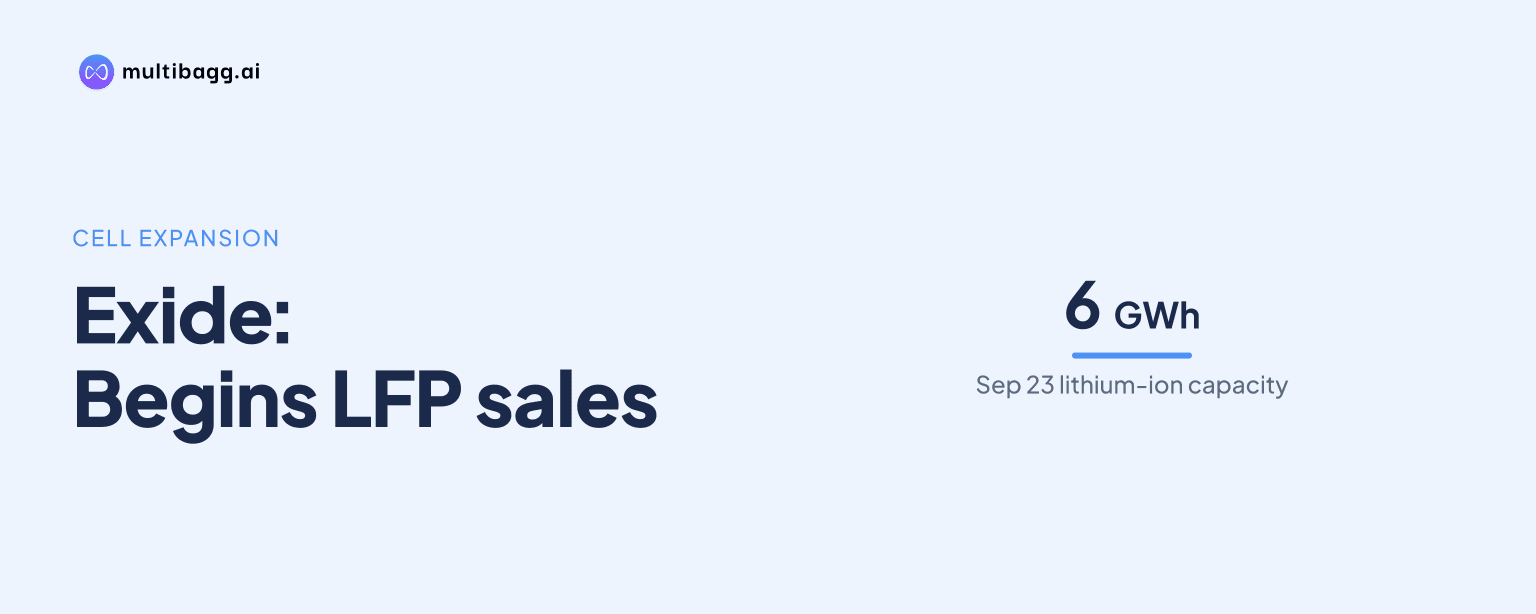
Exide began revenue-generating sales of lithium iron phosphate (LFP) cells in October after commissioning 6 gigawatt-hours (GWh) of lithium-ion capacity in Bengaluru on 23 September, while management said it hoped major original equipment manufacturer (OEM) nickel manganese cobalt (NMC) releases would begin in the fourth quarter or around February.
Know Exide Industries inside out
Results, valuation, peers and who's buying, in one view.
When did Exide begin lithium-ion cell sales?
Exide began commercial LFP cell sales in October, after the second quarter, because management said LFP had a shorter customer-validation cycle than NMC chemistry. Its 102 ampere-hour (Ah) LFP cells were supplied to telecom operators for validation and were also used in Exide-made e-rickshaw battery packs that had been delivered to the market.
The initial revenue therefore comes from LFP applications rather than from high-volume NMC supply to leading two-wheeler OEMs. Exide said the e-rickshaw packs using its 102 Ah LFP cells were operating in the market and had generated positive performance feedback, while telecom validations were still progressing.
Exide also said some smaller customers had placed firm NMC orders, and management indicated that small quantities could start from the following month. It did not disclose customer names or the order-book value, citing non-disclosure agreements, and did not quantify October LFP revenue.
When could Exide receive major NMC OEM approvals?
Exide expects major NMC OEM releases from the start of the fourth quarter or around February, but management described this as a hope rather than a confirmed customer approval date. It added that it expected the releases to occur within the financial year, while smaller-customer NMC volumes could begin earlier in limited quantities.
The qualification sequence for leading two-wheeler OEMs has moved beyond performance tests but is not complete. Exide said NMC performance testing had been satisfactory and customers had given positive feedback; the cells are now in lifecycle testing, to be followed by pack-level and vehicle-level testing.
Exide has also started supplying two-wheeler samples to additional OEMs beyond the leading group. Management described structured customer engagement across research and development, operations and procurement, including frequent factory audits, but did not identify any OEM or report a final production nomination.
How much lithium-ion capacity has Exide commissioned?
Exide commissioned 6 GWh of lithium-ion cell capacity in Bengaluru on 23 September and said its immediate priorities are stabilising the production lines, improving yields and increasing revenue. Exide Energy Solutions, its wholly owned lithium-ion subsidiary, had received cumulative equity investment of Rs 5,352 crore, including Rs 550 crore in the current financial year.
Within the NMC installation, Exide has commissioned two lines of 1.5 GWh each. Management said it would first utilise the initial 1.5 GWh line and move to the second 1.5 GWh line after reaching that level, without providing a timetable, expected utilisation rate or revenue estimate.
The company linked its capacity to current electric two-wheeler demand. It said electric two-wheeler registrations had risen to about 2 lakh vehicles a month during the latest three months and in quarter two, from roughly 1.2 lakh vehicles a month a year earlier.
Exide estimated that new electric two-wheeler demand at the current run rate represents a 7.5 GWh to 8 GWh cell market. Management said its commissioned capacity was adequate to pursue a share of that market even without assuming a further increase in electric-vehicle penetration.
Got a follow-up? Ask IRIS
What is holding back broader cell commercialisation?
Exide can supply cells for two-wheelers, three-wheelers, certain four-wheeler applications, telecom and battery energy storage systems (BESS), but each segment has a separate validation and release path. Telecom customers have received samples and management expects releases soon, whereas LFP e-rickshaw packs have already reached the market.
For BESS, Exide said internal cell validations had produced positive results and that it has the ability to make the cell. However, management said it would wait for clarity on the production-linked incentive (PLI) scheme before proceeding with BESS cell manufacturing.
The principal capital expenditure for the 6 GWh first phase is largely complete, according to management, but the commercial ramp will require further funding. Exide said working-capital needs would rise as it operates the factory over the next two to three years and builds the organisation needed to increase revenue.
Supply-chain localisation is a further two-to-three-year project rather than an immediate substitute for imported inputs. Exide targets localising 50% to 60% of its bill of materials over that period and is working with more than 20 local suppliers, some at performance-checking stages and others still at material testing.
Management said it has also entered long-term purchase agreements with suppliers and may hold more inventory if import restrictions lengthen delivery lead times. It said localisation decisions will depend on each component's technical criticality, cost contribution and shelf life, rather than on local sourcing alone.
How does the cell ramp fit Exide's wider capital plan?
Exide said its capital allocation has three main elements beyond dividend payout: protecting the core business, factory automation and advanced-chemistry cells. In the core business, management said annual spending has historically been close to depreciation of Rs 400 crore to Rs 500 crore, with current spending also directed toward debottlenecking lead-acid capacity.
That lead-acid investment reflects concurrent growth in OEM and aftermarket demand, according to management. Exide said passenger-vehicle OEM volumes had risen from an average 13 lakh a quarter to 16 lakh a quarter, while it aims to allocate capacity between OEM and aftermarket channels without sacrificing aftermarket volume solely to supply OEMs.
The cell-factory ramp is therefore competing for working capital rather than primarily for first-phase construction expenditure. Exide said its 6 GWh plant must be funded through two to three years of line stabilisation, yield improvement and revenue growth, alongside the Rs 550 crore of equity already invested in Exide Energy Solutions during the current financial year.
Conclusion
Exide has passed its first lithium-ion commercial milestone by starting LFP revenue in October, but its larger NMC automotive opportunity remains in customer qualification. The split is material: 102 Ah LFP cells are in market-deployed e-rickshaw packs and telecom validation, while NMC cells for leading two-wheeler OEMs have completed performance testing and entered lifecycle testing before pack and vehicle tests.
The next disclosed milestone is management's expectation of major NMC OEM releases from the beginning of the fourth quarter or around February, with smaller-customer NMC supply potentially earlier. Other points to watch are telecom releases, PLI clarity for BESS manufacturing, yield improvement at the 6 GWh Bengaluru factory and progress from the first 1.5 GWh NMC line toward the second 1.5 GWh line.