










Exide Q2 revenue reaches Rs 5,026 crore, margin expands
Key highlights
- Exide reported Q2 FY27 standalone revenue of Rs 5,026 crore, up 20.3% year on year.
- Q2 FY27 EBITDA was Rs 606 crore, and EBITDA margin increased to 12.1% from 9.4%.
- Solar grew by more than 40% and automotive OEM business grew by more than 25% in Q2 FY27.
- Exide Energy Solutions commissioned a 6 GWh lithium-ion cell plant in Bengaluru on September 23.
powered by IRIS
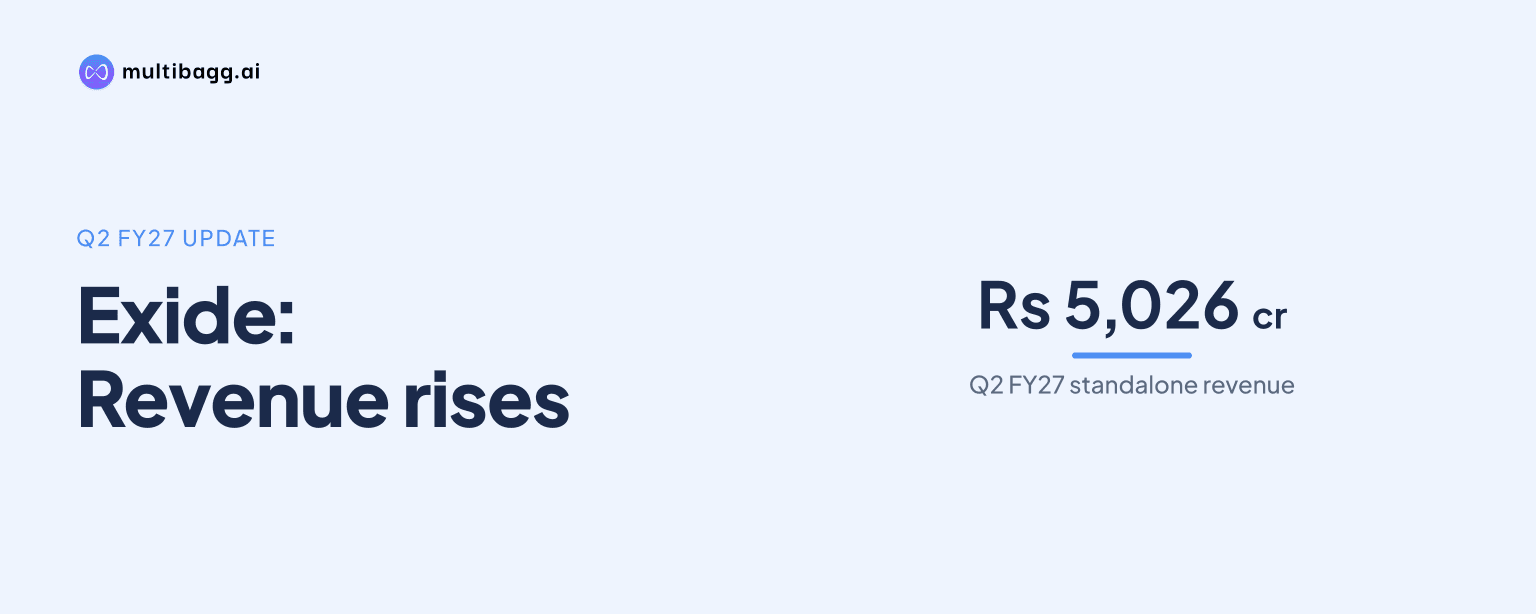
Exide Industries Limited reported Q2 FY27 standalone revenue of Rs 5,026 crore, up 20.3% year on year, while earnings before interest, tax, depreciation and amortisation, or EBITDA, rose 53.6% to Rs 606 crore and its margin increased 270 basis points to 12.1%. Management cited volume growth, calibrated price increases and cost-optimisation measures.
Know Exide Industries inside out
Results, valuation, peers and who's buying, in one view.
How did Exide perform in Q2 FY27?
Exide reported Rs 5,026 crore of standalone revenue in Q2 FY27, crossing Rs 5,000 crore for the quarter and rising 20.3% from the year-earlier period. First-half revenue reached Rs 10,331 crore, up 18.9% year on year, marking the first half in which Exide crossed Rs 10,000 crore of revenue.
EBITDA grew faster than revenue, increasing 53.6% year on year to Rs 606 crore in Q2 FY27. EBITDA margin rose to 12.1% from 9.4% a year earlier, a gain of about 270 basis points, or 2.7 percentage points; first-half margin was 12.2%, up 130 basis points, and first-half pre-tax profit rose 46.5%.
Management said the Q2 FY26 comparison base was unusually low because demand slowed before GST 2.0 implementation. Exide reduced production at that time to improve capital efficiency, creating under-absorption in operations, and management said this low base also contributed to the Q2 FY27 margin increase.
What drove Exide's Q2 FY27 sales growth?
Exide's automotive original equipment manufacturer, or OEM, business grew by more than 25% year on year for a fourth consecutive quarter as vehicle makers increased production and dispatches. Management said Exide gained share in upcoming launches including MG Hector Tomahawk and Tata Aeris, while two-wheeler and four-wheeler replacement sales posted a fourth consecutive quarter of double-digit growth.
Vehicle registrations rose by 1.3 million year on year for two-wheelers in Q2, an increase of 32%, and by 0.3 million for passenger vehicles, an increase of 27%, according to management's reference to Vahan data. Management attributed demand partly to affordability gains from GST rationalisation and said festive buying began after the quarter, while noting that September in the prior year had a soft comparison base.
Home inverter sales increased 20% year on year and solar grew by more than 40% in Q2 FY27, supported by seasonal demand and initiatives including PM Surya Ghar Yojana. Industrial infrastructure, excluding telecom, grew at a high-single-digit rate through industrial uninterruptible power supply and traction motive-power demand, but railway and power-sector government tenders remained muted.
Exports rose by more than 20% year on year for a second consecutive quarter, following a deep decline in the prior year that management attributed to global issues. In September, Exide signed a long-term cooperation agreement with ExCom Energy Solutions GmbH in Germany to expand its industrial battery and energy-storage business across the European Economic Area.
Why did Exide's Q2 FY27 EBITDA margin rise?
Exide's EBITDA margin rose to 12.1% in Q2 FY27 because calibrated price increases, volume growth and cost optimisation helped offset elevated input costs. Management said crude oil prices, geopolitical challenges in West Asia and a weaker rupee kept costs above the prior-year level despite the Rs 606 crore EBITDA result.
Softer London Metal Exchange, or LME, prices for lead and antimony did not fully reduce costs sequentially because of continued rupee depreciation against the US dollar, management said. This meant commodity-price movements did not translate fully into realised input-cost relief during Q2 FY27.
The 12.1% Q2 FY27 margin was slightly below the 12.2% reported for the first half, although both improved year on year. Exide said it remained debt-free and generated operating cash flows, but did not disclose an operating cash-flow amount during the November 5 call.
Got a follow-up? Ask IRIS
What is the status of Exide's lithium-ion cell plant?
Exide Energy Solutions Limited, Exide's wholly owned lithium-ion-cell subsidiary, commissioned a 6 gigawatt-hour, or GWh, lithium-ion cell plant in Bengaluru on September 23. Management said the next steps are to stabilise production lines, improve yields, complete customer qualification and ramp revenue in coming quarters.
For nickel manganese cobalt, or NMC, cells, leading two-wheeler OEMs had completed performance testing and moved to lifecycle testing. Management said pack- and vehicle-level testing would follow, while its 102 ampere-hour lithium iron phosphate, or LFP, cells were under telecom validation and were being used in Exide e-rickshaw battery packs.
Electric two-wheelers accounted for 11.6% of two-wheeler retail in September, a market development management described as relevant to Exide's lithium-ion business. Management also said electric two-wheeler registrations were about 0.2 million vehicles per month in Q2, compared with roughly 0.12 million per month last year.
How is Exide funding core and new-energy expansion?
Exide's cumulative equity investment in Exide Energy Solutions stood at Rs 5,352 crore as of the call, including Rs 550 crore during the current financial year. Management said most capital expenditure for the initial 6 GWh phase was complete, but working-capital needs and organisation-building would continue for the next two to three years during the revenue ramp.
In the lead-acid business, Exide said annual investment is close to depreciation of Rs 400 crore to Rs 500 crore. Management is using brownfield expansion, factory debottlenecking and automation to serve concurrent OEM and replacement demand, and said it was discussing additional conventional-engine battery capacity with OEMs planning their own expansions.
For battery energy storage system cells, management said internal validations were positive and Exide could make the product. However, it said manufacturing would await clarity on the production-linked incentive scheme, under which Exide intends to apply, rather than giving a timetable for battery energy storage system cell production.
Conclusion
Exide's Q2 FY27 result combined 20.3% standalone revenue growth with a 270-basis-point EBITDA-margin increase, led by automotive OEM, replacement, solar and export demand. Price actions and cost measures supported profitability, but management also identified the low Q2 FY26 base, elevated input costs and rupee depreciation as important factors in the comparison.
The next disclosed markers are yield stabilisation and customer approvals at the 6 GWh Bengaluru plant, plus working-capital funding as lithium-ion revenue ramps over the next two to three years. Management also plans further lead-acid debottlenecking and will wait for production-linked incentive scheme clarity before proceeding with battery energy storage system cell manufacturing.