










Finkurve targets 30%-35% off-book AUM within three years
Key highlights
- Finkurve targets off-book AUM of 30%-35% of its overall book within about three years.
- Finkurve’s co-lending share rose to almost 5.8% in Q2 FY27 from around 1%-2% previously.
- Finkurve has a new partner due to go live in Q3 FY27 and an older partnership planned for revival in Q4 FY27.
- Finkurve reported 28.7% capital adequacy and about 95% year-on-year AUM growth in Q2 FY27.
powered by IRIS
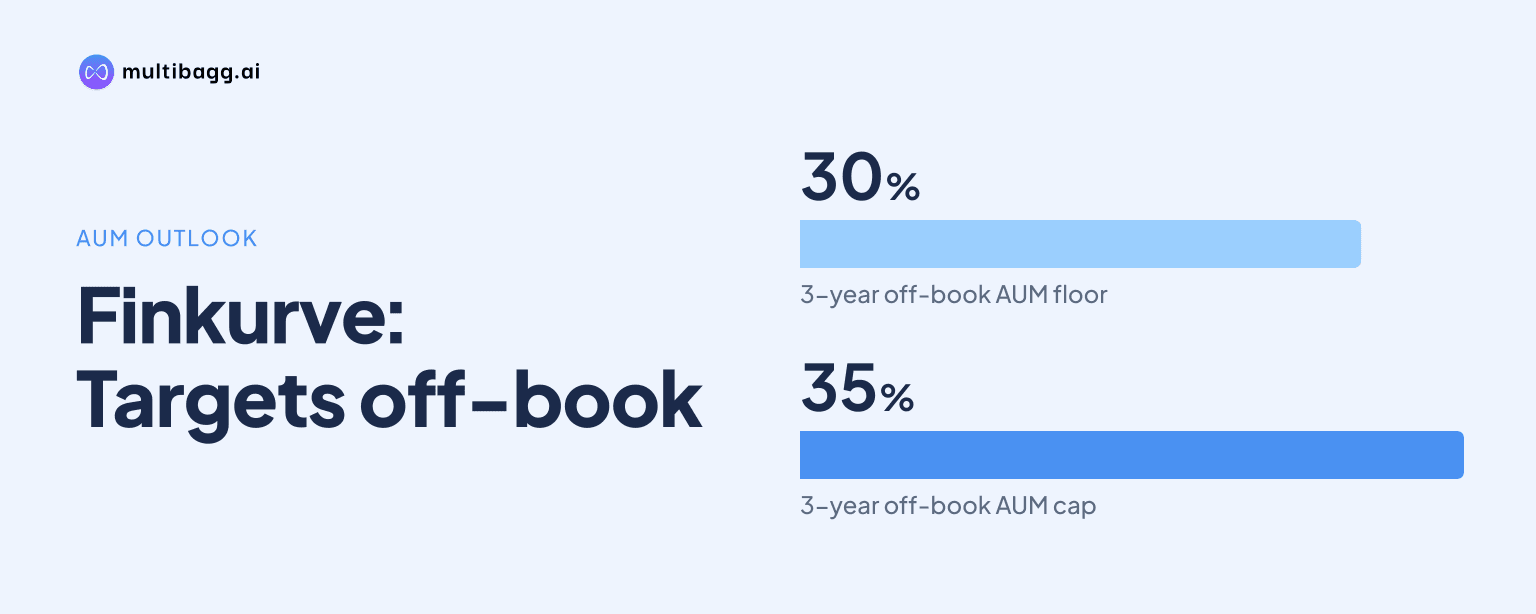
Finkurve Financial Services Limited is targeting off-book assets under management, or AUM, of 30% to 35% of its overall book within about three years, after its co-lending share rose to almost 5.8% in Q2 FY27 from around 1% to 2% previously. Management plans a new partner launch in Q3 FY27 and an older-partner revival in Q4 FY27.
Know Finkurve Financial Services inside out
Results, valuation, peers and who's buying, in one view.
Why is Finkurve targeting 30%-35% off-book AUM?
Finkurve is targeting off-book AUM of roughly one-third of its overall book, or 30% to 35%, in the next three years or so. Chief Financial Officer Aakash Jain said the company had begun this journey and was on track, but Finkurve did not disclose either the current off-book AUM amount or the total AUM underlying the target.
Management described co-lending as an efficient way to manage Tier 1 capital, while Finkurve reported capital adequacy of 28.7% in Q2 FY27 and AUM growth of about 95% year on year. Co-lending allows part of loan funding to be provided through partners, supporting portfolio expansion without all lending remaining on Finkurve’s balance sheet.
How far has Finkurve progressed with co-lending?
Finkurve’s co-lending share had increased to almost 5.8% in Q2 FY27 from around 1% to 2% earlier, according to management. This increase shows that the partnership model was contributing to lending activity, although Finkurve did not provide a reconciliation between this co-lending-share measure and its 30% to 35% off-book AUM target.
Finkurve already has two co-lending partners, and management said one partnership fueled Q2 FY27 growth. It has signed one additional partner expected to go live in Q3 FY27 and plans to revive an older partner in Q4 FY27, while discussions with further potential partners continue at multiple places.
How will Finkurve choose additional co-lending partners?
Finkurve is seeking partners that can help it achieve a better cost of funds as well as add co-lending capacity. Management said it was likely to onboard a few more partners by the end of FY27, but did not identify them or disclose committed loan capacity, expected disbursements or their expected contribution to off-book AUM.
The company’s partnership-led personal-loan portfolio averaged about Rs 45 crore to Rs 50 crore quarter on quarter. Management said incremental income in that business is passed to partners as fees and commission, whereas the yield on the gold-loan portfolio is what affects Finkurve’s profitability.
How does co-lending fit Finkurve’s funding strategy?
Finkurve is using co-lending alongside bank borrowing to diversify its funding sources. In Q2 FY27, management said it raised no fresh non-convertible debentures, or NCDs, because borrowings raised earlier had already been committed by Q1 FY27; it also said the company had received sufficient bank sanctions to draw when required.
Management has internally capped NCD borrowings at 40% to 45% of overall borrowings. Jain said fixed-cost NCDs were sometimes on par with, or cheaper than, institutional borrowing because institutional rates were increasing with repo-linked rates, while the Q3 FY27 and Q4 FY27 partnership actions are intended to add another funding channel.
Got a follow-up? Ask IRIS
What operating trends accompany Finkurve’s off-book plan?
Finkurve reported about 95% year-on-year AUM growth in Q2 FY27, operational-profitability growth of 62% and total-income growth of almost 88%. Gold-loan yield increased to 20.8% from 20%, while the co-lending share rose to almost 5.8%, linking higher portfolio yield and expanding partnerships during the quarter.
Quarterly AUM growth was around 3% in Q2 FY27, compared with about 16% in Q1 FY27 and more than 30% in Q4. Management attributed the moderation to the revised regulatory framework, a correction in gold prices and competition, while retaining its guidance for 50% to 60% AUM growth.
What could affect Finkurve’s three-year off-book target?
Finkurve’s path to 30% to 35% off-book AUM depends on the Q3 FY27 partner launch, the Q4 FY27 revival and further additions expected by the end of FY27. The call did not disclose the partners’ names, underwriting terms, cost of funds or individual capacity, leaving the pace of off-book AUM growth to be demonstrated in later results.
Collection efficiency declined to around 90% in Q2 FY27 from about 98% in the preceding quarter, and management linked the decline to higher delinquencies and non-performing assets. Management said customers were adjusting to revised repayment structures, while maintaining that gold collateral and customer equity provided recovery margin and that auction remained a last resort.
Conclusion
Finkurve is building co-lending into a broader capital and funding strategy, with a stated aim of placing 30% to 35% of its overall book off balance sheet within about three years. The co-lending share’s rise from around 1% to 2% to almost 5.8% in Q2 FY27 indicates early progress, alongside 95% year-on-year AUM growth and 28.7% capital adequacy.
The next disclosed milestones are the new partner going live in Q3 FY27, the older-partner revival in Q4 FY27 and management’s expectation of a few further onboardings by the end of FY27. Subsequent disclosures on off-book AUM, partner capacity, bank borrowing drawdowns and collection efficiency after its decline from about 98% to 90% will indicate how the plan is developing.