










Finkurve shifts gold underwriting to cash-flow assessment
Key highlights
- Finkurve said it currently keeps LTV at or below 85%, despite management citing potential lending up to 125% under cash-flow assessment.
- Finkurve said cash-flow-based lending is currently a very small portion of the business and requires branch-level training and system changes.
- For loans above Rs 2.5 lakh, Finkurve has started seeking business registration and income documents.
- Management reiterated 50% to 60% AUM growth guidance and said customer retention at maturity is above 60%.
powered by IRIS
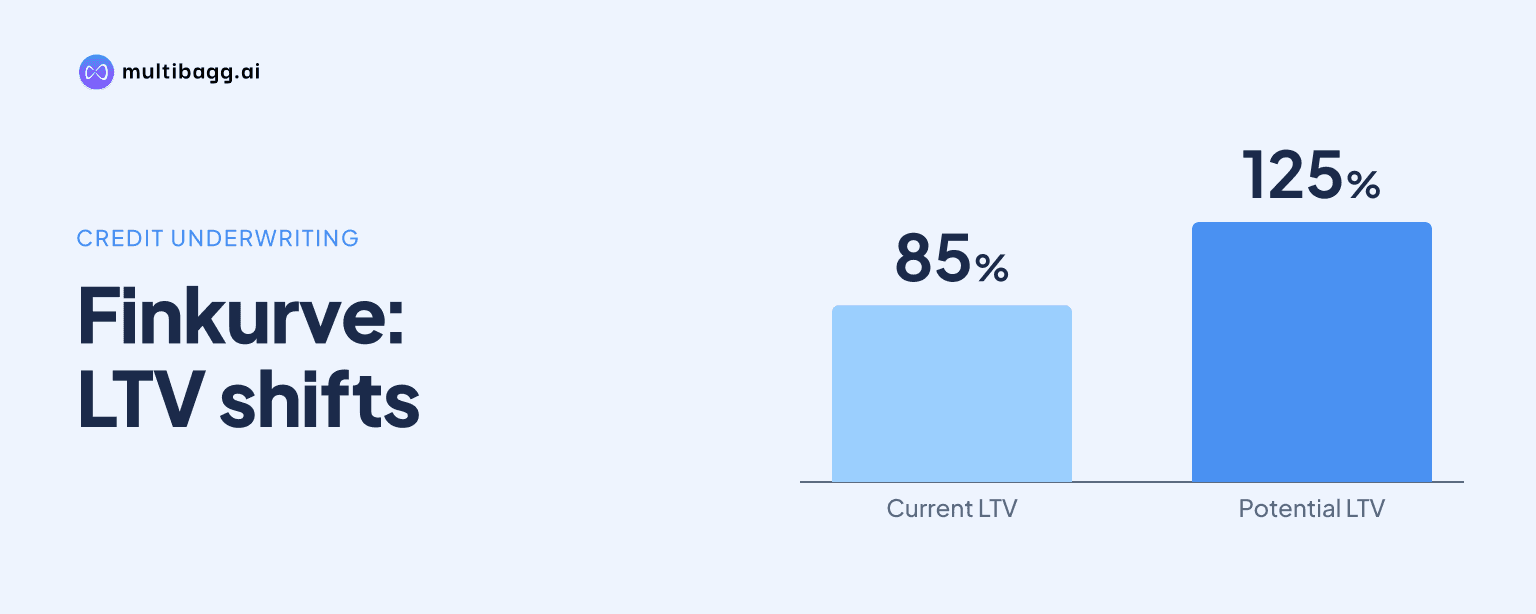
Following the April 2026 gold-loan directions cited on its call, Finkurve Financial Services Limited said it is training branches for cash-flow-based underwriting but currently caps lending at 85% loan-to-value (LTV), while management expects the model could increase yields, defaults and credit costs.
Know Finkurve Financial Services inside out
Results, valuation, peers and who's buying, in one view.
What is changing in Finkurve's gold-loan underwriting?
Finkurve is moving toward assessing a borrower's future cash flows and loan purpose rather than relying only on pledged gold. Management said the historical model treated gold loans largely as consumption loans with no credit assessment, whereas the evolving framework treats gold as collateral for a purpose-driven loan and requires an assessment of repayment ability.
The distinction changes the role of LTV, which measures the loan amount against collateral value. Management said Reserve Bank of India rules allow up to 85% LTV for consumption loans, while income-generating loans with properly assessed borrower income do not have the same stated ceiling. Management said lending up to 125% LTV could be possible when gold collateral and customer cash flows are both considered.
Finkurve said its reported LTV includes accrued interest, unlike disclosures by some non-banking financial companies (NBFCs) that may report LTV without accrued interest. Management attributed the increase in its LTV partly to this reporting method, the 85% consumption-loan allowance and a correction in gold prices. It said Finkurve has a small share of income-generating loans but does not currently lend above 85% LTV.
How prepared is Finkurve for cash-flow lending?
Finkurve is not yet fully equipped across its branch network to conduct cash-flow underwriting. Management said most gold-loan staff are not qualified or trained to assess borrowers' cash flows, although a limited number of branches have employees who joined from other NBFCs and can perform such assessments.
The company has started training employees for the new method, but management said the broader gold-loan market is not ready for it and that the transition will take time. It described the current cash-flow-based share as very small, indicating that conventional lending against gold remains the dominant operating model while training and system work continue.
For loans above Rs 2.5 lakh, Finkurve said it has started collecting business registration proofs, income documents and other information to assess both the customer's capacity and intent to repay. Management did not quantify changes in turnaround times or disbursement volumes after the April 2026 directions raised by an analyst, but the added documentation illustrates the operating change for larger loans.
Finkurve also said modifications to its systems are in process. That work is relevant because a branch-level cash-flow decision requires information capture and credit processes beyond collateral appraisal. Management's comments point to a phased transition rather than an immediate conversion of the whole book to income-assessed lending.
Got a follow-up? Ask IRIS
Could cash-flow underwriting change Finkurve's yields and credit costs?
Finkurve said cash-flow-based lending could lift yields, but management also said it could increase risk, defaults and credit costs. The company framed the new model as more of a secured loan than a traditional gold loan because repayment depends increasingly on assessed cash flows as well as the value of the pledged metal.
Management said gold-loan loss possibilities have historically been minimal, but it explicitly linked higher LTV and cash-flow-based lending to the potential for a higher credit rate and higher credit cost. It said the added risk would need to be reflected in pricing. This differs from a model where gold collateral and margins have been central to recovery protection.
Finkurve said it still sees substantial margin and cushion at its current LTV and does not see incremental risk from its present level. That assessment applies to its existing practice of remaining at or below 85% LTV, not to a future portfolio with greater exposure to cash-flow underwriting or higher lending against assessed income.
Finkurve's recent operating context also shows why underwriting discipline is relevant. Management said collection efficiency declined to around 90% from about 98% in the preceding quarter, and linked the decline to higher delinquencies and a higher non-performing asset (NPA) level. It said auctions remain a last resort, with reminders and customer discussions normally used before collateral is sold.
What revenue opportunity does Finkurve see from cash-flow loans?
Finkurve sees a potential new revenue stream from classifying qualifying cash-flow loans as priority-sector, small and medium enterprise, micro or agriculture loans. Management said those portfolios could then be sold to banks, creating an outlet that conventional consumption gold loans may not provide.
Management also said this model could offer cheaper funding and more efficient use of Tier 1 capital, although it did not provide a target for loan sales, yields or the cash-flow-based share of the portfolio. The opportunity therefore depends on completing staff training, system changes and the required lending assessments before loans can be structured and classified in the manner management described.
The strategic shift comes while Finkurve continues to pursue scale in its core franchise. Management reiterated guidance for 50% to 60% assets under management (AUM) growth and said it had not seen concerns about reaching that range. It characterized the quarter's moderation in AUM growth as an industry transition influenced by the revised regulatory framework, gold-price corrections and competition.
Management is also intentionally reducing average ticket sizes, saying smaller loans can support portfolio health and that the new slab-wise LTV structures influence product design. Customer retention at maturity was stated to be above 60%, while management estimated renewals at roughly 10% to 15% after gold prices corrected, compared with historical renewal levels above 60% to 65% when prices were high.
Conclusion
Finkurve is preparing for a material change in how some gold loans are evaluated: cash flow and purpose may become more important than LTV alone. Management sees scope for higher yields and bank portfolio sales, but it also acknowledges that the model can bring higher defaults and credit costs than a predominantly collateral-led approach.
The next issue to watch is execution of the disclosed training and system-modification plan, especially documentation for loans above Rs 2.5 lakh and the eventual scale of cash-flow-based originations. Management has retained an 85% LTV ceiling for now, so any movement beyond that level, or quantification of priority-sector portfolio sales, would indicate how quickly the strategy is moving from training to deployment.