










Finkurve retains FY27 AUM target after Q2 growth moderates
Key highlights
- Finkurve retained FY27 AUM growth guidance of 50%-60% after Q2 growth of about 3% quarter on quarter.
- Finkurve said gold-loan yield increased to 20.8% from 20%, helping revenue rise by about 20% quarter on quarter.
- Finkurve targets off-book AUM of roughly 30%-35% of the overall book over the next three years.
- Finkurve said collection efficiency declined to around 90% from about 98% in the prior quarter.
powered by IRIS
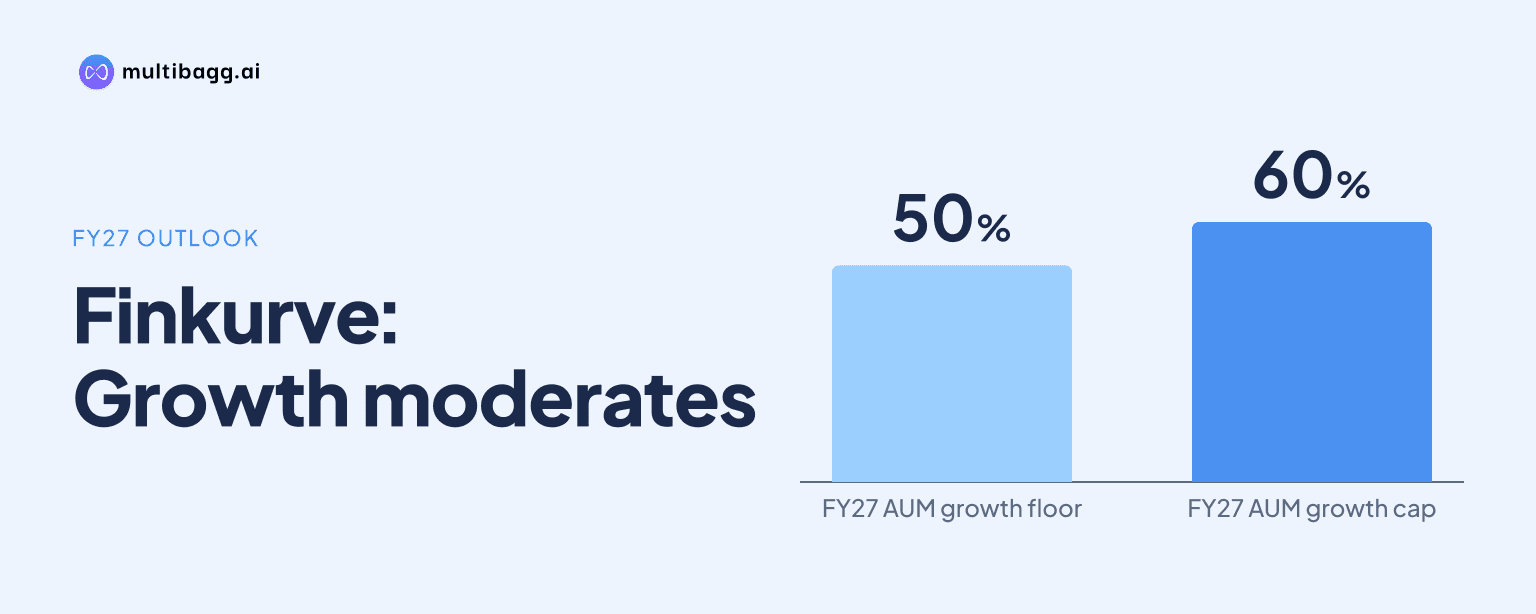
Finkurve retained its FY27 assets under management (AUM) growth guidance of 50%-60% after growth moderated to about 3% quarter on quarter in Q2, versus about 16% in Q1. Management attributed the change to revised regulatory requirements, a sharp correction in gold prices and competitive intensity, while saying it saw no current obstacle to meeting the target.
Know Finkurve Financial Services inside out
Results, valuation, peers and who's buying, in one view.
Why did Finkurve's Q2 AUM growth moderate?
Finkurve said Q2 AUM growth moderated because the gold-loan sector is adapting to a revised regulatory framework, gold prices corrected sharply and competition remained a factor. An analyst described Q2 growth at about 3% quarter on quarter, compared with about 16% in Q1 and more than 30% in Q4. Management called the quarter an industry transition rather than a structural slowdown, citing growth of close to 100% over the preceding year.
Management linked the gold-price correction to borrowers delaying loan requirements. It said that a customer seeking Rs 10,000 may realise only Rs 7,000 against the same gold after prices decline, and may consequently defer borrowing for a quarter until prices stabilise. This explanation concerns the loan value available against collateral, not a stated long-term change in customer demand.
Finkurve also identified competition as part of the Q2 outcome. Management said it focuses on customers in Tier 2 and Tier 3 cities who have little or no access to formal banking channels or large non-banking financial companies (NBFCs). It said competitiveness depends on pricing, turnaround time and loan schemes, rather than pricing alone.
What is Finkurve's FY27 AUM growth target?
Finkurve's FY27 AUM growth target remains 50%-60%, and management said it did not currently see concerns in reaching that range. Management said it would provide updated guidance in later quarters if conditions required a revision. The target is management guidance rather than a reported result and follows the Q2 growth rate of about 3% cited on the call.
Finkurve plans to expand its off-book portfolio through co-lending. Management's medium-term target is for off-book AUM to reach roughly 30%-35% of the overall book, or about one-third, over the next three years. Finkurve had two partners, had signed another expected to go live in Q3, and was reviving an older partner expected to go live in Q4.
Management said one partnership contributed to Q2 growth and that further co-lending activity could affect Q3 and Q4. It also said discussions with multiple potential partners were under way and that it was likely to onboard a few more by the end of the financial year. The stated objectives are diversifying funding sources and securing better funding costs.
Is Finkurve deliberately reducing average loan ticket sizes?
Finkurve said it is consciously reducing average loan ticket sizes and expects them to decline further in coming quarters. An analyst cited about 1,500 customer additions during the quarter alongside the decline in ticket size. Management said lower average tickets are preferable for portfolio health, while also saying product schemes under new loan-to-value (LTV) structures have influenced the change.
Management did not quantify how much of the ticket-size reduction came from the slab-wise LTV restrictions and said it would share that data after the call. It therefore described the shift as a mixture of internal design and regulatory changes. This leaves the precise contribution from each driver unresolved.
Finkurve said it does not currently exceed 85% LTV, including for income-generating loans, even though management said such loans do not face an LTV ceiling when borrower income is assessed. Its reported LTV includes accrued interest, which management said can create differences from NBFCs reporting LTV without accrued interest. For consumption loans, management said the framework permits up to 85% LTV.
For loans above Rs 2.5 lakh, Finkurve said it has started collecting business-registration proofs, income documents and other information to assess repayment ability and intent. Management said staff training and system modifications for cash-flow-based lending are in progress, but described the existing cash-flow-based portion as very small. It also said this lending could involve higher default ratios and credit costs, requiring appropriate pricing.
Got a follow-up? Ask IRIS
Why did Finkurve's revenue rise faster than AUM in Q2?
Finkurve said revenue increased by about 20% quarter on quarter despite AUM growth of about 3%, because gold-loan yield rose to 20.8% from 20% and co-lending's share rose to almost 5.8% from 1%-2%. Management said there was no one-off income. The personal-loan portfolio stayed broadly steady at Rs 45 crore to Rs 50 crore quarter on quarter and carried relatively higher yields, according to management.
Management said its intended portfolio mix is 90% secured lending, currently gold loans, and 10% personal loans. The personal-loan share may increase in later quarters, but management described it as a partnership-led business in which incremental income is passed to partners through fees and commission. It said gold-loan yield, rather than this incremental partner income, directly affects Finkurve's profitability.
Finkurve reported customer retention of more than 60% at loan maturity. Management estimated that renewals, which historically exceeded 60%-65% when gold prices were high, should be around 10%-15% after the price correction. It said it would provide the precise renewals figure after the call.
How is Finkurve changing funding and collections?
Finkurve said it raised no fresh non-convertible debentures (NCDs) in Q2 because the issuance it had raised was already committed by Q1. Management said it has internally capped NCDs at no more than 40%-45% of total borrowings and had received sufficient bank sanctions to draw when business needs require. It said fixed-cost NCDs were then on par with, and at times cheaper than, institutional funding linked to repo rates.
Collection efficiency declined to around 90% from about 98% in the prior quarter, and management linked that decline to higher delinquencies and reported non-performing assets (NPAs). It said revised monthly, bimonthly and quarterly repayment structures made it harder for customers accustomed to bullet repayments to regularise accounts. Management described auctions as a last resort, saying reminders and customer engagement are its usual resolution approach.
Conclusion
Finkurve's unchanged 50%-60% FY27 AUM growth target sits alongside a clear Q2 moderation from about 16% growth in Q1 to about 3%. Management attributes that change to revised requirements, lower gold prices and competition, while its smaller-ticket strategy and additional documentation for loans above Rs 2.5 lakh show that lending practices are also being adjusted.
The next markers are the planned Q3 launch of a signed co-lending partner, the Q4 revival of an older partnership and the possible addition of more partners by the end of the financial year. Management also needs to provide the promised split of the ticket-size effect from slab-wise LTV rules and the precise renewals figure, while staff training for cash-flow-based lending continues.