










Finkurve says repayment shift lifted Q2 delinquencies
Key highlights
- Finkurve said Q2 collection efficiency declined to about 90% from approximately 98% in the previous quarter.
- An analyst cited Finkurve's Q2 GNPA at around 2.6% and NNPA at 2.4%.
- Finkurve said auction is a last resort and did not quantify expected auction recoveries for the next one or two quarters.
- Finkurve said it currently does not go beyond 85% loan-to-value, including for its small income-generating-loan share.
powered by IRIS
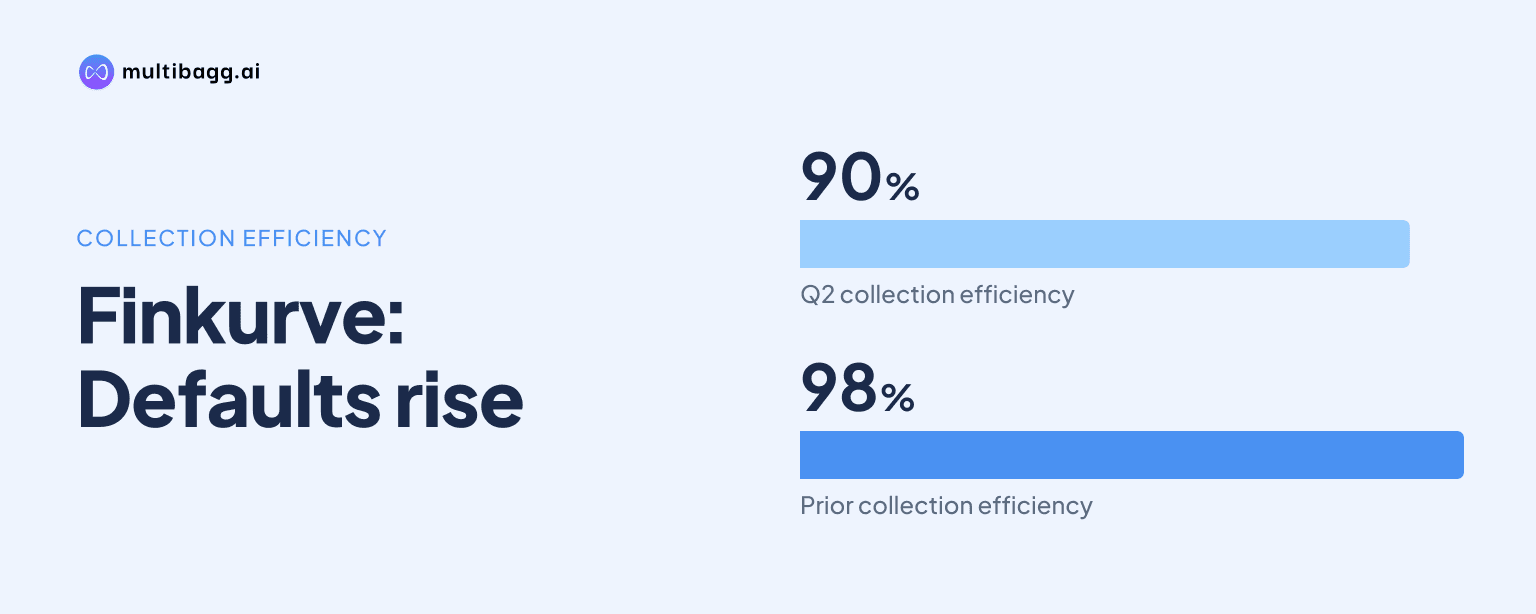
Finkurve said Q2 collection efficiency fell to about 90% from approximately 98% in the previous quarter as borrowers adjusted from bullet repayments to monthly, bimonthly and quarterly schedules, contributing to higher delinquencies. Management said gross non-performing assets of around 2.6% remained supported by pledged-gold margins and that auctions were a last-resort recovery method.
Know Finkurve Financial Services inside out
Results, valuation, peers and who's buying, in one view.
Why did Finkurve's delinquencies increase in Q2?
Finkurve attributed the increase primarily to changes in the regulatory repayment framework for gold loans. Management said customers had traditionally preferred bullet repayment structures aligned with their cash flows, but were now moving to monthly, bimonthly and quarterly payment schedules. It said the transition had made it more difficult for some borrowers to regularise accounts on the revised timetable, lifting reported non-performing assets.
Finkurve distinguished this development from unsecured-credit stress because its gold loans are backed by pledged collateral. Management said borrowers retain significant equity in their gold and Finkurve has margin available for recovery, reducing the incentive to abandon repayment. It also said most accounts classified as non-performing had already been cleared and regularised, although it did not provide a count or value of those accounts.
How did Finkurve's collection efficiency and NPA metrics change?
Finkurve said collection efficiency declined to about 90% in Q2 from approximately 98% in the prior quarter, and its chief financial officer directly linked that deterioration to higher delinquencies and the resulting increase in non-performing assets. An analyst described gross non-performing assets, or GNPA, as around 2.6% during the quarter and net non-performing assets, or NNPA, as 2.4%.
Finkurve characterised GNPA as a technical classification in its collateralised lending model rather than a direct measure of credit cost. That is management's view, rather than a disclosed loss figure: the call did not report auction realisations, provisions, write-offs or the value of accounts that returned to regular status. The 8-percentage-point collection-efficiency change is the clearest period-on-period operating indicator disclosed in the discussion.
Why does Finkurve say gold-loan NPAs do not automatically create credit losses?
Finkurve said a higher NPA ratio in gold lending does not automatically translate into a higher credit loss because pledged gold provides security and customers have equity in it. Management said the company also holds sufficient margin for recovery, whether an account is resolved through customer repayment or, if required, through sale of collateral. It did not disclose a portfolio-wide recovery rate or a loss-given-default ratio.
Finkurve's loan-to-value, or LTV, approach is part of that explanation. Management said Finkurve reports LTV including accrued interest, which can make its disclosed number differ from lenders reporting LTV without accrued interest. It said the Reserve Bank of India framework permits up to 85% LTV for consumption loans, while income-generating loans can have different treatment after cash-flow assessment; Finkurve said it does not currently go beyond 85% even for its small income-generating-loan share.
Got a follow-up? Ask IRIS
Will Finkurve use gold auctions to resolve stressed accounts?
Finkurve said auctions are its last resort, not its primary mechanism for resolving NPAs. Its stated process is to send repayment reminders, speak with customers and assess their intent before pursuing an auction. Management said historically all NPA accounts had been regularised, although the call did not provide a historical period, account count or amount underlying that statement.
This approach reflects Finkurve's assertion that borrowers have both equity in their pledged gold and an incentive to recover it. The chief financial officer said there remains sufficient margin for recovery through either resolution or auction, while also linking the 90% collection efficiency to the higher delinquency figure. Finkurve did not provide an estimate of how much stressed exposure would be auctioned in the next one or two quarters.
What could affect Finkurve's asset quality after Q2?
Finkurve is adapting to a wider operational transition in gold loans, including periodic repayment structures and more purpose-driven lending. Management said that when lending is based on assessed future cash flows rather than solely gold collateral, yields, risks and default ratios can rise. It added that staff training for cash-flow assessment had begun, while only a limited number of branches had personnel with relevant experience from other non-bank financial companies.
Gold-price movements are another disclosed consideration. Management said a sharp correction in gold prices can cause customers to defer borrowing because the value they can realise against the same collateral falls, citing an illustrative requirement of Rs 10,000 that may yield only Rs 7,000 after prices decline. Finkurve also said its conservative lending, continuous collateral monitoring and risk-management processes meant recent gold-price volatility had not materially affected portfolio quality.
Conclusion
Finkurve's explanation for the Q2 asset-quality movement is operational rather than a declared collateral-loss event: collection efficiency moved from approximately 98% to about 90% as customers adjusted from bullet repayment to periodic schedules, and management linked that decline to higher delinquencies. Its position rests on pledged-gold collateral, borrower equity and lending margins, while its preferred remedy remains regularisation through engagement rather than auction.
The next issue to watch is whether collections improve as the new repayment structures become established, particularly because Finkurve did not disclose an auction forecast, recovery amount or credit-cost figure. Management also plans to train staff for cash-flow assessment and said it currently stays at or below 85% LTV, despite regulatory scope for different treatment of income-generating loans. Those developments will determine whether the classification effect remains separate from realised losses.