










FirstCry to add 50-60 FY27 stores after expansion pause
Key highlights
- FirstCry plans around 50 to 60 store openings in the remainder of FY27.
- Management targets roughly 90 to 100 FirstCry store additions annually for the next two to three years.
- FirstCry said offline represented 22% of GMV, with franchisee and company-owned formats split 50-50.
- Rocketbees shipments doubled from 125 thousand to 250 thousand in three months.
powered by IRIS
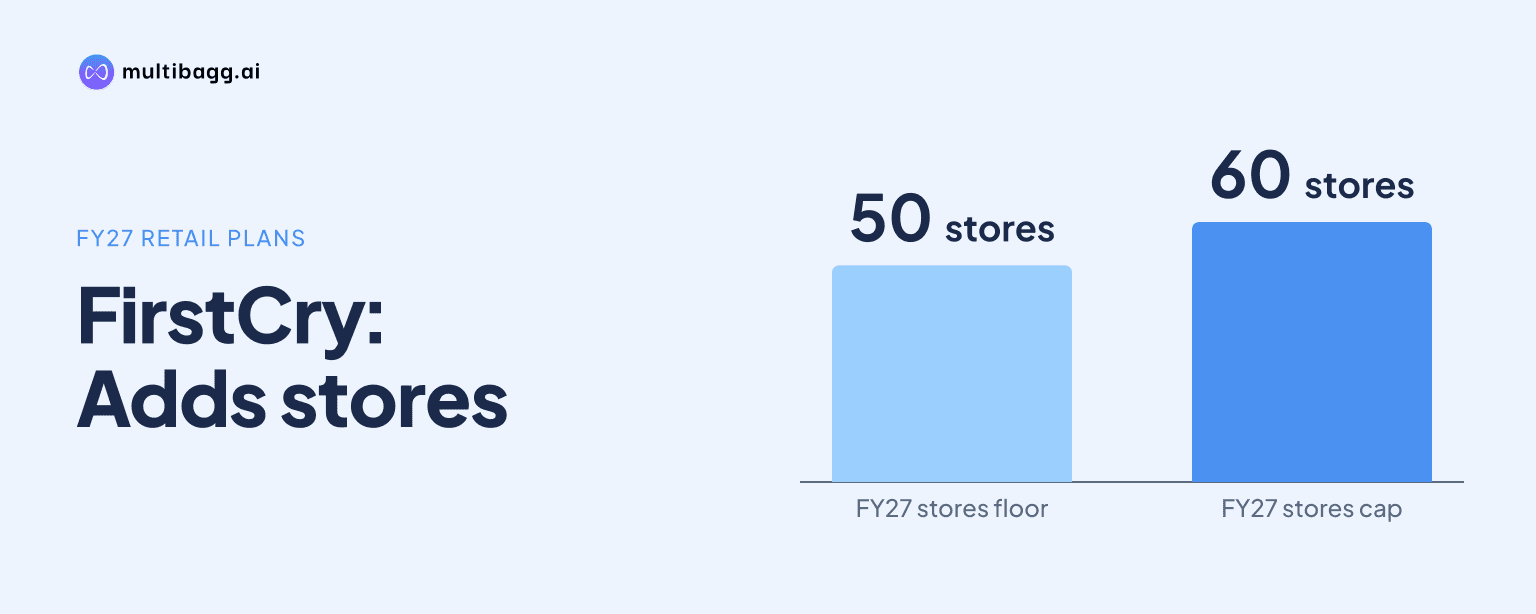
FirstCry plans to open about 50 to 60 stores in the remainder of FY27 after pausing company-owned expansion during an assortment strategy change, with management citing significant improvement in gross merchandise value growth, footfall and conversion over the past three quarters. Management also targets 90 to 100 store additions annually for the following two to three years.
Know Brainbees Solutions inside out
Results, valuation, peers and who's buying, in one view.
Why did FirstCry pause store expansion?
FirstCry paused expansion, particularly in company-owned stores, because it was changing its product assortment strategy. Management said the pause covered the three reported quarters from Quarter 4 of the previous year through Quarter 1 and Quarter 2, rather than representing a withdrawal from physical retail. The stated aim was to improve the merchandise proposition before restarting openings.
Management said the evidence supporting the restart was significant improvement in gross merchandise value, or GMV, growth, led by better footfall and conversion. It did not disclose absolute footfall, conversion or store-level sales figures in the call, but said the gains had emerged across the three-quarter period. FirstCry said it had signed many new properties, while noting that restarting expansion takes time.
The pause was concentrated in company-owned stores, while the restart will include a healthy mix of franchisee-owned, franchisee-operated and company-owned, company-operated formats. Management said offline business represented 22% of GMV and was split 50-50 between the two formats. The plan is therefore not solely a company-store rollout.
How many stores will FirstCry open after the pause?
FirstCry expects around 50 to 60 new stores in the remainder of FY27, including franchisee and company-owned locations. Management presented this as the initial reopening programme after the assortment-led pause and said it had signed properties for the expansion. The target covers the remaining part of FY27 rather than a full annual opening cycle.
For the following two to three years, management said FirstCry can target roughly 90 to 100 store additions each year. This is a management target, not reported openings. The proposed annual pace is higher than the 50 to 60 planned for the remainder of FY27 because management said the expansion engine requires time to restart.
FirstCry described its physical network as almost 1,200 stores and used 1,200 stores as the base for assessing the impact of 50 to 60 additional locations. A 50-store programme equals about 4.2% of that base, while 60 stores equal 5.0%. The target of 90 to 100 additions would equal about 7.5% to 8.3% of the stated base before any closures or further openings.
What capital and working-capital impact does FirstCry expect?
FirstCry said capital expenditure is roughly Rs 2,000 to Rs 2,200 per square foot for the stores under discussion. Management said these locations are generally 3,000 to 4,000 square feet each, defining the size range rather than a uniform store format. It did not disclose a total FY27 capital-expenditure budget for the 50 to 60 planned stores.
Management does not expect a material change in working-capital requirements from opening 50 to 60 stores, or from further expansion in the next year. It cited the 1,200-store base, offline business's 22% share of GMV and the 50-50 format split. This was management's assessment, and the call did not quantify inventory, receivables or payables by store format.
The format mix is relevant to the funding approach because franchisee-operated outlets can extend physical coverage without every location being company owned. At the same time, company-owned stores can implement the product assortment strategy that preceded the restart. FirstCry did not disclose how the 50 to 60 FY27 openings would be divided between the two formats.
Got a follow-up? Ask IRIS
How does FirstCry link stores with online and rapid delivery?
FirstCry says its physical stores, regular e-commerce platform and FC Qwik rapid-delivery service form one network for parents. Management said customers can shop through almost 1,200 stores, use FC Qwik for delivery in 60 to 90 minutes or 180 minutes, and buy long-tail products through regular e-commerce. This is FirstCry's stated omnichannel model.
Management said it plans to expand physical-store coverage from Quarter 3 while increasing FC Qwik and regular online serviceability through Rocketbees. It said the three channels can serve different urgency levels and shopping needs, supporting a larger share of customers' spending. FirstCry did not disclose the number of cities or stores covered by FC Qwik in the call.
FirstCry said Rocketbees shipments doubled to 250 thousand from 125 thousand in three months. Management presented that increase as evidence of its focus on delivery performance and unit economics. It also said the store network makes FC Qwik asset-light for FirstCry, without disclosing a separate FC Qwik profitability measure.
Can FirstCry's network withstand rapid-commerce competition?
FirstCry said competitive intensity in diapering moderated from Quarter 2 as larger horizontal quick-commerce operators reduced discounts and focused on unit economics. Management reported an almost 100-basis-point improvement in the India offline and online business in Quarter 2 compared with Quarter 3 of FY26, when it said the pressure began. One basis point is one-hundredth of a percentage point.
Management attributed the improvement to several factors, including discount moderation, rather than to competition alone. It said the India multichannel business has 78% online and 22% offline GMV, more than 7,500 brand partnerships and close to 58% home-brand share. Management believes these features can support margin expansion alongside mid- to late-teen growth over a longer period.
On newer rapid-commerce specialists, management said OZi and Peeko operated in single-city formats, naming NCR for OZi and Bengaluru for Peeko. It argued that a dense model would be difficult to scale across hundreds of cities because FirstCry operates about 2 million stock-keeping units, or SKUs, and fashion accounts for more than 50% of its business. This is management's competitive assessment rather than an independently verified market forecast.
Conclusion
FirstCry's store restart is based on management's reported improvement in GMV growth, footfall and conversions after a three-quarter assortment-led pause. The 50 to 60-store plan for the remainder of FY27 is modest relative to an almost 1,200-store network, while the franchisee and company-owned mix underpins management's expectation of no material working-capital change.
The next evidence point is whether FirstCry delivers 50 to 60 openings in the remainder of FY27 and advances towards its stated target of 90 to 100 additions annually over the next two to three years. Management also identified Quarter 3 and Quarter 4 as periods when improved growth, gross margin and earnings before interest, tax, depreciation and amortisation, or EBITDA, margin should become visible in reported results.