










firstcry.com narrows Q2 loss 75.1% as inventory days hit 105
Key highlights
- FirstCry's Q2 FY27 reported PAT loss narrowed 75.1% year on year to Rs 12.6 crore.
- Q2 FY27 revenue increased 14.1% year on year to Rs 2,395.8 crore.
- Q2 FY27 gross margin fell to 35.1% from 36.7% a year earlier.
- Inventory days rose to 105 in Q2 FY27 from 99 in Q2 FY26.
powered by IRIS
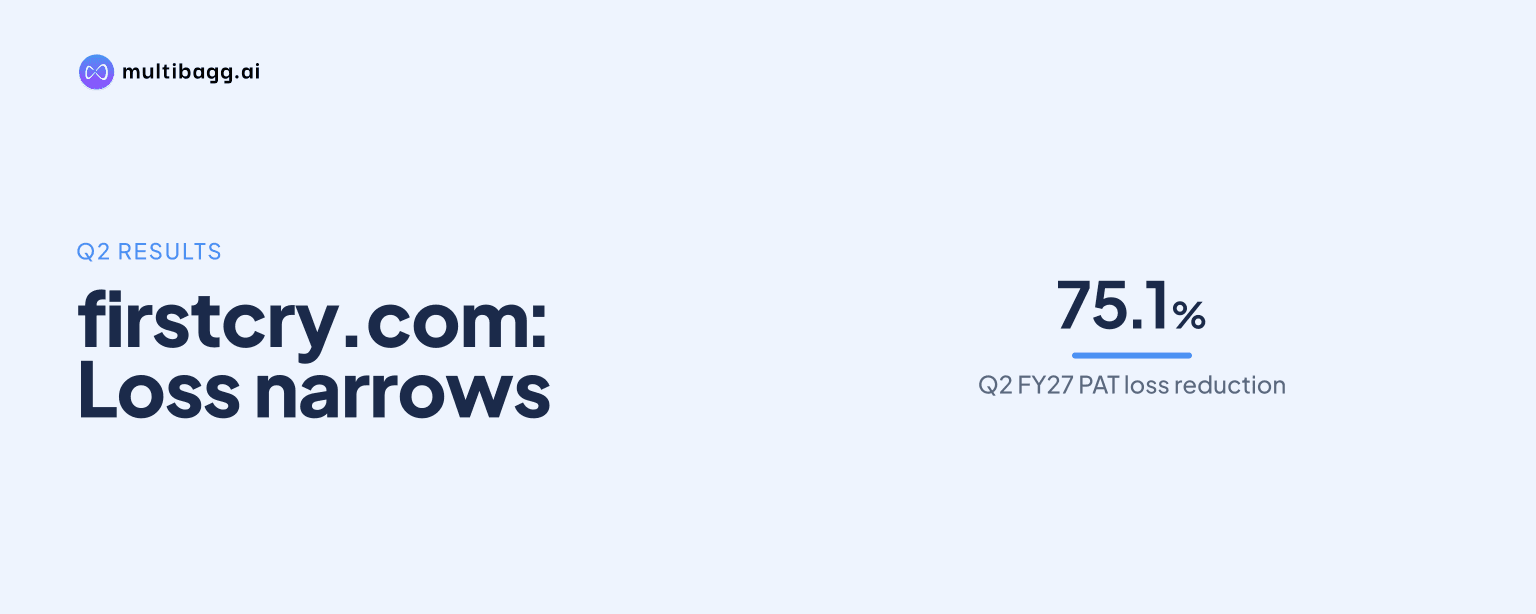
firstcry.com (FirstCry) cut its reported Q2 FY27 loss after tax by 75.1% year on year to Rs 12.6 crore, while inventory days rose to 105 from 99 in Q2 FY26. Revenue increased 14.1% to Rs 2,395.8 crore, but gross margin declined by 160 basis points and adjusted EBITDA margin fell by 90 basis points.
Know Brainbees Solutions inside out
Results, valuation, peers and who's buying, in one view.
Why did FirstCry's Q2 FY27 revenue grow?
FirstCry's Q2 FY27 revenue grew 14.1% year on year to Rs 2,395.8 crore, representing its highest growth rate of the last six quarters shown in the presentation. Revenue was Rs 2,099.1 crore in Q2 FY26 and Rs 2,106.2 crore in Q1 FY27, so the latest quarter was higher both year on year and sequentially.
The revenue gain did not carry through to a higher gross-margin percentage. Q2 FY27 gross margin was 35.1%, compared with 36.7% in Q2 FY26 and 36.5% in Q1 FY27. In absolute terms, gross margin increased to Rs 842 crore from Rs 770.1 crore a year earlier because revenue expanded, but its share of sales declined.
For the first half of FY27, revenue rose 13.6% to Rs 4,502.1 crore from Rs 3,961.6 crore in H1 FY26. FirstCry reported H1 gross margin of Rs 1,611.4 crore, or 35.8% of revenue, versus Rs 1,487.7 crore and 37.6% in the prior-year period. This shows that the margin percentage decline extended beyond one quarter.
How did FirstCry's profitability change in Q2 FY27?
FirstCry's reported profit after tax, or PAT, loss narrowed to Rs 12.6 crore in Q2 FY27 from Rs 50.5 crore in Q2 FY26. The reported PAT margin improved to negative 0.5% from negative 2.4%, and the Q2 FY27 loss was also lower than the Rs 44 crore loss recorded in Q1 FY27.
Adjusted PAT turned positive at Rs 7.7 crore in Q2 FY27, compared with an adjusted loss of Rs 4 crore in Q2 FY26. Adjusted PAT margin was 0.3%, compared with negative 0.2% a year earlier and negative 0.4% in Q1 FY27. The presentation separately reports adjusted and reported figures but does not give a reconciliation on these pages.
Adjusted earnings before interest, tax, depreciation and amortisation, or adjusted EBITDA, declined 2.7% year on year to Rs 117.5 crore despite the revenue increase. Its margin fell to 4.9% from 5.8% in Q2 FY26, although it improved from 4.2% in Q1 FY27. The comparison indicates that sequential profit conversion improved, while the year-on-year margin remained lower.
FirstCry's disclosed cost mix points to lower expense ratios in marketing and indirect costs, alongside stable direct costs. Marketing expense was 7.8% of Q2 FY27 revenue against 8.3% in Q2 FY26, indirect cost was 13.5% against 13.9%, and direct cost was 8.9% against 8.8%. Yet the 160-basis-point decline in gross margin was larger than these operating-cost ratio improvements, leaving adjusted EBITDA margin 90 basis points lower year on year.
Got a follow-up? Ask IRIS
What changed in FirstCry's working capital and inventory?
FirstCry's net working-capital days rose to 61 in Q2 FY27 from 54 in Q1 FY27, reversing the reduction recorded through FY26. The metric had declined from 70 days in Q1 FY26 to 57 days in Q4 FY26 before rising during the first two quarters of FY27.
Inventory days increased more sharply, reaching 105 in Q2 FY27 from 91 in Q1 FY27, 85 in Q4 FY26 and 99 in Q2 FY26. The 20-day increase from Q4 FY26 occurred while Q2 FY27 revenue was Rs 2,395.8 crore, compared with Rs 2,162.7 crore in Q4 FY26.
The presentation calculates working-capital and inventory days by dividing the respective balances by year-to-date revenue and multiplying by the number of days in the year-to-date period. It also says inventory days are affected by the advancement of festivals and sales by third-party, or 3P, platforms. It does not quantify the effect of those events on the 105-day Q2 FY27 reading.
What is FirstCry management planning for FY27?
FirstCry management's FY27 priorities are omni-channel growth, service improvement and profitability, with no numerical revenue or margin target disclosed on the cited page. The plan includes extending RocketBees coverage to improve delivery reliability and expanding FirstCry Qwik for convenience, following Q2 FY27 revenue growth of 14.1%.
For store productivity, management plans to build on assortment changes and resume store expansion. The presentation reported 1,188 modern stores as of September 30, 2026, while 22% of India multi-channel retail gross merchandise value came from offline channels.
In India Multichannel, management intends to recover manufacturing input-cost pressure through pricing pass-through, increase the home-brand mix and optimise discounts. These stated actions are relevant to the Q2 FY27 gross margin of 35.1%, which was below the 36.7% reported a year earlier, but management did not specify timing or the expected margin effect.
Management also plans to reduce international losses through product mix and operating efficiency, while GlobalBees has completed its inventory and warehouse transition. Separately, the preschool network increased to 512 preschools in 218 cities as of September 2026 from 432 preschools in 190 cities a year earlier, with student enrolment rising to 28,785 from 22,742.
Conclusion
FirstCry's Q2 FY27 accounts show a substantial reduction in reported PAT loss, with the loss narrowing to Rs 12.6 crore as revenue reached Rs 2,395.8 crore. However, the comparison also shows lower gross and adjusted EBITDA margins than in Q2 FY26, while inventory days increased to 105 and net working-capital days rose to 61.
What to watch next is management's FY27 execution on pricing pass-through, home-brand mix, discount optimisation, RocketBees coverage, FirstCry Qwik and resumed store expansion. Future results can also show whether the completed GlobalBees inventory and warehouse transition, and management's international efficiency plans, coincide with changes in inventory days, margins and reported losses.