










FirstCry reaches 102 RocketBees cities as Qwik shipments double
Key highlights
- FirstCry RocketBees expanded from 72 cities in Q1 FY27 to 102 cities in Q2 FY27.
- FirstCry Qwik reached about 250,000 September monthly shipments, roughly 2.0 times its June volume.
- FirstCry reported more than 90% on-time delivery and about 20% faster turnaround time for RocketBees.
- FirstCry offline GMV grew 14.0% year on year in H1 FY27, versus 4.8% in H1 FY26.
powered by IRIS
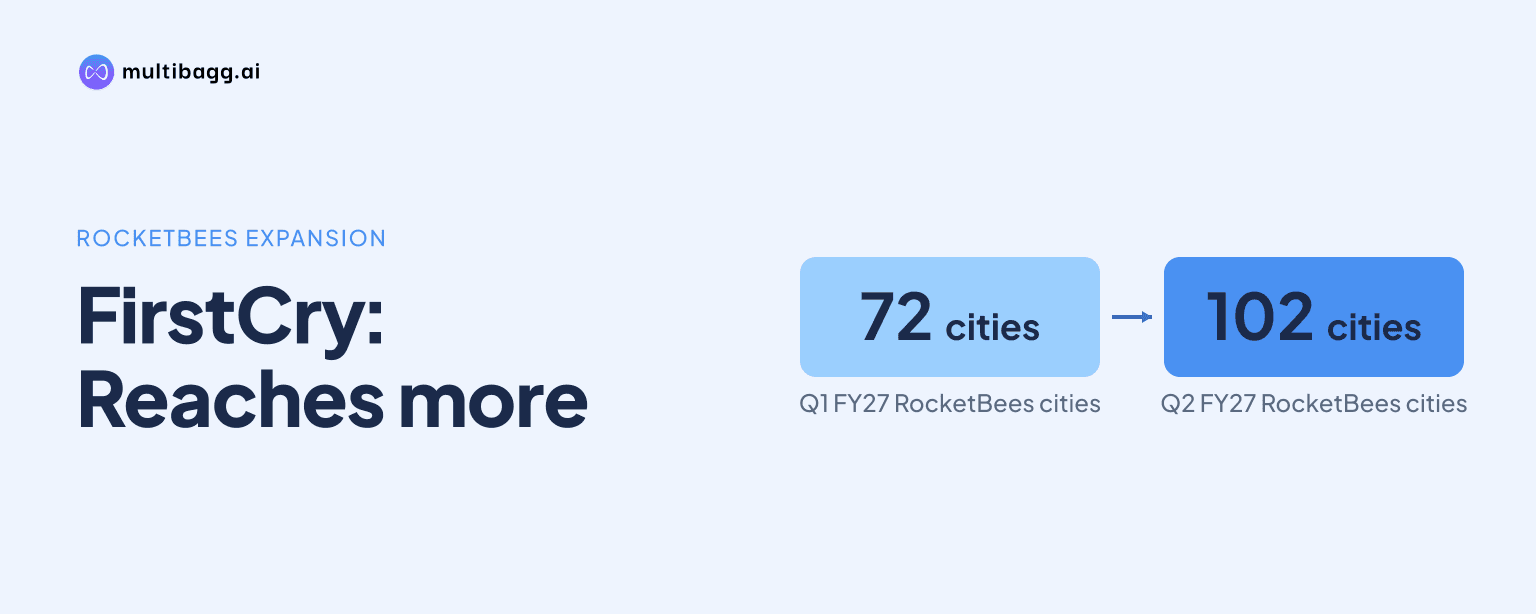
In Q2 FY27, FirstCry expanded RocketBees to 102 cities, while FirstCry Qwik doubled monthly shipments to about 250,000 in September from June. RocketBees handled over 60% of online shipments, and FirstCry reported 14.0% year-on-year offline gross merchandise value growth in H1 FY27 after changing its store assortment.
Know Brainbees Solutions inside out
Results, valuation, peers and who's buying, in one view.
How far has FirstCry expanded RocketBees?
FirstCry expanded RocketBees from 13 cities in Q2 FY26 to 102 cities in Q2 FY27, an increase of 89 cities over four quarters. The dedicated delivery network also increased from 72 cities in Q1 FY27, adding 30 cities during the latest quarter. At the Q2 FY27 scale, FirstCry said RocketBees handled more than 60% of its online shipments.
The expansion accelerated after Q3 FY26, when RocketBees covered 22 cities, reaching 62 cities in Q4 FY26. The network then added another 40 cities across Q1 FY27 and Q2 FY27. FirstCry describes RocketBees as a dedicated network designed to improve delivery reliability, rather than presenting city coverage by itself as a financial result.
What delivery changes does RocketBees report?
RocketBees reported turnaround time about 20% faster, on-time delivery above 90%, 50% fewer return-to-origin shipments and 60% fewer delivery-related complaints at its Q2 FY27 footprint of 102 cities. The presentation does not disclose absolute turnaround times, complaint volumes or return-to-origin shipment volumes behind these percentage comparisons.
FirstCry also reported that online transaction-frequency cohorts in RocketBees-serviced cities improved by more than 10%, resulting in an overall year-on-year improvement of more than 5%. The company links this result to delivery coverage and fulfilment speed, but it does not disclose the underlying customer cohort size, transaction-frequency base or RocketBees' precise contribution to the overall increase.
How quickly is FirstCry Qwik scaling?
FirstCry Qwik reached 16 cities and about 250,000 monthly shipments in September, compared with 12 cities and about 125,000 monthly shipments in June. This was approximately 2.0 times the June shipment volume, or about 100% growth in one quarter. FirstCry Qwik offers a mother, baby and kids assortment delivered within hours in selected pin codes.
The FirstCry Qwik rollout began as a three-city pilot in Q3 FY26 with an approximately three-hour delivery proposition. By Q4 FY26, it covered five cities and processed about 60,000 March shipments. September monthly shipments were therefore more than four times the March level, while the service added 11 cities from its pilot footprint to Q2 FY27.
Got a follow-up? Ask IRIS
What changed in FirstCry's offline business?
FirstCry increased depth in frequently chosen products and introduced accessible entry prices in its offline assortment, which it said supported higher footfalls and conversion. Offline gross merchandise value, or GMV, grew 14.0% year on year in H1 FY27, compared with 4.8% in H1 FY26. The presentation identifies the assortment reset, rather than a larger total store network, as the change associated with this growth.
The quarterly comparison also improved: offline GMV growth reached 13.0% year on year in Q2 FY27, up from 6.5% in Q2 FY26. FirstCry's total modern-store network was 1,188 stores in September 2026, down by 10 from 1,198 a year earlier. FirstCry and other company-operated stores increased by 48 to 309, while BabyHug company-operated stores declined by 70 to 220.
How did India Multichannel perform during the rollout?
FirstCry's India Multichannel revenue increased 18.6% year on year to Rs 1,637.9 crore in Q2 FY27, from Rs 1,381.1 crore in Q2 FY26. This was the highest revenue-growth rate among the eight quarters shown in the presentation. The RocketBees expansion, FirstCry Qwik scale-up and 13.0% offline GMV growth all occurred during the same Q2 FY27 period.
Profitability moved differently from revenue in Q2 FY27. India Multichannel adjusted earnings before interest, tax, depreciation and amortisation, or adjusted EBITDA, was Rs 112.2 crore, compared with Rs 125.4 crore a year earlier, while adjusted EBITDA margin declined to 6.9% from 9.1%. Gross margin fell to 33.9% from 37.0%, and FirstCry said manufacturing margins remained under pressure from crude-linked raw-material costs.
How did FirstCry's store mix change?
FirstCry's modern-store count declined by 10 year on year to 1,188 in September 2026, but the composition changed through conversions and company-operated store additions. Franchise-owned, franchise-operated FirstCry stores increased by 12 to 659, while total company-owned, company-operated, or COCO, stores declined by 22 to 529.
BabyHug COCO stores fell by 70 to 220 in September 2026, while FirstCry and other COCO stores rose by 48 to 309. The presentation states that 37 BabyHug COCO stores were converted to FirstCry COCO stores in H1 FY27. This store-mix movement took place alongside 14.0% offline GMV growth in H1 FY27, compared with 4.8% in H1 FY26.
Conclusion
FirstCry's Q2 FY27 operating data show delivery-network expansion, faster rapid-delivery volumes and an offline assortment reset occurring together. RocketBees reached 102 cities and handled over 60% of online shipments, while FirstCry Qwik processed about 250,000 September monthly shipments, double June's level. Offline GMV growth increased to 14.0% in H1 FY27 from 4.8% a year earlier, even as the modern-store base declined by 10 stores.
The next reported indicators to watch are whether FirstCry Qwik expands beyond 16 cities and whether RocketBees retains its stated delivery outcomes as coverage grows. FirstCry also identified crude-price stabilisation as an unresolved condition that would allow customer pricing to catch up and support manufacturing-margin recovery, after India Multichannel gross margin was 33.9% in Q2 FY27.