










FirstCry’s Middle East EBITDA loss narrows to 6.4% revenue
Key highlights
- FirstCry’s Q2 FY27 International Adjusted EBITDA loss narrowed to Rs 15.9 crore, or 6.4% of revenue, from Rs 18.9 crore, or 8.0%, a year earlier.
- FirstCry’s Q2 FY27 International gross margin rose to 28.5% from 26.3% in Q2 FY26.
- FirstCry’s International revenue grew 5.8% to Rs 249.3 crore in Q2 FY27, while gross merchandise value rose 10.0% to Rs 502.1 crore.
- FirstCry’s H1 FY27 International Adjusted EBITDA loss was Rs 32.6 crore, compared with Rs 40.4 crore in H1 FY26.
powered by IRIS
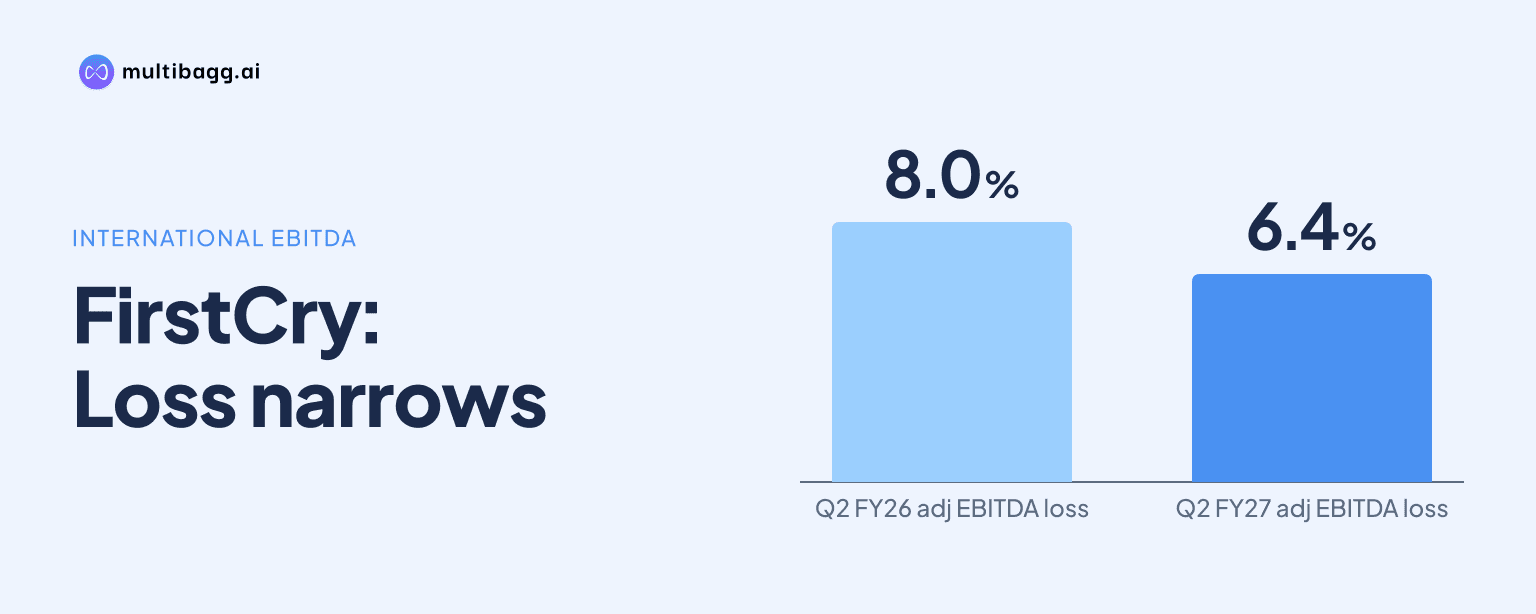
FirstCry narrowed its International business Adjusted EBITDA loss to 6.4% of revenue in Q2 FY27, from 8.0% in Q2 FY26, as gross margin reached 28.5% and revenue rose to Rs 249.3 crore. The segment comprises operations in the United Arab Emirates and Saudi Arabia, where management cited geopolitical disruptions.
Know Brainbees Solutions inside out
Results, valuation, peers and who's buying, in one view.
How did FirstCry’s Middle East profitability change in Q2 FY27?
FirstCry’s Adjusted EBITDA, or adjusted earnings before interest, tax, depreciation and amortisation, loss narrowed to Rs 15.9 crore in Q2 FY27 from Rs 18.9 crore in Q2 FY26. The loss margin improved by 160 basis points to 6.4% of revenue from 8.0%, while revenue increased by Rs 13.6 crore year on year.
FirstCry also reported a lower first-half loss. H1 FY27 Adjusted EBITDA was negative Rs 32.6 crore, compared with negative Rs 40.4 crore in H1 FY26, and the detailed cost table puts the loss margin at 6.8%, versus 9.1%. Revenue rose to Rs 481.4 crore from Rs 443 crore across the two six-month periods.
What drove FirstCry’s gross-margin improvement?
FirstCry’s Q2 FY27 gross margin was 28.5%, up from 26.3% a year earlier, raising gross profit to Rs 70.9 crore from Rs 62 crore. Management said gross-margin improvement showed the strength of its India playbook and identified higher home-brand mix plus higher-margin category and brand selection as margin levers.
The improvement extended across H1 FY27, when gross margin reached 28.1% from 25.7% in H1 FY26 and gross profit rose by Rs 21.6 crore to Rs 135.2 crore. Quarterly gross margin moved from 24.9% in Q1 FY26 to 28.5% in Q2 FY27, although it fell to 24.5% in Q3 FY26 before recovering to 27.5% in Q4 FY26.
The Q2 FY27 margin was the highest among the six reported quarters. Q1 FY27 gross margin was 27.7%, compared with 24.9% in Q1 FY26, meaning both quarters in H1 FY27 exceeded the corresponding prior-year levels. The presentation does not quantify how much of the 220-basis-point Q2 improvement came from home brands, categories or individual brands.
How did FirstCry’s International costs change?
FirstCry’s loss narrowed despite higher rupee costs in all three disclosed operating categories in Q2 FY27. Direct cost rose to Rs 22.3 crore from Rs 19.8 crore, marketing cost rose to Rs 25.2 crore from Rs 24.2 crore, and indirect cost increased to Rs 39.3 crore from Rs 36.9 crore.
Marketing was the only listed cost line that declined as a share of revenue, falling to 10.1% in Q2 FY27 from 10.3% in Q2 FY26. Direct cost increased to 9.0% of revenue from 8.4%, while indirect cost rose to 15.8% from 15.6%; FirstCry defines indirect cost as salary and other selling, general and administrative costs, excluding employee stock-option plan costs.
Gross profit increased by Rs 8.9 crore between the two Q2 periods, while the three listed cost categories increased by a combined Rs 5.9 crore. That difference corresponds with the Rs 3 crore reduction in the Adjusted EBITDA loss. FirstCry described the result as improving operating efficiency, but did not disclose a break-even quarter or full-year profitability target.
Got a follow-up? Ask IRIS
Did FirstCry’s Middle East revenue growth slow in Q2 FY27?
FirstCry’s International revenue grew 5.8% year on year to Rs 249.3 crore in Q2 FY27, compared with reported growth of 13.3% in Q2 FY26. Management described the latest increase as 6% and said geopolitical disruptions affected the Middle East business, while adding that it has higher potential in a stable environment.
Gross merchandise value, defined by FirstCry as the monetary value of orders including taxes and before returns, grew 10.0% to Rs 502.1 crore in Q2 FY27. That was faster than revenue growth of 5.8%, and compared with gross merchandise value of Rs 456.3 crore and growth of 8.9% in Q2 FY26.
Orders were flat year on year at 0.52 million in Q2 FY27, while average order value increased to Rs 9,713 from Rs 8,738. Average annual transacting customers, reported by FirstCry as AUTC, rose 5.5% to 0.55 million. The data indicate that the higher gross merchandise value occurred with unchanged order volume and a higher average order value.
How far has FirstCry progressed toward profitability?
FirstCry reported that its International Adjusted EBITDA margin improved from negative 25% in FY23 to negative 7% in H1 FY27. The absolute loss was Rs 120.1 crore in FY23, widened to Rs 139.6 crore in FY24 and Rs 140.1 crore in FY25, then reduced to Rs 90.7 crore in FY26 and Rs 32.6 crore in H1 FY27.
The H1 FY27 loss was Rs 7.8 crore lower than H1 FY26’s Rs 40.4 crore loss. FirstCry’s long-term chart rounds the respective margins to negative 7% and negative 9%, while the detailed half-year cost table gives negative 6.8% and negative 9.1%, showing the same direction of change.
FirstCry lists four mechanisms for further margin progress: higher home-brand mix, higher-margin category and brand selection, customer-acquisition quality and retention, and operating leverage as revenue grows. These are disclosed margin levers rather than a forecast, and the presentation does not specify when the International business could reach adjusted EBITDA break-even.
Conclusion
FirstCry’s Q2 FY27 International figures show that margin and loss reduction continued while revenue growth slowed amid the disruption management described. Gross margin rose to 28.5%, gross merchandise value increased 10.0% to Rs 502.1 crore, and the Adjusted EBITDA loss fell to Rs 15.9 crore, even as orders remained flat at 0.52 million.
The next results will show whether geopolitical conditions become more stable and whether revenue growth improves from 5.8%. Investors can also monitor the disclosed home-brand, category-selection, customer-retention and operating-leverage levers, alongside whether the H1 FY27 loss margin of 6.8% continues to narrow without a stated break-even target.