










FirstCry Rocketbees reaches 102 cities, covers 60% of shipments
Key highlights
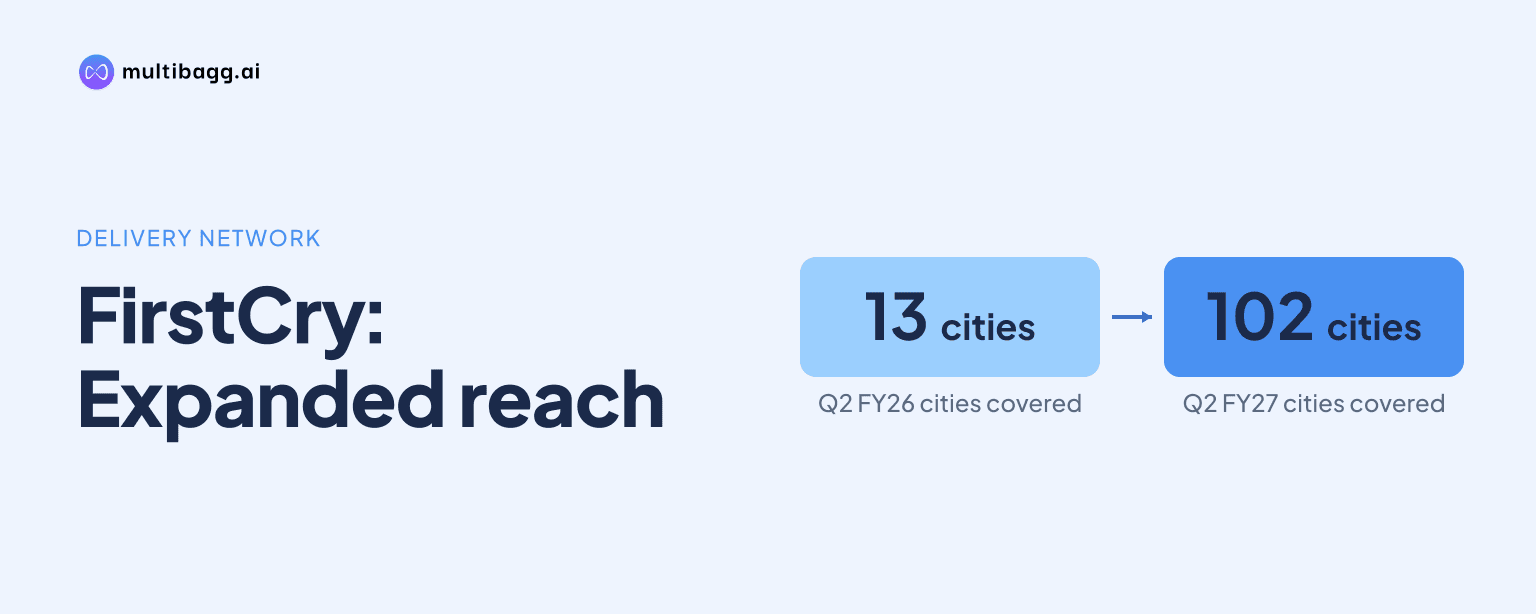
- FirstCry expanded Rocketbees from 13 cities in Q2 FY26 to 102 cities in Q2 FY27.
- Rocketbees covered almost 60% of online shipments and reported delivery turnaround times 20% faster in Q2 FY27.
- Rocketbees-served customer cohorts recorded 10% higher transaction frequency year on year in Q2 FY27.
- FirstCry said Rocketbees reverse pickups cost about one-third of comparable third-party logistics pickups.
powered by IRIS
FirstCry expanded its Rocketbees delivery network to 102 cities in the second quarter of fiscal year 2027 (Q2 FY27), covering almost 60% of online shipment volume. Management reported delivery turnaround times 20% faster, more than 90% on-time delivery, 50% fewer return-to-origin shipments and 60% fewer delivery complaints.
Know Brainbees Solutions inside out
Results, valuation, peers and who's buying, in one view.
How large is FirstCry's Rocketbees delivery network?
FirstCry's Rocketbees network reached 102 cities in Q2 FY27, up from 13 cities when the initiative began in Q2 FY26. The network covered almost 60% of total online shipment volume after roughly one year of expansion, according to management.
FirstCry said Rocketbees recorded 50% fewer return-to-origin, or RTO, shipments and 60% fewer delivery complaints in Q2 FY27. RTO means an order could not be delivered and was returned to the seller, making the measure relevant to reverse logistics as well as fulfilment quality.
Management said Rocketbees costs were front-loaded when the network was launched, alongside investment in FirstCry Qwik. It said the initiative's direct-cost outcome had become positive as the network expanded, but did not disclose Rocketbees revenue, absolute operating cost or standalone profitability for Q2 FY27.
How has Rocketbees changed FirstCry customer activity?
FirstCry said transaction frequency among online customer cohorts in Rocketbees service cities improved 10% year on year in Q2 FY27. That increase contributed to a 5% improvement in FirstCry's overall frequency cohorts, linking the delivery programme to repeat ordering.
The gap between the 10% service-city increase and the 5% overall improvement indicates that the reported benefit was concentrated in Rocketbees-served areas. Rocketbees covered almost 60% of online shipment volume in Q2 FY27, rather than the whole online network.
FirstCry's India Multichannel segment reported 13% year-on-year order growth in Q2 FY27, its strongest order growth in six quarters according to management. Online gross merchandise value, or GMV, rose about 8%, while online revenue net of discounts, returns and taxes increased more than 10% year on year.
Management did not quantify how much of the 13% order growth came directly from Rocketbees. It also cited softer diapering competition and continued performance in the non-diapering portfolio, which represented about 85% of India Multichannel GMV in Q2 FY27.
How much has Rocketbees lowered FirstCry reverse-logistics costs?
FirstCry said a Rocketbees reverse pickup costs about one-third of the amount it previously paid third-party logistics providers for a comparable pickup. Management identified reverse-pickup savings as the key reason direct costs declined during Q2 FY27.
Direct costs were 8.7% in Q2 FY27, compared with 9.2% for the first half of FY27, a 50-basis-point difference. A basis point is one-hundredth of a percentage point. Management also said direct costs improved by almost 100 basis points from Q1 FY27 to Q2 FY27 as Rocketbees and Qwik scaled after their initial cost build-up.
FirstCry reported a 6.9% adjusted earnings before interest, tax, depreciation and amortisation, or EBITDA, margin for India Multichannel in Q2 FY27. That was 120 basis points above Q1 FY27, while management said it had saved about 90 basis points in costs below gross margin year on year.
The company said gross-margin recovery remained incomplete because crude-linked raw-material prices continued to pressure manufacturing margins. Management said price increases had an extended lag, although it expected recovery to progress in Q3 FY27 and potentially be completed by Q4 FY27.
Got a follow-up? Ask IRIS
What delivery improvements has FirstCry reported from Rocketbees?
FirstCry reported that Rocketbees delivered orders 20% faster in Q2 FY27, with on-time delivery above 90%. The network also had 50% fewer RTO shipments and 60% fewer delivery complaints than the referenced earlier performance level.
These logistics measures were disclosed alongside 18.6% year-on-year India Multichannel revenue growth in Q2 FY27, which management described as the segment's strongest growth in eight quarters. India Multichannel also remained profit after tax, or PAT, positive during the quarter.
Offline GMV rose 12.9% in Q2 FY27 despite FirstCry operating 10 fewer stores, with management attributing the increase mainly to existing-store growth and assortment changes. The comparison shows that the segment's growth was not limited to online delivery operations.
Management said the timing of Dussehra shifted some festive sales from September 2026 into October 2026. It said this affected Q2 growth, even as online revenue net of discounts, returns and taxes grew more than 10% and online GMV increased about 8%.
How is FirstCry building Qwik alongside Rocketbees?
FirstCry expanded Qwik to 16 cities by the end of Q2 FY27, from a three-city pilot that management said started around December. Qwik offered delivery in one to three hours in many cities, compared with three-hour delivery at the earlier stage.
Qwik shipment count doubled from March to June and doubled again from June to September, according to management. FirstCry did not disclose the absolute number of Qwik shipments, its current share of online volume or the financial cost of the service.
Rocketbees and Qwik have different disclosed roles. Rocketbees covered almost 60% of online shipment volume through its 102-city network, while Qwik is designed for faster fulfilment in selected city catchments and PIN codes.
For each Qwik catchment, management said its ambition is for the service to handle 20% of total shipments. Across India, FirstCry aims to make Qwik available across almost 50% of its serviceable footprint and eventually direct around 10% of total online shipment volume through Qwik, without providing a target date.
Conclusion
FirstCry's Q2 FY27 disclosures show Rocketbees at a scale covering almost 60% of online shipment volume, with reported gains in delivery speed, on-time performance, RTO rates and customer complaints. Management also linked the network to 10% higher transaction frequency in served-city cohorts and lower reverse-pickup costs, while India Multichannel revenue grew 18.6%.
The next measure to watch is whether Rocketbees continues to lower direct costs after the 8.7% ratio reported in Q2 FY27. Management also plans to expand Qwik beyond 16 cities toward almost 50% serviceability and around 10% of online shipment volume, while expecting crude-linked manufacturing-margin recovery to progress through Q3 FY27 and potentially Q4 FY27.