










FirstCry Middle East adjusted EBITDA loss fell 15.9% in Q2 FY27
Key highlights
- FirstCry’s Middle East adjusted EBITDA loss fell 15.9% to Rs 15.90 crore in Q2 FY27.
- FirstCry’s Middle East gross margin increased 220 basis points to 28.5% in Q2 FY27.
- FirstCry’s Middle East revenue rose 6% to Rs 249.30 crore in Q2 FY27 despite geopolitical disruption.
- FirstCry’s H1 FY27 Middle East adjusted EBITDA loss ratio narrowed to 6.8% from 9.0%.
powered by IRIS
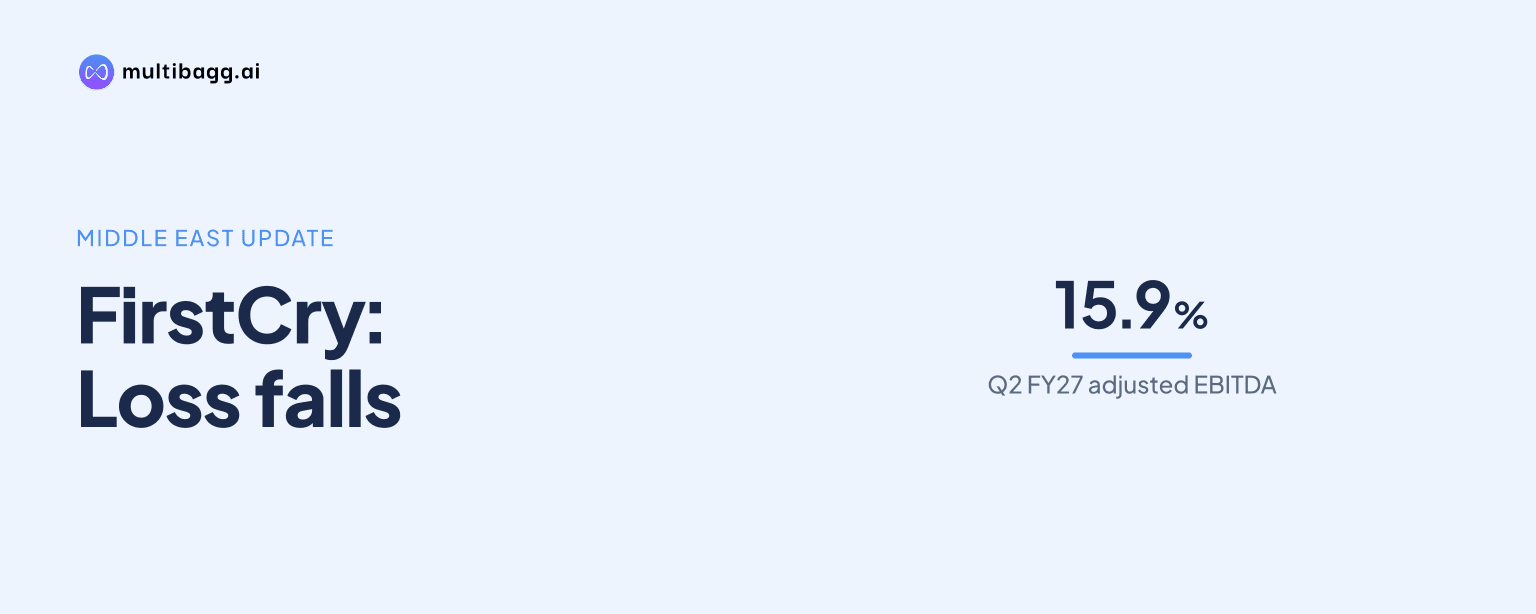
FirstCry cut its Middle East adjusted EBITDA loss by 15.9% to Rs 15.90 crore in Q2 FY27, despite geopolitical disruption that management said constrained revenue growth to 6%. Gross margin increased by 220 basis points to 28.5%, while revenue rose to Rs 249.30 crore and gross merchandise value grew 10% year on year.
Know Brainbees Solutions inside out
Results, valuation, peers and who's buying, in one view.
How did FirstCry’s Middle East business perform in Q2 FY27?
FirstCry’s Middle East business recorded 10% year-on-year gross merchandise value, or GMV, growth and 6% revenue growth in Q2 FY27, while adjusted EBITDA losses declined 15.9% year on year. Revenue increased to Rs 249.30 crore from Rs 235.70 crore in Q2 FY26, despite management describing geopolitical disruption as ongoing since Q1 FY27.
FirstCry improved gross margin to 28.5% from 26.3%, a 220-basis-point increase. Adjusted EBITDA loss as a share of revenue narrowed to 6.4% from 8.0%, meaning the absolute loss fell while the international operation added Rs 13.60 crore of quarterly revenue. A basis point is one-hundredth of a percentage point.
Why did FirstCry’s Middle East adjusted EBITDA loss narrow?
FirstCry narrowed the Middle East loss through a higher home-brand mix, higher-margin category and brand selection in non-home-brand sales, and a focus on customer acquisition quality and retention. Management said the home-brand mix reflected acceptance of its categories, product mix and assortment among parents in the region, while retention should improve unit economics over time.
The gross-margin improvement from 26.3% to 28.5% was the most visible financial result of those product and assortment actions in Q2 FY27. Management also cited operating leverage as revenue grew, saying direct and indirect costs can gain leverage with scale. This was management’s explanation of the loss reduction, rather than a disclosed numerical split among home brands, category selection, customer retention and costs.
How did FirstCry’s first-half Middle East performance compare with last year?
FirstCry’s Middle East revenue rose to Rs 481 crore in H1 FY27 from Rs 443 crore in H1 FY26, while adjusted EBITDA losses declined to Rs 32.60 crore from Rs 40 crore. Management described the first-half revenue increase as about 9% to 10%, and the loss ratio narrowed to 6.8% of revenue from 9.0% a year earlier.
Gross margin improved by 240 basis points in H1 FY27 versus H1 FY26, slightly more than the 220-basis-point improvement reported in Q2 alone. The half-year figures show that the Q2 reduction was part of a broader change: the operation generated Rs 38 crore more revenue while reducing adjusted EBITDA losses by Rs 7.40 crore.
Management also presented a longer adjusted EBITDA margin progression, from negative 25% in FY23 to negative 10% in FY26 on a full-year basis. The H1 FY27 loss ratio of 6.8% was below the H1 FY26 level of 9.0% and the FY26 full-year level of 10%, although FirstCry did not provide a dated EBITDA-neutrality target.
Got a follow-up? Ask IRIS
How did geopolitical disruption affect FirstCry’s Middle East growth?
FirstCry said geopolitical disruptions have been ongoing since Q1 FY27 and had a domino or cascading effect on the Middle East business, limiting Q2 FY27 revenue growth to 6%. Management said the business had greater growth potential in a stable environment, but it did not quantify revenue forgone because of the disruption or identify individual affected markets.
The difference between 10% GMV growth and 6% revenue growth was reported alongside the disruption, but FirstCry did not provide a detailed bridge between the two measures. GMV measures the value of merchandise sold, while revenue is the company’s reported sales measure. The disclosed Q2 FY27 outcome was a 220-basis-point gross-margin gain and a Rs 3 crore reduction in adjusted EBITDA losses.
The disruption remains an unresolved operating condition rather than a completed financial adjustment. FirstCry’s Q2 FY27 revenue of Rs 249.30 crore exceeded Rs 235.70 crore a year earlier, but management’s comments indicate that it does not regard the 6% increase as representing normal regional potential in a stable environment.
What is FirstCry’s plan for Middle East profitability?
FirstCry plans to continue reducing Middle East losses through product mix and operating efficiency, with management saying it aims to make the business EBITDA neutral fairly soon. The stated levers are home brands, higher-margin non-home-brand selection, customer retention and scale-driven cost leverage, which management also linked to the H1 FY27 adjusted EBITDA loss of Rs 32.60 crore.
Management said the international operation has progressed on this objective over the last eight quarters, but it did not set a quarterly target for revenue growth, gross margin or EBITDA break-even. The Q2 FY27 loss margin of 6.4% and H1 FY27 loss margin of 6.8% provide the disclosed benchmarks for future product-mix and efficiency gains.
Customer retention is central to the plan because management expects better retention to improve unit economics before it increases customer acquisition. That sequence is relevant in an operation where Q2 FY27 revenue rose 6% during geopolitical disruption: management described its approach as sustainable growth combined with lower losses, rather than setting a rapid expansion target.
Conclusion
FirstCry’s Middle East operation combined higher sales with lower losses in Q2 FY27: revenue reached Rs 249.30 crore, gross margin reached 28.5%, and adjusted EBITDA loss fell to Rs 15.90 crore. The H1 FY27 result of Rs 481 crore in revenue and Rs 32.60 crore in adjusted EBITDA losses supports management’s view that home-brand mix, category selection and customer retention are improving the operation’s economics.
The next issue to watch is whether FirstCry can continue progressing toward management’s stated EBITDA-neutral objective while geopolitical disruption persists. Future quarterly disclosures should show whether the 220-basis-point Q2 gross-margin gain, 6.4% Q2 adjusted EBITDA loss margin and operating-efficiency measures continue to improve without a more stable regional environment.