








Freshara sees second-half margin relief as freight eases
MAX Plan at ₹4,999/yr

Find your next multibaggerBe a Pro Investor
Research stocks and track your picks on the go. Download the app.
Key highlights
- Freshara said ocean freight rose two to three times in H1 FY27, while energy costs reached almost twice earlier levels.
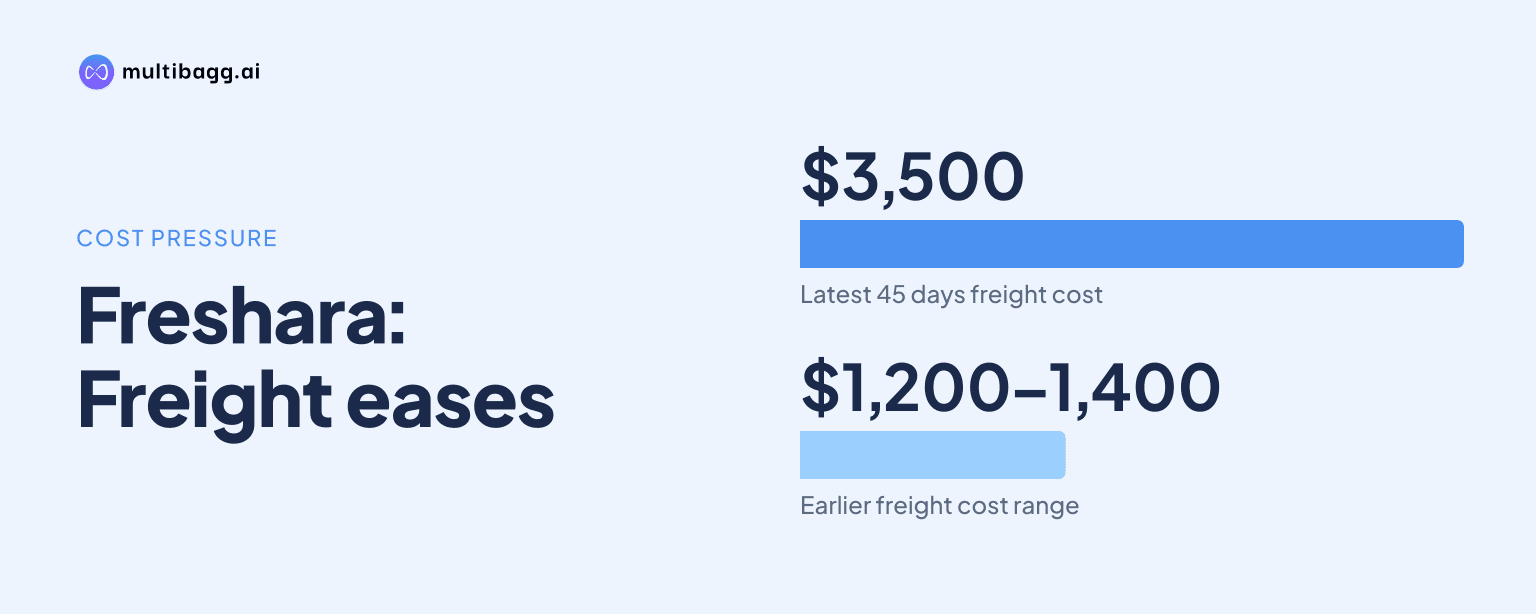
- Freshara said freight declined over the latest 45 days, though a Europe container still costs around $3,500 versus $1,200 to $1,400 earlier.
- Freshara reported approximately Rs 170 crore of orders in hand and expects another Rs 100 crore of orders next quarter.
- Freshara is targeting consolidated FY27 revenue of Rs 575 crore to Rs 600 crore.
powered by IRIS
Pickl Freshara Agro Exports Limited expects second-half FY27 margins to improve after ocean freight rose two to three times and energy costs nearly doubled in the previous half, as freight has declined over the latest 45 days and customer contracts are due for repricing in December and January. Freshara said operating costs should reduce substantially from the previous half if rates remain stable.
Know Freshara Agro Exports inside out
Results, valuation, peers and who's buying, in one view.
Why did Freshara face margin pressure in H1 FY27?
Freshara said ocean freight was the most significant cost disruption in H1 FY27. Management attributed the increase to war-related container shortages from India, saying freight multiplied by two to three times. Rates changed within 10 to 14 days, meaning the freight payable when a shipment left could differ materially from the cost assumed when the customer contract was booked.
The second quarter was more difficult than the first quarter, according to management. Freshara said shipping companies did not honour contracts during that period, leaving it without effective freight arrangements when prices were changing rapidly. The company said it can earn a margin on ocean freight when rates are stable, but could not do so when end customers were also dealing with sudden shipping-cost increases.
The issue was the timing of cost recovery rather than an announced change in product pricing strategy. Management said export contracts cannot be revised every fortnight, so the company at times had to absorb part of the sudden rise. This constrained its ability to pass through costs immediately even where customers ultimately accepted a higher freight component.
Energy-linked inputs created a second pressure point. Management said energy costs had spiralled to almost twice the earlier level, affecting sugar, furnace oil and other production inputs. Freshara said it was passing on some of these increases, but described the response as a knee-jerk adjustment because contracts could not be changed at the same pace as input costs.
What could improve Freshara's second-half margins?
Freshara expects lower freight volatility and contract repricing to improve second-half margins. Management said ocean freight had come down substantially from the prior half-year over the latest 45 days, while energy costs were also declining. However, it stressed that freight had not returned to the February-March level, so the outlook does not depend on a full return to earlier shipping rates.
The company gave an example of a Europe-bound container that had cost about $1,200 to $1,400, then rose to about $5,000 and had subsequently fallen to around $3,500. This shows that freight remained well above the earlier reference level even after the recent decline. Management's expected benefit is therefore primarily from lower costs than the peak and more predictable pricing, rather than from complete normalisation.
Freshara said most customer contracts come into play in December and January, giving it an opportunity to reprice freight and input-cost increases. Management said customers are now more aware of the global freight environment than they were during the earlier ad hoc increases. It expects this to reduce the lag between higher shipping costs and customer-price adjustments.
In response to an analyst asking whether second-half earnings before interest, tax, depreciation and amortisation, or EBITDA, could reach 12% to 13%, management said there were “very high chances” of improvement but did not issue formal margin guidance. It said one or two basis points of margin correction should occur if freight stabilises. A basis point is one-hundredth of a percentage point, and management made the expectation conditional on the absence of another abrupt rate move.
How will retail capacity and utilisation affect Freshara's costs?
Freshara expects higher utilisation of its retail-pack lines to lower production costs. Management said that once the same lines and units handle greater daily volumes, current costs could decline by at least one-third. The company has modernised Unit One with a faster retail-pack line and is adding another retail production line at Unit Two for the upcoming crop season.
Both newly installed production lines were fully booked with new customer orders, according to management. Freshara expects both facilities to have two lines in the coming year. It said manpower costs should remain relatively similar, while energy use and labour hours per unit of output should improve as volumes rise.
Management said Freshara could double from the current level with only a marginal rise in costs, though that is an operating expectation rather than a reported outcome. The first year of the expansion was focused on adding lines, while the current and coming year are intended to focus on improving production efficiency. Results will depend on throughput from the added retail capacity.
Retail-pack sales have increased by almost 25% compared with earlier years, management said. Freshara described itself as primarily an industrial packer before 2024 and said it is evolving into a retail and food-service packer. It also has two large orders from the top two European retail chains that management expects to service in coming months.
Got a follow-up? Ask IRIS
How does Spain affect Freshara's profitability and revenue outlook?
Freshara said its Spanish business generated around Rs 95 crore of revenue in H1 FY27 and helped almost double consolidated revenue. Management said the Spanish business's margins had improved as planned, while the consolidated company was operating at a 7.5% profit after tax, or PAT, margin. No standalone margin figure for the Spanish unit was disclosed.
For FY27, Freshara is targeting Rs 170 crore to Rs 200 crore of revenue from the Spanish business, depending on foreign-exchange movement. Management said the unit could generate close to Rs 200 crore while operating at about 50% productivity, and that it had historically generated about Rs 300 crore of revenue. The historical figure was not presented as current-year guidance.
The operational link between India and Spain is product allocation. Freshara said it has begun shifting gherkin production to India, allowing the Spanish operation to hold less gherkin inventory and focus more on olives. Management expects this programming change to help Indian lines run more efficiently while allowing the Spanish facility to devote more capacity to olives.
Sarasa also changes the group's sales-channel profile. Management said the group was 100% business-to-business, or B2B, in the prior year, while the expected mix this year is 60:40. It said Freshara revenue would be B2B and Sarasa revenue business-to-consumer, or B2C, reflecting the Spanish retail platform rather than a stated conversion of Indian export customers.
What order visibility supports Freshara's second-half plan?
Freshara reported approximately Rs 170 crore of orders in hand and expects to close an additional Rs 100 crore of orders in the next quarter. Management later clarified that Rs 170 crore was the order book rather than a revenue forecast. It said the Indian unit is targeting Rs 260 crore to Rs 270 crore of FY27 sales.
The company is targeting consolidated FY27 revenue of Rs 575 crore to Rs 600 crore. Management said the second half is its major export period and normally carries the largest volumes of the year. That seasonal pattern supports the expectation of better second-half numbers, but it also puts emphasis on delivery schedules, product quality and working-capital management.
Freshara said it intends to add another customer-specific production line each year to meet retail demand and is targeting about 30% organic growth again next year. Management said any inorganic acquisition would be additional to that organic plan. It estimated working-capital requirements of Rs 30 crore to Rs 50 crore over the next 12 months.
A potential acquisition could require another Rs 50 crore, management said, but the funding source had not been decided. Management indicated it could provide narrower information in one or two months. The company also said it expects to begin quarterly calls from the coming quarter, after noting paid-up capital of close to Rs 25 crore.
Conclusion
Freshara's second-half margin outlook rests on lower and more stable ocean freight, repricing of customer contracts and greater utilisation of retail-pack capacity. The company faced a sharp H1 disruption as freight rose two to three times and energy-related input costs nearly doubled, while its planned response combines cost recovery with operating efficiencies rather than relying on a full return to earlier freight rates.
The next indicators are whether freight remains below its peak, whether December and January contract repricing improves realised margins, and whether the two-line configuration at both facilities increases output as planned. Management is targeting Rs 575 crore to Rs 600 crore of FY27 revenue, while its approach to funding potential acquisition and working-capital needs remains unresolved.

