








Pickl Freshara Agro Exports Limited targets Sarasa Rs 500 crore
MAX Plan at ₹4,999/yr

Find your next multibaggerBe a Pro Investor
Research stocks and track your picks on the go. Download the app.
Key highlights
- Freshara said Sarasa can return to its previous Rs 300 crore revenue level as an immediately achievable target.
- Management said Sarasa could reach Rs 500 crore in two to three years if Indian-made gherkins gain customer acceptance.
- Freshara said two large European retail chains became customers during the preceding six months under year-long contracts.
- Freshara said an example olive sourcing cost fell by Rs 100, to Rs 150 from Rs 250.
powered by IRIS
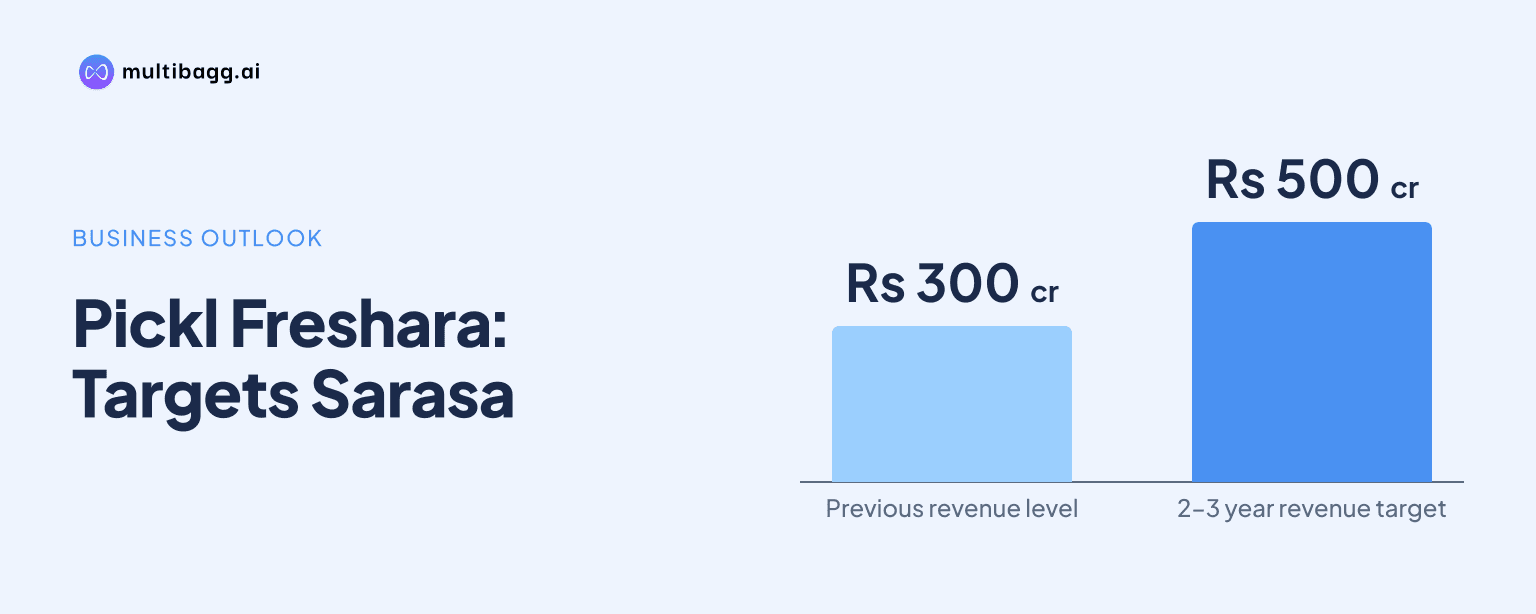
On its November 19, 2026 earnings call, Pickl Freshara Agro Exports Limited said Sarasa could reach Rs 500 crore of revenue in two to three years if Indian-made gherkins gain customer acceptance. Freshara called Sarasa's previous Rs 300 crore revenue level an immediately achievable target, supported by SKU rationalisation, retail listings and broader European distribution.
Know Freshara Agro Exports inside out
Results, valuation, peers and who's buying, in one view.
What is Freshara's revenue roadmap for Sarasa?
Freshara's stated roadmap is to restore Sarasa to Rs 300 crore of revenue before pursuing Rs 500 crore in a couple of years or, if needed, within three years. Management said Sarasa had previously operated at Rs 300 crore, making that level an immediate achievable target. The Rs 500 crore objective was framed as a landmark contingent on the acceptance of gherkins supplied from India.
The plan is centred on product selection rather than volume growth across every category. Management said the first year would involve flushing out slow stock-keeping units, or SKUs, that had historically generated business without sufficient profit. It said Freshara was selecting products with higher margins because it wanted to focus on profit after tax, or PAT, as well as earnings before interest, tax, depreciation and amortisation, or EBITDA.
Freshara has removed gherkin production from Spain and is testing whether customers will accept Indian-made supply within Sarasa's range. Management did not provide a gherkin volume forecast, expected pricing or the proportion of Sarasa revenue that could be sourced from India. That leaves the Rs 500 crore goal dependent on customer uptake as well as execution of the revised product mix.
How will Freshara expand Sarasa sales in Spain and Europe?
Freshara expects retail listings to be a major sales lever because Sarasa is not yet listed with several leading retail chains in Spain. Management said Sarasa's volumes could become two times higher once those listings are secured. The company also said it had won contracts with two large European retail chains during the preceding six months, with year-long agreements for a retail-packaging operation.
Freshara said retail demand should catch up faster than industrial demand, following the creation of a separate retail-packaging unit in fiscal year 2025-26. The company did not disclose the current revenue split between retail and industrial packaging. However, management linked the recent retail contribution to the Spanish operation and said customers gained in the previous 12 months were supporting the shift in mix.
Freshara also wants Sarasa to become a branded exporter rather than chiefly a white-label supplier. Management said it was identifying distributors, markets and price points, and expected to be present in at least a few additional countries by the following year. It said Sarasa's Spanish presence had changed customer access, with at least five or six potential customers approaching Freshara in a week and with Europe enabling bids for contracts that were unavailable from India.
Business-to-business supply and white labelling remain possible where demand is sizable, according to management. Freshara said a branded launch needs a proper distribution setup or it could fail. It is also exploring the United Kingdom, where Freshara already supplies business-to-business customers, but management said Sarasa's initial priority remains Spain and the wider European opportunity.
Got a follow-up? Ask IRIS
What could improve Sarasa's profitability?
Freshara said Sarasa's six-month turnaround created scope for margins to approach the Indian business's levels within one or two years, provided purchasing discipline continues. An analyst on the call said Sarasa had reached an 8% PAT margin; management did not independently restate that percentage but said it viewed the six-month performance as a turnaround and saw room for improvement in the coming months.
Higher retail volumes could support that improvement because management described employee expense as Spain's principal fixed cost, with energy a smaller component. It said successful listings with currently unserved Spanish chains could double volume, while there is no farming or contract-farming cost in Spain comparable with Freshara's Indian operations. The call did not provide Sarasa's absolute fixed-cost base or a quantified margin target.
Olive procurement is another stated lever. Freshara said it had already begun sourcing from Egypt and could also buy from Greece, Morocco and other origins with surplus crop. Management gave an example of olive cost falling to Rs 150 from Rs 250, a reduction of Rs 100 per unit, and said even Spanish olive varieties are now grown in Egypt.
Freshara said the European market increasingly buys olives from lower-cost destinations rather than waiting for a particular origin. Yet the company did not disclose volumes sourced from Egypt, Greece or Morocco, so the total profit effect cannot be calculated from the call. The strategy nevertheless gives Sarasa multiple procurement options rather than reliance on Spanish-origin olives alone.
What could determine whether Freshara reaches the target?
Freshara said extra capacity will be required as European retail contracts grow because each large customer may need a dedicated production line. Management said flavours and product variants cannot necessarily share an existing line, and it was adding production lines and employees to work directly with customers on technical requirements. The transcript does not specify the number of lines, capital spending or commissioning date.
The pace of new listings and distributor appointments is also unresolved. Freshara has two large European retail-chain contracts with year-long terms, but management did not identify the chains or disclose their expected annual sales. Its forecast of being in a few additional countries by the following year depends on choosing suitable distributors and establishing the required brand infrastructure.
An eventual European Union free-trade agreement, or EU FTA, could further affect the economics of Indian-made Sarasa products. Management said the agreement was not yet in force and expected it in the next year, with quotas and other details still requiring finalisation. It said Indian-made Freshara or Sarasa products could enter Europe duty-free or at lower duties, improving competitiveness against Turkey, which management estimated faced 5% duty.
The EU FTA benefit remains conditional on its final rules and on qualifying products being supplied from India. Freshara said Turkish products are a head-to-head comparison for customers, particularly in gherkins. Management's assessment was that lower European duties could bring more customers and better margins, but it did not quantify any revenue or margin gain from the agreement.
Conclusion
Freshara's plan for Sarasa combines a return to its former Rs 300 crore revenue level with a conditional Rs 500 crore ambition. The operating approach is to eliminate slow SKUs, concentrate on products with better profitability, expand Spanish and European retail listings, and use Indian-made gherkins alongside lower-cost olive sourcing from markets such as Egypt.
The next developments to watch are customer acceptance of Indian gherkins, listings with leading Spanish retail chains and the build-out of dedicated production lines for retail customers. Management also expects the EU FTA in the next year, but quotas and other terms remain unresolved, making the eventual tariff benefit to Freshara's European business uncertain.

