








Freshara Says Shipping Delays Stretched Working Capital to 160 Days
MAX Plan at ₹4,999/yr

Find your next multibaggerBe a Pro Investor
Research stocks and track your picks on the go. Download the app.
Key highlights
- Freshara said its working-capital cycle rose from 90-120 days two years ago to about 150-160 days.
- Shipping delays lasted at least 7-9 months as blocked routes extended export transit and collections.
- Freshara expects working-capital days to reduce by another 30 days if ocean-freight disruption eases.
- The Spanish business has credit terms of roughly 60-90 days, versus Freshara’s current 150-160-day cycle.
powered by IRIS
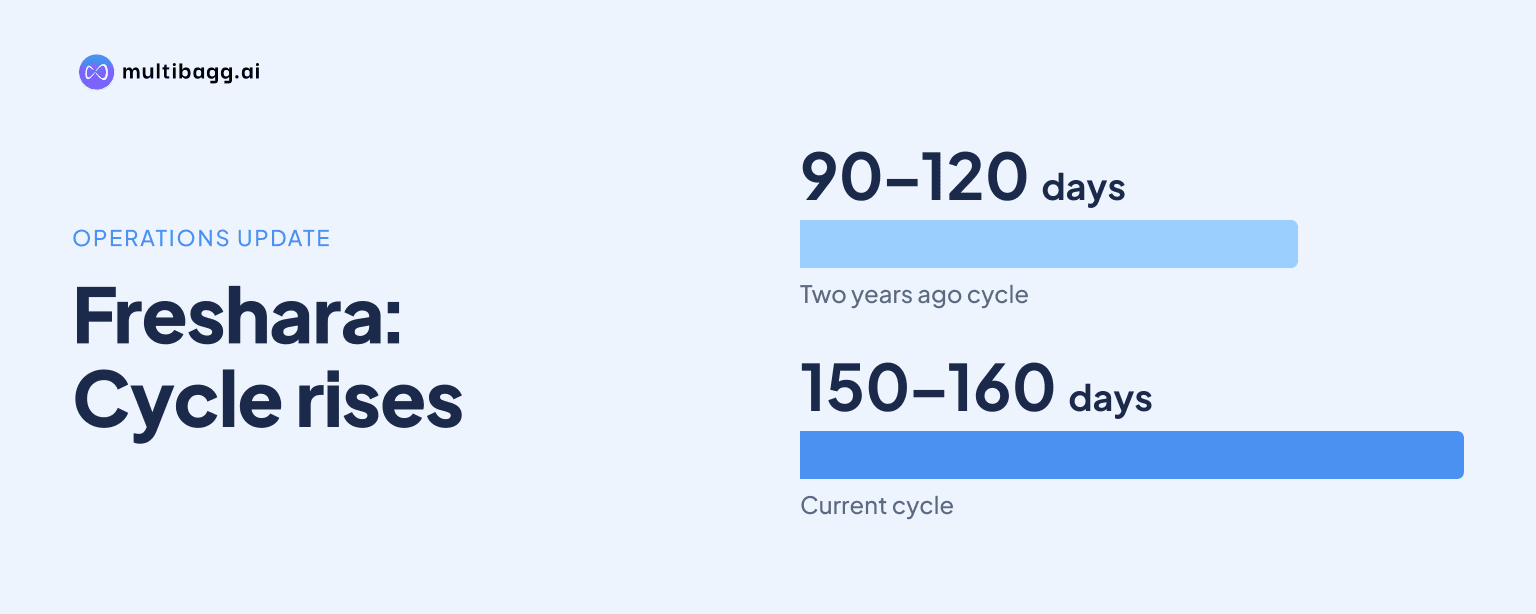
On its November 19, 2026 earnings call, Pickl Freshara Agro Exports Limited said shipping-route disruption stretched its working-capital cycle to 150-160 days from 90-120 days two years earlier, as delayed sea deliveries slowed export collections and held cash longer in transit.
Know Freshara Agro Exports inside out
Results, valuation, peers and who's buying, in one view.
What caused Freshara’s working-capital cycle to reach 150-160 days?
Freshara said delayed sea deliveries were the main reason its working-capital cycle reached 150-160 days. Management said deliveries had been delayed for at least seven to nine months as expanding conflict blocked routes, extending the period between export shipment and receipt of customer payments.
The comparison is with a cycle of about 90-120 days two years earlier, meaning the cash-conversion period has lengthened by roughly 30-70 days. Management identified ocean freight as the factor that determines how an exporter can manage working capital, rather than identifying product shelf life or a change in customer credit policy as the cause.
Freshara also said its growth model requires it to carry a wide range of stock-keeping units, or SKUs, for retail and white-label customers. The company said it has more customers than other Indian exporters in its product category and seeks to maintain availability even on difficult trading days, which requires inventory alongside receivables tied up during transit.
How could Freshara’s Spanish business lower consolidated cash needs?
Freshara said its Spanish business operates with market credit terms of roughly 60-90 days, which management expects to reduce consolidated working-capital capacity needs. The Spanish operation currently has limited exports, so it is less exposed to the extended sea-transit cycle affecting the Indian export business.
The contrast is substantial: the Spanish business’s 60-90-day credit period is below Freshara’s current 150-160-day group working-capital cycle. Management did not provide a formal consolidated working-capital-day target, but said the Spanish unit should bring down the overall requirement for cash to run the business.
Management also linked this change to a shift in sales channels. Freshara expects a 60:40 mix for the year, with Freshara revenue in business-to-business, or B2B, and Sarasa revenue in business-to-consumer, or B2C. The prior year was 100% B2B, according to management, although it did not quantify the separate working-capital requirement of each channel.
Got a follow-up? Ask IRIS
What other factors are affecting Freshara’s cash conversion and margins?
Freshara said seasonal crop procurement also affects cash flow in both India and Spain. Management identified September and October as key olive-harvesting months in Spain, when procurement rises, and said the standalone balance sheet was cash positive while the consolidated position had a small difference because of this cyclicality.
Management expects Freshara to be cash positive by the end of the financial year, but did not disclose a consolidated cash balance or a cash-flow figure. This followed an analyst’s question on negative cash flow at an annual revenue run rate of Rs 400-500 crore, and management distinguished the standalone position from the consolidated result.
Freshara generally does not use factoring or receivables discounting because management considers the interest cost expensive. It is exploring the option as it reviews working capital more closely, but did not disclose a facility amount, pricing, timing or expected share of receivables that could be financed this way.
Freight has also affected reported margins because sales include freight expenses, while higher freight limited Freshara’s ability to earn a margin on that component. Management said freight volume was roughly three times the previous half-year level and estimated additional freight expense of Rs 10-15 crore.
Management gave an example in which Rs 25 crore of freight could normally generate about Rs 2.5 crore of profit. It said sharply higher freight prevented that margin from being passed through because customers were already delaying purchases, so a large part of sales carried freight revenue without the usual freight margin.
When does Freshara expect working capital to improve?
Freshara expects working-capital days to reduce by another 30 days if it does not face further external problems in ocean freight. Management made that expectation conditional on routes and transit conditions, rather than publishing a fixed target for the end of the cycle.
Freight and energy costs had declined from elevated levels, according to management, which cited falling crude prices and reductions in costs for certain raw materials and products every 15 days. Management said Freshara could be two to two-and-a-half bips better than the first half, but did not commit to returning fully to FY26 cost levels.
The company’s inventory strategy remains an offsetting consideration. Freshara said it will continue to stock multiple SKUs for an expanding retail and white-label customer base, so faster delivery and collection may reduce the cycle without eliminating the need for working capital to support higher volumes and broader product availability.
Management said it did not foresee a near-term cash crunch from working capital or acquisition activity, adding that each acquisition would be planned separately from the existing financial framework. That is management’s assessment, not a disclosed forecast of cash balances, debt or acquisition spending.
Conclusion
Freshara’s 150-160-day working-capital cycle reflects disrupted export logistics and slower collections rather than a stated deterioration in customer credit policy. The movement from 90-120 days two years earlier, combined with seven to nine months of delayed deliveries, explains why more cash has remained tied up in receivables and goods in transit as the company expands customers and SKUs.
The next issue to watch is whether ocean-freight conditions improve enough to support the 30-day reduction management anticipates, and whether Freshara is cash positive at the financial year-end as management expects. Investors can also track whether the Spanish business continues to operate on 60-90-day credit terms as the company works toward a 60:40 B2B-B2C revenue mix for the year.

