








Freshara projects 60:40 B2B-B2C mix after Sarasa acquisition
MAX Plan at ₹4,999/yr

Find your next multibaggerBe a Pro Investor
Research stocks and track your picks on the go. Download the app.
Key highlights
- Freshara projects a 60:40 B2B-B2C revenue mix this year, compared with 100% B2B last year.
- Freshara targets Rs 170-200 crore of revenue from the Sarasa operation in Spain this year.
- Management targets overall revenue of Rs 575-600 crore, including Rs 260-270 crore from the Indian unit.
- Sarasa could generate close to Rs 200 crore at about 50% productivity, according to management.
powered by IRIS
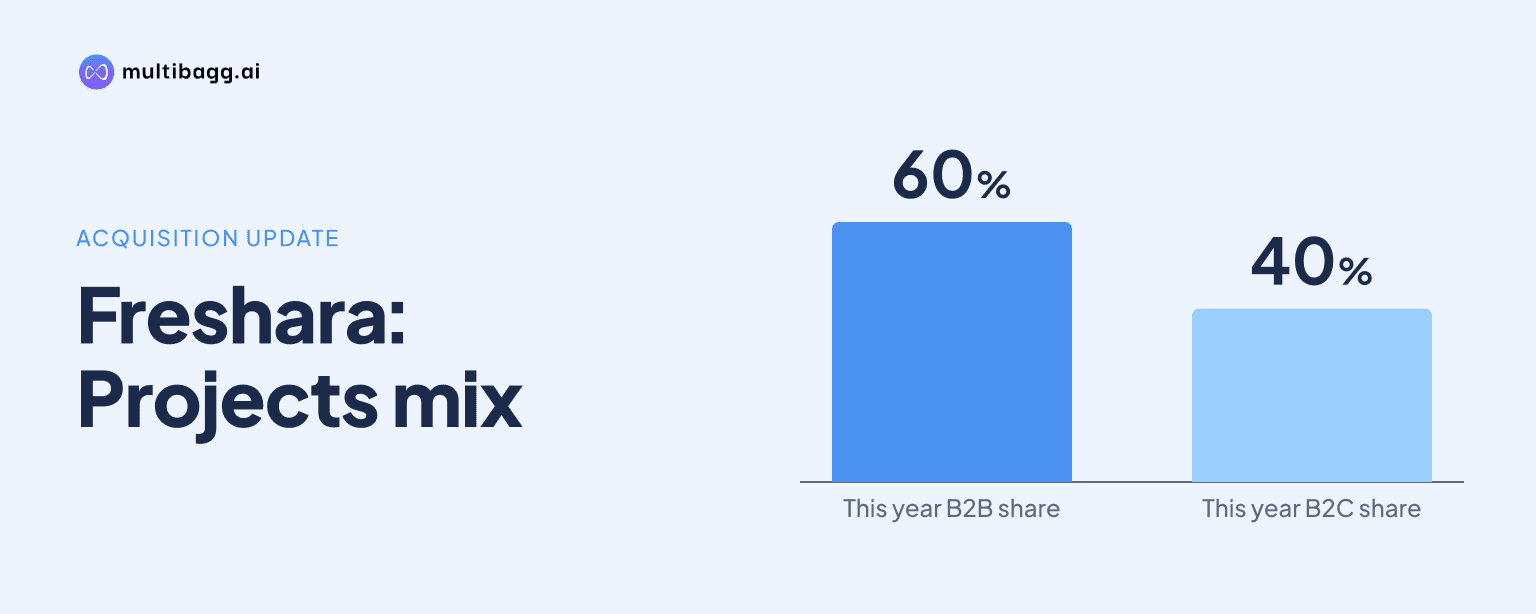
Pickl Freshara Agro Exports Limited expects a 60:40 business-to-business, or B2B, and business-to-consumer, or B2C, revenue mix this year, versus 100% B2B last year, after acquiring Sarasa in Spain. Management linked the change to Sarasa’s branded retail sales and targeted Rs 170-200 crore of revenue from the Spanish operation.
Know Freshara Agro Exports inside out
Results, valuation, peers and who's buying, in one view.
How did Sarasa alter Freshara's customer model?
Freshara said Sarasa changed its expected mix to 60% B2B and 40% B2C this year from 100% B2B last year. Management said revenue from the Indian operation would be B2B, while Sarasa revenue would be B2C, making the Spanish acquisition the direct driver of the change.
Sarasa brings branded consumer retail activity rather than only additional industrial or export volumes. Management said Sarasa products command higher prices than Indian products and that the Spanish unit could exceed Freshara’s revenue at one-third of its quantities. Freshara is initially concentrating on Sarasa’s established Spanish distribution network before pursuing broader global sales.
Management’s overall revenue target is Rs 575-600 crore. It expects the Indian unit to generate Rs 260-270 crore, comprising an order book close to Rs 170 crore and a further anticipated order book exceeding Rs 100 crore, while the Spanish operation is targeted at Rs 170-200 crore depending on foreign-exchange movements.
How is Freshara building Sarasa's retail distribution?
Freshara is first seeking wider Sarasa distribution in Spain, where management estimated its market share at less than 5% and set an aim of 15-20%. The company wants Sarasa available across retail outlets so supermarket shoppers can select it as a first or second preference, an ambition management said has not yet been achieved.
Freshara is also assessing distributors and price points in other countries, with management saying Sarasa could enter at least a few markets next year. It reported winning contracts with two large European retail chains in the preceding six months, including year-long agreements, while prioritising distribution development rather than converting the Spanish unit into a white-label exporter.
Management expects Sarasa to deliver close to Rs 200 crore this year at about 50% productivity. It said the Spanish facility historically generated about Rs 300 crore of revenue, suggesting capacity remains available within the existing site, although Freshara did not provide a dated sales forecast beyond the current-year target.
How will production changes support the retail shift?
Freshara is moving gherkin production to India so the Spanish operation can hold less gherkin inventory and produce more olives. Management said the arrangement should improve utilisation at both sites: Indian lines can run more efficiently, while the Spanish plant can devote more capacity to olives.
The company expects the Spanish unit’s financial year to close in December and said it should deliver a higher number from next year. That expectation rests on the production reprogramming and stronger use of existing distribution, not on an announced expansion into new geographies during the current year.
Freshara said retail-pack expansion should grow faster than industrial packing, although industrial-pack products are also increasing and require less new capacity. Management cited about 25 potential retailers in Europe and 10-15 in the United States, and said the longer-term product mix should tilt further toward retail packs and away from industrial packaging.
Got a follow-up? Ask IRIS
What could the B2C shift mean for margins and working capital?
Freshara’s management said full capacity utilisation could support earnings before interest, taxes, depreciation and amortisation, or EBITDA, margins of 14-15%, and later clarified that consolidated profit after tax, or PAT, margin could be around 11%. These are management expectations rather than guidance for a specified reporting period.
Near-term margins remain tied to freight conditions and customer pass-throughs. Management said it expected one or two basis points of margin improvement in the second half if freight stabilised, after freight costs rose materially during the first half and contracts could not be immediately repriced.
The Spanish operation may reduce consolidated working-capital requirements because its local-market credit period is about 60-90 days, according to management. Freshara said its overall working-capital cycle had increased from 90-120 days two years earlier to about 150-160 days because delayed shipping routes disrupted deliveries for seven to nine months.
Management anticipates cutting the working-capital cycle by another 30 days if external ocean-freight disruption eases. It also said a larger retail and white-label customer base requires more stock keeping units, or SKUs, and inventory, meaning the pace of growth and freight reliability will both influence cash needs.
What targets and funding plans accompany Freshara's strategy?
Freshara said existing Indian facilities could reach Rs 1,000 crore of revenue in about 24 months through incremental production lines, without another industrial setup. Management also said the Spanish business could reach at least 50 million with limited additions to machinery and production lines, and described a combined capacity opportunity of around Rs 1,500 crore.
Management did not confirm a timeline for the combined target when asked whether it could be achieved by FY30. It said it was targeting the level, while noting that a further full-scale acquisition would be required after the Indian facilities reach their nearer-term capacity objective.
For the next 12 months, Freshara estimated working-capital needs of Rs 30-50 crore and said a potential acquisition could require another Rs 50 crore. Management had not selected a funding source and said it expected to provide narrower information within one or two months, while stating that each acquisition would be planned separately from the existing business.
Freshara said it would not pursue European assets simply to add olive production. Management said an acquisition would need a strong brand or manufacturing relevance in a geography that is difficult to serve through freight, and cited its expectation of recovering the Sarasa investment within at most 1.5 years through profitability.
Conclusion
Freshara’s Sarasa acquisition has shifted the expected customer model from entirely B2B last year to a 60:40 B2B-B2C mix this year. The change is anchored in Rs 170-200 crore of targeted Spanish sales, branded retail distribution and a production plan that moves gherkins to India while freeing Spanish capacity for olives.
The next measures to watch are Sarasa’s December financial close, the planned entry into at least a few additional countries next year, and the targeted 30-day reduction in working-capital days if freight disruption eases. Management’s expected update within one or two months on financing for possible acquisitions will also clarify how Freshara intends to fund further expansion.

