










Gabion H1 profit doubles as cash outflow reaches Rs 5.69 crore
Key highlights
- Gabion’s H1 FY27 revenue rose 76.2% to Rs 71.53 crore.
- Gabion’s H1 FY27 profit after tax increased 124.1% to Rs 5.42 crore.
- Gabion reported a Rs 5.69 crore operating cash outflow as inventory rose Rs 11.26 crore from March 2026.
- Gabion had 35 live contracts worth Rs 179.9 crore, with Rs 110.5 crore yet to be billed.
powered by IRIS
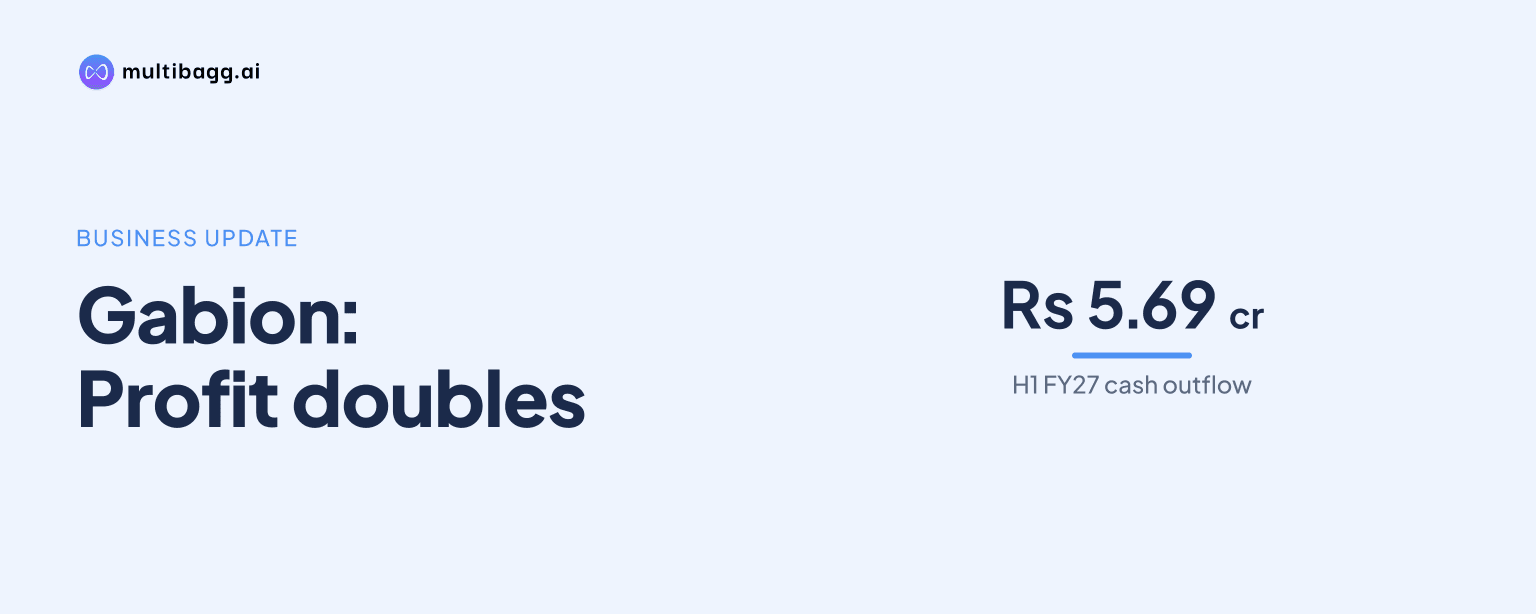
Gabion Technologies India Limited reported H1 FY27 profit after tax of Rs 5.42 crore, up 124.1% year on year, but posted a Rs 5.69 crore operating cash outflow as inventory increased for order-book execution. Revenue rose 76.2% to Rs 71.53 crore and September-end inventory stood at Rs 46.76 crore.
Know Gabion Technologies India inside out
Results, valuation, peers and who's buying, in one view.
How did Gabion perform in H1 FY27?
Gabion increased revenue, operating profit and net profit in H1 FY27, with profit after tax rising faster than sales. Consolidated revenue from operations rose to Rs 71.53 crore from Rs 40.59 crore in H1 FY26, a 76.2% increase. Earnings before interest, tax, depreciation and amortisation, or EBITDA, rose 78.5% to Rs 10.27 crore from Rs 5.7 crore, while profit after tax increased to Rs 5.42 crore from Rs 2.42 crore.
Gabion’s reported margins also increased during the six months ended September 2026. EBITDA margin was 14.4%, compared with 14.2% in H1 FY26, while profit-after-tax margin rose to 7.6% from 6%. Earnings per share were Rs 4 for H1 FY27, and finance cost declined to Rs 2.09 crore from Rs 2.52 crore. Net debt-to-equity was 0.86 at September 30, 2026.
Management said employee cost had fallen to 10% of revenue from 14% while discussing the EBITDA result. It also said it was working on plant utilisation and inventory-cost optimisation, and expected margins to remain stable in coming years. Those are management expectations rather than reported future results.
Why did Gabion report a Rs 5.69 crore operating cash outflow?
Gabion reported a Rs 5.69 crore operating cash outflow in H1 FY27 because it built inventory to support order-book execution. The chief financial officer said working capital was an area of close attention because the operating model carries both project inventory and trade receivables. The cash outflow contrasts with the Rs 5.42 crore profit after tax reported for the same half year.
Inventory stood at Rs 46.76 crore at September-end, up Rs 11.26 crore from Rs 35.50 crore in March 2026. Trade receivables rose to Rs 43.91 crore from Rs 42.82 crore over the same period, an increase of Rs 1.09 crore. Together, receivables and inventory reached Rs 90.67 crore in September, compared with Rs 78.32 crore in March, although management specifically linked the operating cash outflow to inventory building.
Gabion also recorded net cash usage of Rs 4.86 crore in investing activities during H1 FY27, primarily for the Assam unit and capacity expansion at Paonta Sahib. That investing cash use was separate from the Rs 5.69 crore operating outflow, but both arose while Gabion was adding manufacturing capacity and carrying materials for contracts. Management identified tighter working capital, particularly collections, as a priority for the remainder of FY27.
Got a follow-up? Ask IRIS
What drove Gabion’s revenue growth and order book?
Gabion said H1 FY27 revenue growth came from execution on economic-corridor and hillside infrastructure projects. Management cited Dilip Buildcon’s CG02 package on the Raipur-Visakhapatnam corridor, H.G. Infra packages in Odisha and Andhra Pradesh, Bengaluru-Vijayawada corridor projects, the Chennai-Tirupati highway, and Shivalik landslide treatment work on NH-07 in Uttarakhand.
Gabion won 14 new work orders worth Rs 53.4 crore between April and September 2026. As of the November 6, 2026 call, management said the order book exceeded Rs 120 crore. Its 35 live work contracts had a total value of Rs 179.9 crore, of which Rs 69.4 crore had been billed and Rs 110.5 crore remained to be billed, making the unbilled portion larger than the billed amount.
More than half of Gabion’s order book was in rockfall and slope protection, followed by embankments and retaining walls, with a newer contribution from ash ponds. About 79% of the order book was with private and engineering, procurement and construction clients, while 21% was direct government work. The contracts covered 11 states, and management said no individual state accounted for more than one-fifth of the order book.
Gabion said solutions and supply each contributed about 50% of H1 FY27 revenue, while tonnage was 80% above the comparable prior-year period. Management also said the solutions business had a profit-after-tax margin about 5 percentage points higher than the supply business. Gabion did not disclose segment revenue or profit amounts, so the effect of that mix on reported H1 profit cannot be quantified from the call.
Can Gabion expand capacity while controlling working capital?
Gabion is expanding manufacturing capacity while management says inventory and collections require tighter control. The Assam unit near Guwahati, with capacity of about 5,000 metric tonnes annually and on-site polyvinyl chloride, or PVC, coating, is operational. At Paonta Sahib, new lines are being added beside a 9,200-metric-tonne annual certified plant, and management said group capacity across Assam and Nepal would reach 18,000 metric tonnes on commissioning.
The planned 18,000-metric-tonne capacity would be almost double the 9,108 tonnes Gabion produced in FY26. Management said machinery for the remaining Paonta Sahib capacity addition was in transit and expected to reach the factory in December 2026 for installation. The project is part of the Rs 4.86 crore H1 FY27 investing cash use that management attributed mainly to the Assam unit and Paonta Sahib expansion.
Management said the expanded manufacturing base could support Rs 150 crore of manufacturing revenue potential. It also said PVC compound backward integration was planned by the end of FY27, or conservatively in the first quarter of the next financial year, and could add 1 percentage point to manufacturing-side profit-after-tax margin. A later galvanised iron wire integration remained under discussion with possible manufacturing partners; management estimated that it could add another 1.1 percentage points.
Gabion guided to FY27 turnover of Rs 180 crore to Rs 200 crore and FY28 turnover of Rs 300 crore to Rs 350 crore. Management also said bids already submitted totalled about Rs 200 crore and expected new orders of around Rs 150 crore in FY27, largely for execution in the next year. These management targets depend on project execution, capacity commissioning and the collection discipline identified in H1 FY27.
Conclusion
Gabion’s H1 FY27 results combined a 76.2% increase in revenue, a 78.5% rise in EBITDA and a 124.1% increase in profit after tax with a Rs 5.69 crore operating cash outflow. The difference between Rs 5.42 crore of profit after tax and negative operating cash flow reflected inventory rising by Rs 11.26 crore to Rs 46.76 crore, while receivables reached Rs 43.91 crore.
The next measures to watch are Gabion’s stated plan to execute its Rs 120 crore-plus order book through the peak season, tighten collections, install Paonta Sahib machinery expected in December 2026 and ramp up the Assam unit. Management’s Rs 180 crore to Rs 200 crore FY27 turnover guidance and planned PVC backward integration by the first quarter of the next financial year provide disclosed milestones.