










Gabion Technologies India Ltd.: Services reached 44.61% in FY26
Key highlights
- GTI’s services share rose to 44.61% of FY26 revenue from 34.19% in FY24.
- Manufacturing’s revenue share declined from 57.62% in FY24 to 49.65% in FY26.
- GTI had Rs 110.5 crore left to bill across 35 live works contracts as of November 2026.
- GTI won 14 works orders worth Rs 53.4 crore during April-September 2026.
powered by IRIS
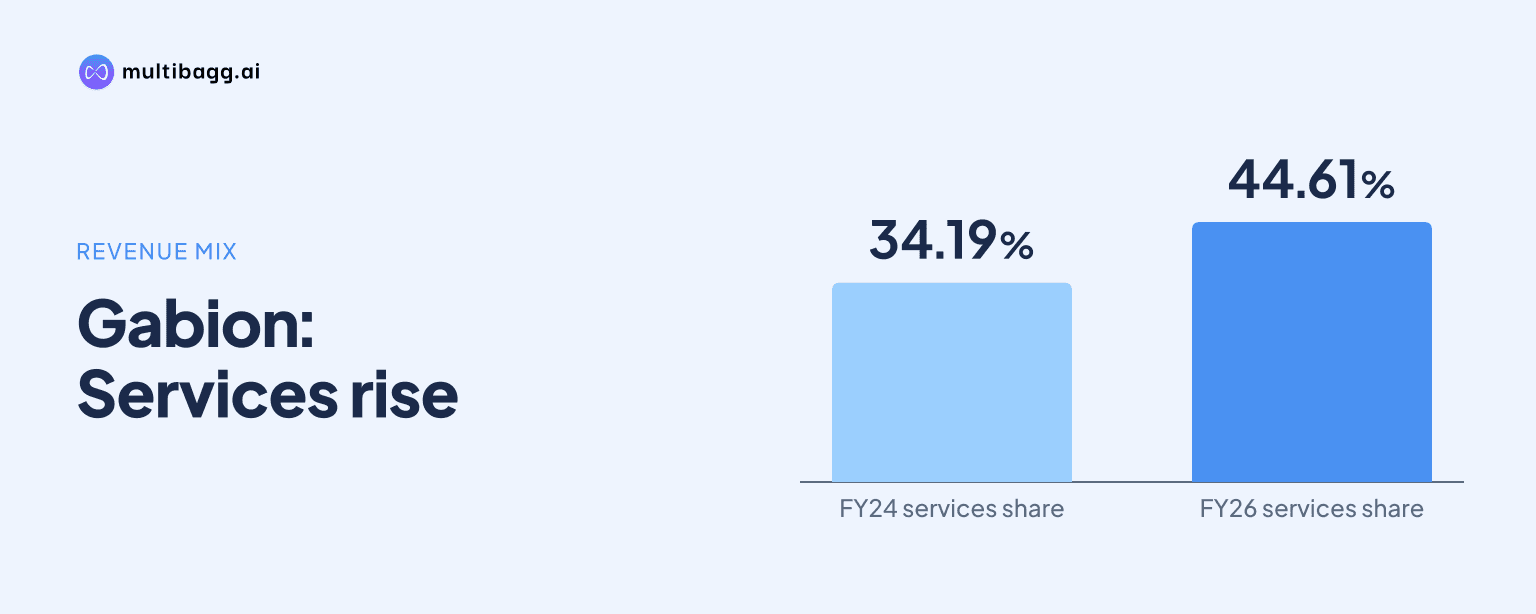
Gabion Technologies India Ltd. generated 44.61% of its revenue from services in financial year 2026 (FY26), up 10.42 percentage points from 34.19% in FY24. The change coincided with manufacturing’s share falling to 49.65% from 57.62%, while GTI retained manufacturing, trading, design and project-execution activities in its operating model.
Know Gabion Technologies India inside out
Results, valuation, peers and who's buying, in one view.
Why did GTI’s services share rise in FY26?
GTI’s services contribution increased to 44.61% in FY26, making it only 5.04 percentage points below manufacturing’s 49.65% share. The FY26 outcome followed a 33.50% services share in FY25 and a 34.19% share in FY24. Thus, services rose by 11.11 percentage points in the year from FY25 to FY26, after declining by 0.69 percentage points between FY24 and FY25.
The shift was across the three reported verticals rather than a move away from product supply. Manufacturing fell by 7.97 percentage points from FY24 to FY26, and trading declined by 2.44 percentage points. Manufacturing and services together still represented 94.26% of FY26 revenue, indicating that the mix remained concentrated in GTI’s two core verticals.
What work is included in GTI’s services business?
GTI’s services business comprises works contracts and technical and project services. The works-contract categories are government contracts, private contracts and government sub-contracts, while technical and project services cover design consultancy, supervision services and project management.
GTI says its in-house geotechnical design and engineering team was established during 2016-2020, before the FY24-FY26 revenue-mix period. Its design and execution offering includes slope stabilisation, erosion control, river-training and retaining-wall projects, as well as anchor-mesh and rockfall-protection systems. The company states that it is pre-qualified to bid independently for government tenders and can provide delivery from design to commissioning.
The service activity is paired with a manufacturing and supply portfolio that includes gabions, gabion mattresses, sack gabions, tail mesh gabions and defence gabions. It also includes reinforcement and protection products such as high-strength flexible geogrids, PP rope gabions, DT mesh netting, RockNet, Ring Net, StrongNet and Strongmat. This product range gives GTI a stated route to combine supplied materials with design and installation work.
Got a follow-up? Ask IRIS
How does GTI connect manufacturing with project execution?
GTI connects manufacturing with project execution by designing its own products into, and installing them in, its own works. The integrated process starts with galvanised iron wire bought from mills in Himachal Pradesh, Uttar Pradesh, Haryana and Chhattisgarh, then moves through PVC coating, double-twist weaving, finishing and assembly, fabrication and extrusion, and finally design and installation.
The company’s Paonta Sahib, Himachal Pradesh facility has 9,200 metric tonnes per annum of certified capacity, five double-twist gabion lines and four PVC-coating lines. GTI describes the site’s systems and practices as ISO and BIS certified, with incoming materials tested. The Assam unit near Guwahati is operational with about 5,000 metric tonnes per annum of capacity and on-site PVC coating.
Production rose from 8,492 metric tonnes in FY24 to 8,588 metric tonnes in FY25 and 9,108 metric tonnes in FY26. GTI also identifies captive consumption as a feature of the model, meaning its material feeds its own project sites. Its disclosed next step is planned in-house PVC compound production, intended to increase control over a key input; the presentation gives no commissioning date for that plan.
What current contracts could support GTI’s service activity?
GTI reported Rs 179.9 crore of total contract value across 35 live works contracts as of November 2026, of which Rs 69.4 crore had been billed and Rs 110.5 crore remained to be billed. It also reported winning 14 works orders valued at Rs 53.4 crore during April-September 2026. These figures describe contract activity and billing visibility, rather than revenue recognised in a specified future period.
Rockfall and slope protection represented the largest application category at Rs 60.2 crore as of September 2026, followed by embankments and retaining walls at Rs 28.8 crore. Ash ponds accounted for Rs 11.2 crore and erosion control and other applications for Rs 2.3 crore. Private and engineering, procurement and construction clients accounted for 79% of the contract value, compared with 21% for direct government clients.
GTI’s stated bidding process includes bid or no-bid evaluation of scope, site complexity, eligibility, order load, cost and margin estimates before tender submission. During execution, it says materials are mobilised from its own units and approved vendors, monthly running bills are raised on verified records, and variations are managed. Completion certificates are described as technical credentials for subsequent, larger tenders, while retention is released after a one-to-two-year defect-liability period.
Conclusion
GTI’s FY26 mix shows a measurable movement toward services: the segment gained 10.42 percentage points of revenue share from FY24, while manufacturing and trading both lost share. The presentation nevertheless describes an integrated model rather than separate service and product operations, with in-house design, project management and execution linked to gabion, netting and geosynthetic manufacturing.
The next disclosed items to watch are conversion of the Rs 110.5 crore balance-to-be-billed across 35 live contracts, the execution of Rs 53.4 crore of orders won in April-September 2026, and progress on the planned in-house PVC compound facility. GTI also reports 18,000 metric tonnes per annum of group capacity on commissioning, including 3,800 metric tonnes from new lines and Nepal.