










Ganesh says acquired unit delivered 49% of H1 revenue
Key highlights
- Ganesh said its acquired mining and transport subsidiary generated Rs 340 crore, or 49%, of consolidated H1 FY27 revenue.
- The subsidiary contributed Rs 39 crore of H1 FY27 segment EBITDA, representing a stated 57% share at a 16.8% margin.
- The acquired business added a Rs 2,566 crore order book as of September 30 and won a Rs 100 crore rail-link subcontract in H1 FY27.
- Ganesh reported Rs 586 crore of consolidated borrowings in September, compared with Rs 494 crore in March.
powered by IRIS
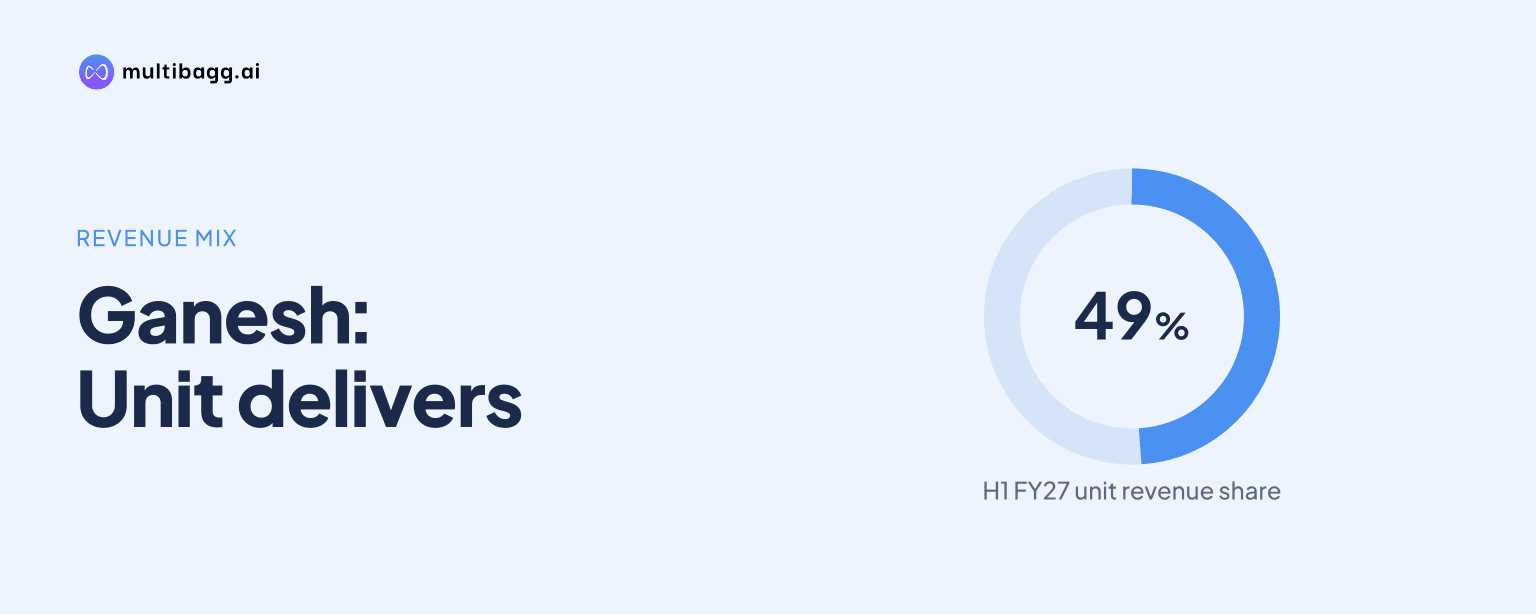
Ganesh Infraworld said its acquired mining and transport subsidiary delivered Rs 340 crore, or 49%, of consolidated revenue in H1 FY27, while contributing 57% of segment EBITDA and adding a Rs 2,566 crore order book as of September 30. Management said the subsidiary was the largest driver of consolidated growth after the acquisition.
Know Ganesh Infraworld inside out
Results, valuation, peers and who's buying, in one view.
How much did the acquired business contribute to Ganesh’s H1 FY27 results?
The acquired mining and transport subsidiary contributed Rs 340 crore of revenue in H1 FY27, equal to 49% of Ganesh’s consolidated revenue, management said. It reported Rs 39 crore of segment earnings before interest, tax, depreciation and amortisation, or EBITDA, which management said represented 57% of segment EBITDA, at a stated 16.8% margin.
The subsidiary therefore supplied a larger stated share of segment EBITDA than revenue, with 57% of EBITDA against 49% of revenue. Management called the acquired operation Ganesh’s biggest growth driver and said its performance after acquisition was in line with the business plan prepared for the business.
The analyst referred to the transaction as the acquisition of Kandoi Transport, while management referred to the operating subsidiary as Tycoon and Tycoon Mines. The call did not disclose a purchase price, acquisition date, separate pre-acquisition financials or a return calculation, so its figures show the subsidiary’s current H1 FY27 contribution rather than the financial return on the deal.
Why did the acquired business account for more EBITDA than revenue?
Management attributed the larger EBITDA contribution to the mix of mining and water work, which it described as higher-margin segments than civil work. Ganesh reported a consolidated H1 EBITDA margin of 15.2%, up from 11.9% a year earlier, as mining and water contributed a greater share of business.
In the September-quarter discussion, management said revenue grew almost 50% year on year and EBITDA rose 78% year on year. It linked the improvement in operating performance to mining and water revenue, but did not provide the corresponding September-quarter revenue or EBITDA amounts in the call.
Management said mining development and operation, or MDO, projects can generate EBITDA margins of about 24%. It said the mining business reported around 19% EBITDA in H1 because fixed costs remained high while billing was lower during the September quarter, and management expected mining EBITDA margin to approach about 24% by year-end if execution and billing improved.
What order book did the acquired business add to Ganesh?
The acquired mining and transport subsidiary added a Rs 2,566 crore order book to Ganesh’s portfolio as of September 30, according to management. It also won a Rs 100 crore Bhikhanashila Rail Link subcontract in H1 FY27, which management said was secured by the subsidiary.
Management distinguished the duration of standalone and subsidiary contracts. It said Ganesh’s standalone orders generally have a 24-month tenure and an average remaining life of about 18 months, whereas mining-development orders at the subsidiary typically span seven to nine years and had an average remaining life of about 3.5 years.
Management said the subsidiary’s net worth, credentials and asset quality could help Ganesh seek direct orders from clients. That was a stated strategic benefit rather than a disclosed order win, and management said there was no current discussion or pending plan for another acquisition.
Got a follow-up? Ask IRIS
How is Ganesh funding the subsidiary’s fleet and operations?
Ganesh reported consolidated borrowings of Rs 586 crore in September, compared with Rs 494 crore in March. Management said the debt increase reflected consolidation of the subsidiary’s borrowings and investment in the equipment-leasing fleet, while Rs 193 crore of short-term loans and advances related to the subsidiary.
Term loans were Rs 277 crore, cash credit was Rs 223 crore and unsecured loans were Rs 87 crore. Management said term loans funded the mining and transport fleet and new leasing assets, while cash credit and unsecured loans funded working capital; net fixed assets were about Rs 410 crore, largely comprising the mining and transport fleet and equipment-leasing assets.
Debt-to-equity was 1.27 times in September, compared with 1.22 times in March. Management said it aimed to reduce leverage through scheduled term-loan repayments, a second-half working-capital release and about Rs 28 crore from outstanding warrant conversions, although it also said a pending debt tie-up could be completed in the December quarter.
What cash-flow and profit pressures remain for Ganesh?
Ganesh recorded negative operating cash flow of Rs 82 crore in H1 FY27 after working capital absorbed Rs 176 crore. Management said the business generated Rs 107 crore of operating cash before working-capital changes, compared with Rs 46 crore in the prior year, and attributed the cash absorption to growth, monsoon-season billing patterns and advances to suppliers and subcontractors.
Management said H2 normally has higher execution and government payments after the rainy season, which could allow billing, collections and adjustments of supplier advances against bills to release working capital. This was management’s expectation, not a reported improvement in H1 collections or operating cash flow.
Profit after tax declined despite revenue and EBITDA growth because depreciation rose by about Rs 18 crore and finance cost increased by about Rs 14 crore, management said. It linked both costs to investment ahead of revenue growth in the leasing fleet, mining and transport fleet and working capital, and said depreciation under the written-down-value method and interest expense should decline over time as assets age and term loans are repaid.
Conclusion
Ganesh’s H1 FY27 figures show that the acquired mining and transport subsidiary had become central to consolidated operations, delivering 49% of revenue and a stated 57% of segment EBITDA while bringing a Rs 2,566 crore order book. The mix also coincided with the group’s consolidated EBITDA margin rising to 15.2% from 11.9% a year earlier, although working-capital absorption, depreciation and interest costs continued to weigh on cash flow and profit after tax.
Next, investors can watch whether H2 execution releases the Rs 176 crore of working capital absorbed in H1 and whether mining margins move toward management’s approximately 24% year-end expectation. Other disclosed items to track are the possible December-quarter debt tie-up, repayments on Rs 277 crore of term loans and the expected conversion of about Rs 28 crore of outstanding warrants.