










GEE Limited says 45%-50% market could shift to organised suppliers
Key highlights
- GEE says 45%-50% of India’s Rs 1.20 lakh crore welding-consumables market is unorganised.
- Management aims to increase GEE’s market share from about 6%-6.5% to 12%.
- GEE added more than 130 dealers during the previous six months.
- Management expects planned 25%-30% growth to be roughly 60% volume-led and 40% value-led.
powered by IRIS
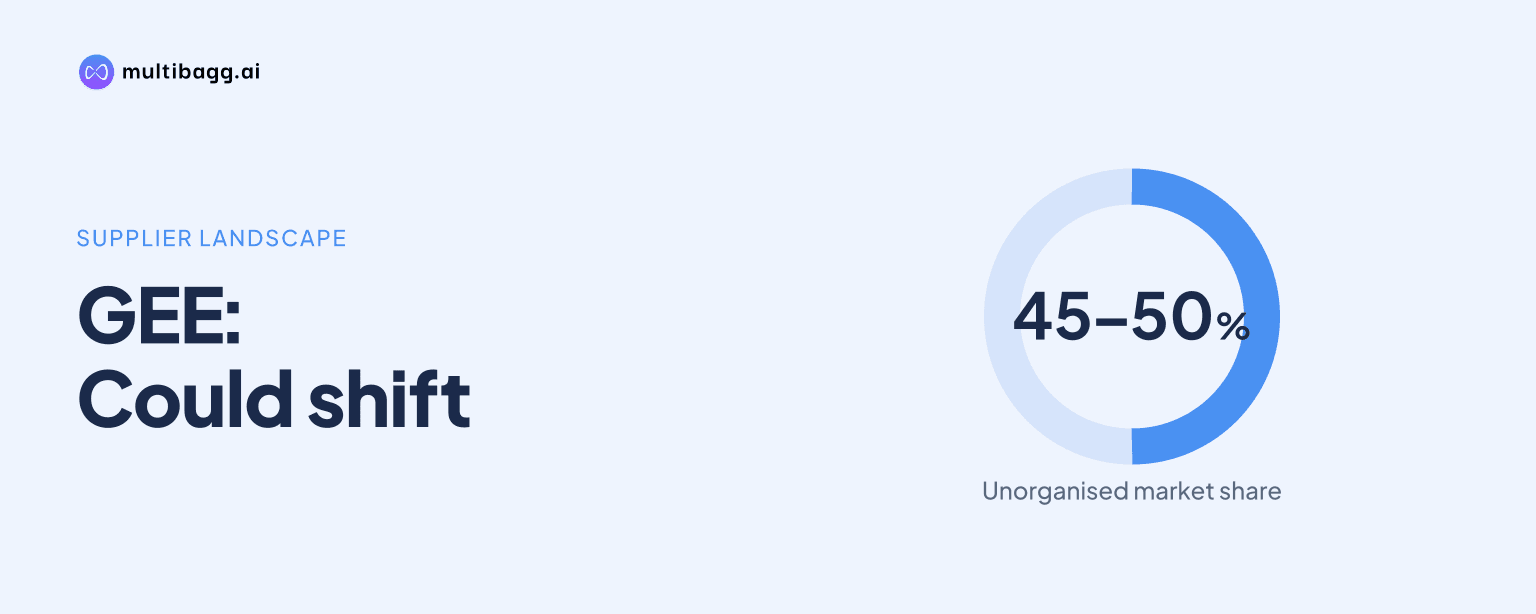
GEE Limited says 45%-50% of India’s Rs 1.20 lakh crore welding-consumables market is served by unorganised suppliers, creating an opportunity for organised vendors as critical projects demand approved and technically capable products. Management linked its growth plan to this formalisation potential, alongside wider distribution and specialised applications.
Know GEE inside out
Results, valuation, peers and who's buying, in one view.
How much of India’s welding-consumables market is unorganised?
GEE says about 45%-50% of India’s Rs 1.20 lakh crore welding-consumables market remains unorganised. Management presented that estimate as a potential source of growth for organised suppliers, rather than saying its expansion would depend only on taking share from the two or three larger competitors cited by an analyst.
The implied organised portion is 50%-55% of the market, while GEE’s stated opportunity is to participate in the migration of regional and informal suppliers into organised channels. Management specifically cited fabrication activity in the Nagpur and Raipur belt, where it said smaller suppliers and fabrication shops continue to operate.
GEE linked the expected shift to import substitution in specialised industrial work. Management said some defence and other projects had previously used inputs imported from Germany and other European countries, while the Make in India push is encouraging Indian manufacturers to supply such components. It did not provide historical import volumes, peak import levels or a quantified substitution estimate.
Why does GEE expect critical projects to favour organised suppliers?
GEE says critical applications require high-quality welding consumables because the products join metal components in projects such as nuclear reactors, chemical pipelines, freight corridors, highways, railway coaches and aircraft carriers. Management said a failure in a welded joint can affect human safety as well as the infrastructure and capital invested in those projects.
Management said welding consumables account for about 2% of the steel used in a project. GEE’s argument is that this limited share of total project material cost makes specification, consistency and product performance important in large industrial applications, even where the consumable itself represents a comparatively small component of project spending.
GEE also said vendor approvals restrict the field of suppliers for certain customers. Management stated that only two or three companies in India are approved for some customers, including Bharat Heavy Electricals Limited and Nuclear Power Corporation of India Limited. It said GEE was the second or third company in the country to secure Nuclear Power Corporation approval and supplies tailor-made products to the Defence Research and Development Organisation.
Management differentiated those uses from mass fabrication applications such as window grills. It cited a 0.0001 defect in a weld and a 0.1% of a millimetre leakage as illustrations of the risks it associates with sensitive infrastructure, arguing that experienced research and development personnel matter more where weld integrity is critical.
Got a follow-up? Ask IRIS
How does GEE plan to capture the formalisation opportunity?
GEE plans to use distribution expansion, higher volumes and specialised products to pursue the opportunity. Management said it aims to increase market share from roughly 6%-6.5% to 12%, describing the target as achievable in a Rs 1.20 lakh crore market despite the analyst’s reference to about 6% industry growth.
Management expects its planned 25%-30% growth to be approximately 60% volume-led and 40% value-led. It said volume growth should come from higher capacity utilisation and broader reach, while value growth is expected from applications including defence and other sectors requiring more specialised welding consumables. These are management projections rather than reported growth figures.
Dealer additions are one method GEE identified for reaching smaller markets and project locations. Management said it added more than 130 dealers in the previous six months and is expanding coverage across geographies and sectors. It said local dealers and distributors help serve sites where customers cannot maintain large inventories of consumables.
GEE said southern India is a key part of its expansion plan, rejecting an analyst’s suggestion that the region was not needed for growth. Management said its eastern and western locations can serve Andhra Pradesh, Telangana and Tamil Nadu at broadly comparable distances, while identifying energy, steel, infrastructure, defence and railways as priority sectors.
What supports GEE’s growth and margin expectations?
GEE’s growth outlook also relies on the seasonal revenue pattern described by management. It said the company has historically generated more than 55% of annual revenue in H2, or the second half, while H1, or the first half, accounts for 40%-45%, as monsoon conditions can slow infrastructure execution during the first two quarters.
Management described the recent quarter as temporary amid war-related and geopolitical disruption, without providing a numerical quarterly revenue figure in this call excerpt. It said it was seeing work on the ground and expects its 25%-30% growth trajectory to extend through FY27 and the following two to three years.
On input costs, GEE said it generally takes 15-25 days to pass steel-price changes through to finished-product pricing. Management said the business does not typically use long-term supply contracts because welding consumables are a small part of project execution, and customers procure as needed either directly or through local distributors.
GEE said finished-goods prices also do not decline immediately when steel prices fall. Management described this timing as a mechanism that helps protect gross profit margins, while noting that customers such as Larsen & Toubro can procure for numerous project sites through both centralised procurement and local dealer networks.
Conclusion
GEE’s formalisation case rests on management’s estimate that 45%-50% of the Rs 1.20 lakh crore welding-consumables market remains unorganised. The company is seeking to address that opportunity through vendor approvals, tailored products for critical applications, more than 130 new dealers in six months and broader coverage of infrastructure-linked sectors.
The next disclosures to watch are progress toward GEE’s 25%-30% growth expectation, its stated goal of increasing market share from about 6%-6.5% to 12%, and whether H2 again contributes more than 55% of annual revenue. Management also said cash accrual from land monetisation is intended to fund inorganic acquisitions without making them debt-heavy, but gave no acquisition target or timetable.