










GEE targets 12%-13% EBITDA margin through specialised mix
Key highlights
- GEE targets a sustainable EBITDA margin of 12% to 13%, versus its stated current range of 8% to 9%.
- GEE plans to raise specialised and niche products from 27% to 35% to 40% of its product basket in the coming year.
- GEE expects EBITDA margin of 9% or above in Q3 and Q4 after Q2 raw-material cost pressure.
- GEE plans to expand capacity from 59,000 to 71,000 metric tonnes and exceed 90% utilisation by FY29 or FY30.
powered by IRIS
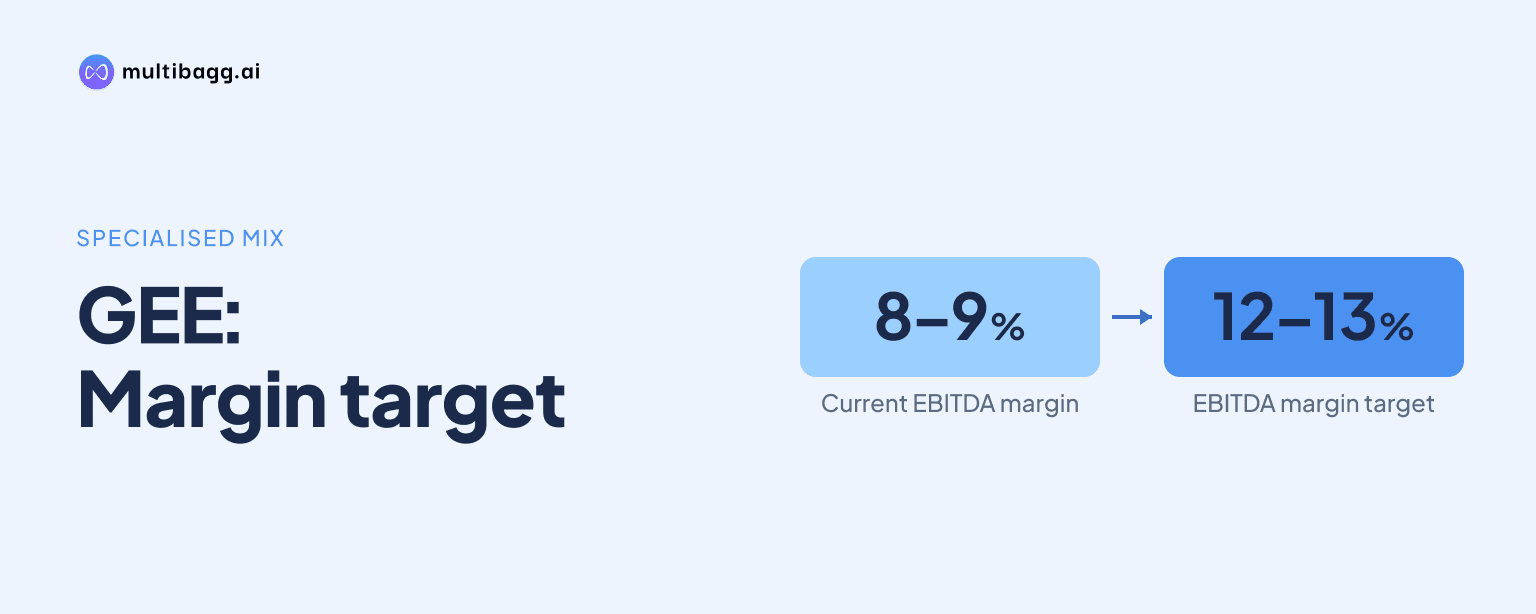
GEE Limited is targeting a sustainable earnings before interest, tax, depreciation and amortisation (EBITDA) margin of 12% to 13%, after input-cost pressure affected Q2 profitability, by lifting specialised products from 27% to 35%-40% of its product basket and using more factory capacity. Management expects EBITDA margin to recover to 9% or above in Q3 and Q4.
Know GEE inside out
Results, valuation, peers and who's buying, in one view.
Why did GEE's Q2 profitability fall despite revenue growth?
GEE said higher raw-material prices were the main reason Q2 profitability declined even as revenue grew 18.6% year on year. An analyst on the call said operating profit fell by about 12% year on year and profit after tax declined by around 6%, while management attributed the divergence principally to input-price inflation rather than a weaker product mix.
Management said steel prices had risen steeply during the preceding six months, while higher oil and gas prices also raised costs. It described the pressure as temporary and said market conditions were beginning to normalise. GEE did not provide a reported Q2 EBITDA margin in the call, but described its current margin range as 8% to 9%.
The company also linked its working-capital position to steel-price volatility. Inventory days rose from 100 to 127 days, according to an analyst, as GEE stocked material against sharp price increases and sought to supply customers, dealers and distributors more quickly. Management said inventory accumulation was both a response to prices and a commercial strategy to support delivery availability.
How will specialised consumables improve GEE's EBITDA margin?
GEE plans to raise specialised and niche products to 35% to 40% of its product basket in the coming year, from a current 27%. Management said the mix change would directly support EBITDA margin because it is adding higher-value products rather than relying only on commodity welding consumables.
The call did not disclose a product-by-product margin comparison, but management outlined a substantial difference in selling-price ranges. Conventional mass-moving welding consumables can sell for about Rs 100 to Rs 125 per kilogram, while specialised products can range from Rs 275 to Rs 1,500 per kilogram, depending on technical configuration and the raw materials used.
GEE cited silver brazing alloy wire, nickel wire and GTX-series products as examples of specialised offerings. The wider selling-price range does not establish a fixed margin differential, as management said prices depend on the product. However, management presented the shift toward these products as the first of three levers for moving EBITDA margin from 8% to 9% toward 12% to 13%.
What other levers does GEE have to expand margins?
GEE said better sales realisation is its second margin lever. Management said Ador and ESAB currently receive higher realisation for similar products, although they operate in the same industry ecosystem. It added that Ador historically operated in a 7% to 9% EBITDA-margin range before its improvement, while ESAB has a higher margin percentage.
Management attributed the realisation gap to the competitors' historical goodwill and said GEE's more than 50 years of industry experience, quality standards, research team and approvals could support higher price realisation over time. This was management's assessment of the commercial opportunity, not a disclosed target for a specific price increase.
The third lever is scale. GEE has consolidated capacity of around 59,000 metric tonnes and plans to expand it to 71,000 metric tonnes, while targeting utilisation above 90% by FY29 or FY30. Management said a higher utilisation rate from currently unutilised capacity should lower operational cost per tonne through economies of scale.
Got a follow-up? Ask IRIS
When does GEE expect to reach its EBITDA-margin target?
GEE management indicated a staged path rather than a single-date commitment for 12% to 13% EBITDA margin. It said it expected a 0.5 percentage-point improvement in FY27, followed by another 0.5 to 0.75 or 1 percentage point in FY28, with a double-digit EBITDA margin expected in FY28 and a further increase in FY29.
In a separate response, management framed the 12% to 13% objective as sustainable EBITDA margin to be achieved over the next one to two years. Earlier in the call, it had described a three- to four-year horizon for reaching a sustainable 12% to 13% range. The disclosed FY27 through FY29 progression gives the more specific milestones, although management did not provide a quarterly path beyond Q3 and Q4.
For the near term, GEE said it was looking to restore EBITDA margin to 9% and above in Q3 and Q4 through improving market conditions and more value-added products. That expectation followed Q2 input-price pressure, rather than a disclosed change in selling prices or a specified reduction in steel costs.
Management also connected margin expansion to growth in turnover. It has outlined a 25% to 30% year-on-year top-line growth objective and said it more realistically targets Rs 1,000 crore of revenue in FY30. Reaching that scale would depend on sales growth alongside the specialised-product mix and greater capacity use.
What operational issues could affect GEE's margin plan?
GEE plans to reduce working-capital intensity, beginning with a move below 100 days and then toward market-peer levels by FY28. Management said higher inventory was primarily caused by steel-price spikes, and it expects leaner inventory management to lower overall working-capital utilisation by the year end.
The company has working-capital limits of around Rs 100 crore from banks and said it was using around Rs 40 crore at the time of the call. Management said the company has no term loans or long-term capital loans, and that higher borrowings reported at September-end reflected advances paid to steel suppliers including JSW, SAIL and Tata.
GEE also said other expenses were Rs 12.50 crore for the quarter, compared with Rs 9.50 crore in the comparison cited by an analyst. Management did not identify a single exceptional cost, saying the increase reflected expenditure on securing approvals and deeper market penetration. It did not describe this cost category as a permanent manufacturing-cost increase.
Its sales model is approximately 55:45 across business-to-business and business-to-consumer channels. GEE directly supplies customers including BHEL, DRDO, L&T and JCB, while dealers and distributors may be used where customers prefer lower inventory or where payment terms are more favourable. Management said dealer channels can enable advances, upfront payments or shorter trade cycles.
Conclusion
GEE's margin plan combines a recovery from steel, oil and gas cost pressure with measurable changes in its portfolio and factory use. Management is seeking to increase specialised products from 27% to 35% to 40%, raise capacity from 59,000 to 71,000 metric tonnes and move EBITDA margin from 8% to 9% toward a sustainable 12% to 13% range.
The next points to watch are GEE's stated Q3 and Q4 EBITDA-margin expectation of 9% or above, its year-end effort to bring working-capital days below 100, and progress toward a double-digit margin in FY28. Management has also set a utilisation target above 90% by FY29 or FY30, while targeting Rs 1,000 crore of revenue more realistically in FY30.