










GEE plans Rs 35-40 crore capex to double MIG-wire capacity
Key highlights
- GEE plans Rs 35 crore to Rs 40 crore of capex over the next two years and management expects 18% to 20% returns.
- GEE plans to double MIG-wire capacity from 12,000 metric tons to 24,000 metric tons.
- GEE targets flux-cored wire capacity of 12,000 metric tons, up from about 250 metric tons.
- Management targets specialised and niche products at 35% to 40% of the basket, versus about 27% currently.
powered by IRIS
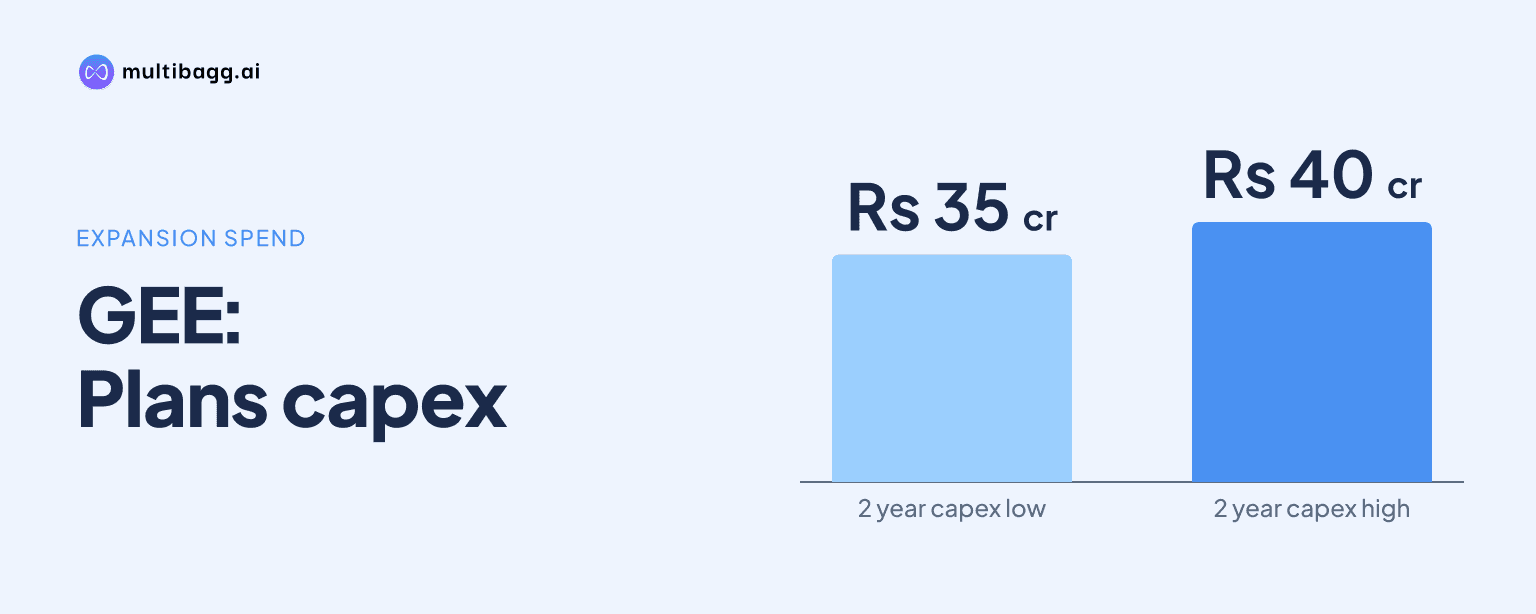
GEE plans Rs 35 crore to Rs 40 crore of capital expenditure over the next two years to double MIG-wire capacity from 12,000 to 24,000 metric tons and expand flux-cored wire capacity from about 250 to 12,000 metric tons. Management expects returns of 18% to 20% from the programme.
Know GEE inside out
Results, valuation, peers and who's buying, in one view.
What does GEE's planned capacity expansion include?
GEE's expansion includes an additional MIG-wire line, flux-cored wire production, SOFT FLUX lines and ancillary machinery intended to remove bottlenecks. Management said one flux-cored wire line had already been installed, with commercial production expected by the last week of November, although the call did not specify the year.
MIG wires, which management described as continuous wires and wire rods, are the immediate priority because GEE said its existing 12,000-metric-ton capacity is 100% utilised. The company plans to add 12,000 metric tons of MIG-wire capacity, while targeting an increase in flux-cored wire capacity from around 250 metric tons to 12,000 metric tons.
The flux-cored wire target is proportionately much larger, taking capacity to 48 times the current 250-metric-ton level, compared with a doubling of MIG-wire capacity. Management grouped the MIG addition, the two product verticals and ancillary equipment within the stated Rs 35 crore to Rs 40 crore programme, without giving individual budgets or commissioning dates for each component.
How much will GEE spend and what return does management expect?
GEE initially outlined Rs 35 crore to Rs 40 crore of capital expenditure over the next two years and said management expects returns of 18% to 20%. In the detailed response, management also referred to around Rs 30 crore to Rs 40 crore for the three product areas and ancillary machinery, leaving the final lower end of spending unspecified.
The 18% to 20% figure is management's expected return rather than a reported outcome. GEE did not define whether the measure is project return, return on capital employed or another calculation, and it did not provide separate economics for the MIG-wire addition, flux-cored wire target or SOFT FLUX lines.
The investment was discussed in response to a question on FY27 and FY28, while management described its execution window as the next two years. The last-week-of-November milestone applies only to the installed flux-cored wire line, not to the full Rs 35 crore to Rs 40 crore capital programme.
Why is GEE adding MIG and flux-cored wire capacity?
GEE is adding MIG-wire capacity because its existing 12,000-metric-ton line is fully utilised, according to management. The planned addition removes that stated production constraint, while the expansion from 250 metric tons to 12,000 metric tons seeks to scale flux-cored wire as a separate product vertical.
The programme also sits alongside management's plan to increase specialised and niche products to 35% to 40% of the product basket from about 27% currently. Management said conventional mass-moving welding consumables sell for about Rs 100 to Rs 125 per kg, while specialised products such as silver brazing alloy wire, nickel wire and GTX-series products can range from Rs 275 to Rs 1,500 per kg.
Management said GEE has unutilised capacity in other parts of its manufacturing base despite full MIG-wire utilisation. It cited higher output, a larger specialised-product mix and improving price realisation as mechanisms that could reduce per-ton operating costs and raise earnings before interest, tax, depreciation and amortisation, or EBITDA, margins.
Got a follow-up? Ask IRIS
How could the expansion affect GEE's revenue and margins?
GEE said it could add around Rs 300 crore of incremental revenue from its existing facilities, compared with revenue of around Rs 370 crore in the last fiscal year, without significant additional capital expenditure. Management qualified that statement by saying some spending would still be required to streamline procedures and processes.
Management targets Rs 1,000 crore of revenue in FY30, which it described as more realistic than FY29. The call did not split the potential Rs 300 crore of incremental revenue between MIG wires, flux-cored wire, SOFT FLUX lines and existing welding-consumable products.
GEE said EBITDA margin was around 8% to 9% and management aims to reach 12% to 13% over the longer term. It projected a 0.5-percentage-point improvement in FY27, followed by a further 0.5 to 1 percentage point in FY28, with a double-digit EBITDA margin expected in FY28.
What could determine GEE's expansion execution?
GEE's execution depends on starting commercial production on the installed flux-cored line, completing the 12,000-metric-ton MIG addition and developing demand for higher output. Management said it added more than 130 dealers in the previous six months and was expanding into additional geographies and sectors, including areas where its prior presence had been lower.
Raw-material pricing remains relevant because management said higher steel prices pressured second-quarter margins. GEE said it generally takes 15 to 25 days to pass through an increase in input costs, while finished-goods prices also do not fall immediately when raw-material prices decline.
Management said GEE has no term loans and uses working-capital facilities rather than long-term capital borrowing. After an investor cited borrowings rising from around Rs 39 crore to Rs 56.60 crore over six months, management said advances to steel suppliers had raised balances at the end of September and that bank working-capital limits were around Rs 100 crore, with about Rs 40 crore utilised when it spoke.
Conclusion
GEE's planned investment addresses a fully utilised 12,000-metric-ton MIG-wire line while building scale in flux-cored wire from about 250 metric tons to 12,000 metric tons. Management links the programme to an 18% to 20% expected return, a shift in specialised-product mix from 27% toward 35% to 40%, and a longer-term EBITDA-margin target of 12% to 13%.
The next disclosed milestone is commercial production from the installed flux-cored wire line by the last week of November. Progress toward the 24,000-metric-ton MIG-wire target, dealer additions beyond the more than 130 reported in six months, and movement toward the FY30 revenue target of Rs 1,000 crore will indicate how the expansion plan is developing.