










GEE says steel price rises pass through in 15-25 days
Key highlights
- GEE said steel-price increases can be passed through to customers within 15 to 25 days.
- Management projected 25% to 30% growth, with roughly 60% expected from volume.
- GEE added more than 130 dealers in the six months discussed on the call.
- Management placed GEE's organised-market share at about 6% to 6.5%.
powered by IRIS
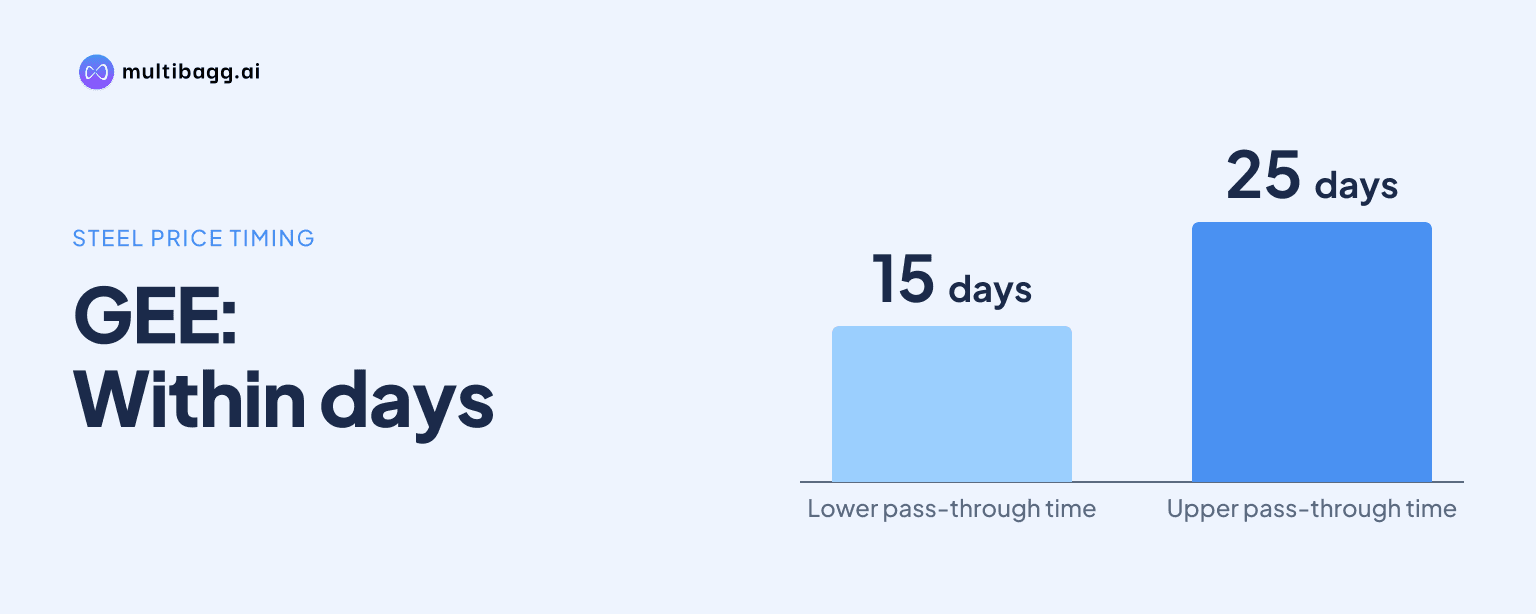
GEE says it can pass steel-price increases to customers within 15 to 25 days, despite long-term customer contracts not being standard in its industry. Management said the lag, together with finished-goods prices not falling immediately when steel becomes cheaper, has kept gross profit margins intact while it targets 25% to 30% growth.
Know GEE inside out
Results, valuation, peers and who's buying, in one view.
How does GEE pass higher steel costs to customers?
GEE says it typically takes 15 to 25 days to raise finished-product prices after steel input prices increase. Management said an immediate next-day adjustment is not possible, but described the lag as an overall protection mechanism against rising steel prices. It cited this mechanism in explaining why gross profit margins have remained intact.
The same timing works in the other direction, according to management. When steel prices decline, GEE does not cut finished-goods prices the next day, partly offsetting the exposure created while prices are being raised after an input-cost increase. Management did not disclose a contractual price-indexing clause, pass-through formula or customer-specific pricing schedule.
Does GEE have long-term contracts with customers?
No. GEE said long-term contracts are not a market practice in the welding-consumables industry, including with customers such as Bharat Heavy Electricals Limited, Larsen & Toubro, Defence Research and Development Organisation and Oil and Natural Gas Corporation. Management said some business is tender based, while approved vendors can receive orders based on prior supply performance.
GEE described procurement as occurring when customers need material for projects rather than through multiyear supply commitments. In an example involving Larsen & Toubro operating 100 sites across India, management said a central procurement division may send requirements while local project sites also purchase through dealers and distributors because they cannot carry large inventories.
Management said welding consumables account for about 2% of the steel used in a project. That relatively small portion of project material use is part of GEE's explanation for its ability to revise prices, although the call did not quantify the pass-through rate for any individual tender or customer.
How much of GEE's planned growth should come from volume?
Management said roughly 60% of GEE's projected 25% to 30% growth should come from volume, with the remaining roughly 40% coming from value. The volume contribution includes more than commodity products, as management linked it to increased capacity utilisation, wider distribution and additional supply into targeted projects and sectors.
GEE said it was operating at about 60% utilisation, leaving room for more production before capacity becomes a constraint. Management described a “massive scaling up” of utilisation as a key growth driver, while improved product mix and sales to applications including defence could support the value component of the 60:40 volume-to-value split.
GEE put its current share of the organised market at about 6% to 6.5% and said even Rs 1,000 crore of revenue would represent only about 10% to 12% market share. Management did not quantify market share at a six-month interval, so it did not claim a measured increase from 6.5% to a later figure.
Got a follow-up? Ask IRIS
What is GEE doing to expand sales volumes?
GEE added more than 130 dealers in the six months discussed on the call, according to management. The expansion targets geographies and sectors where its earlier presence was lower, including southern India, cement, infrastructure-execution companies and smaller local markets. Management said dealer coverage is important because welders need product availability and seamless use at project sites.
GEE also sees scope to capture demand moving from unorganised suppliers to organised manufacturers. Management described the welding-consumables market as about Rs 12,000 crore, with roughly 45% to 50% in the unorganised segment. It said domestic replacement of European inputs and imports in defence-related and other applications could support this shift.
Management identified energy, steel, infrastructure, defence and railways as sectors where GEE is working aggressively. It referred to nuclear-power capacity of 8 gigawatts and said the government is looking to triple it by 2031 and reach 100 gigawatts by 2040. Those statements describe the demand backdrop GEE is targeting, rather than an order forecast from the company.
What could improve GEE's margins beyond pricing pass-through?
Management identified three levers for moving earnings before interest, tax, depreciation and amortisation, or EBITDA, margin from 8% to 9% toward 12% to 13%. First, it said value-added niche products represent about 27% of GEE's product basket and that it plans to increase the proportion to 35% to 40%, which management expects to lift margins.
Second, management said GEE is beginning to realise a price premium after returning to the market more aggressively, supported by approvals and more than 50 years of industry experience. Third, higher utilisation of unutilised capacity should reduce operating cost per tonne through economies of scale. The call did not provide a date for reaching the 12% to 13% EBITDA-margin range.
GEE also outlined capacity additions supporting both product mix and volume. Management said one flux-cored wire line had been installed, with commercial production expected in the last week of November. It plans to raise metal inert gas, or MIG, wire capacity from 12,000 metric tonnes, which it said was fully utilised, to 24,000 metric tonnes, and to increase flux-cored wire capacity from about 250 metric tonnes to 12,000 metric tonnes.
Conclusion
GEE's pricing model relies on a 15-to-25-day adjustment window rather than long-term customer contracts or an explicitly disclosed indexation mechanism. Management's position is that this timing, delayed finished-goods price cuts when steel becomes cheaper, more than 130 dealer additions in six months and higher capacity utilisation can support 25% to 30% growth, of which roughly 60% is expected from volume.
The next items to watch are commercial production from the new flux-cored wire line, the planned increase in value-added niche products from 27% toward 35% to 40%, and capacity expansion in MIG and flux-cored wire. Management said it more realistically targets Rs 1,000 crore of revenue in FY30, making progress on utilisation and the 12% to 13% EBITDA-margin objective relevant execution measures.