










GEL H1 CGD volumes rose 31% despite Morbi normalisation
Key highlights
- GEL's H1 FY 27 CGD volumes rose about 31% year on year to 11.5 MMSCMD.
- Morbi volume fell from about 8 MMSCMD in Q1 FY 27 to 3.8 MMSCMD in Q2 FY 27.
- GEL's Q2 FY 27 CNG volume increased 11% year on year to 3.67 MMSCMD.
- GEL imported 24 LNG cargoes in H1 FY 27, compared with 14 in H1 FY 26.
powered by IRIS
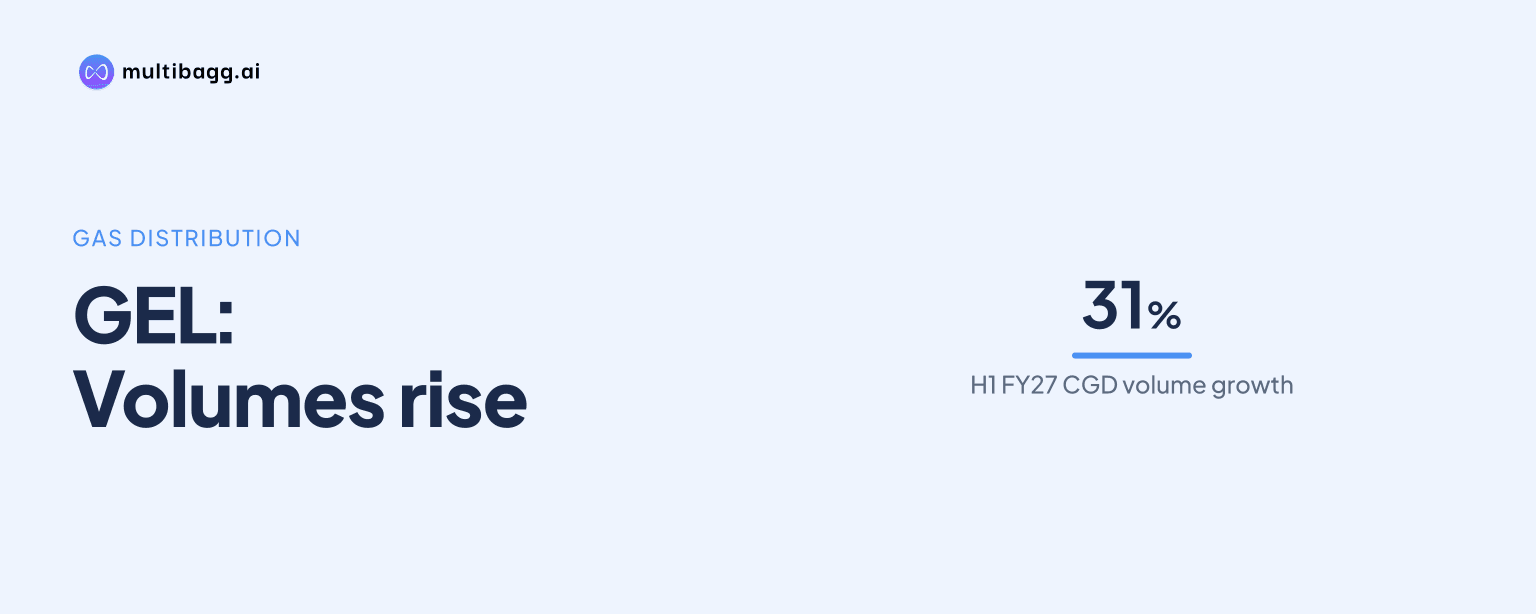
Gujarat Energy Limited reported city gas distribution (CGD) volume of 11.5 million metric standard cubic metres a day (MMSCMD) in the first half of financial year 2027 (H1 FY 27), about 31% higher year on year, despite Morbi ceramic-cluster demand falling from about 8 MMSCMD in Q1 FY 27 to 3.8 MMSCMD in Q2 FY 27.
Know Gujarat Energy inside out
Results, valuation, peers and who's buying, in one view.
Why did GEL's H1 CGD volumes grow 31%?
GEL's H1 FY 27 CGD volume growth was supported by industrial demand and continued compressed natural gas (CNG) penetration, according to management. CGD volumes reached 11.5 MMSCMD for the six months, while second-quarter (Q2) volume was 10.7 MMSCMD, 24% above Q2 FY 26. The higher H1 growth rate reflected the exceptional Morbi demand reported in Q1 FY 27 as well as growth in other markets.
Industrial piped natural gas (PNG) was the largest disclosed contributor to the volume increase. Q2 industrial PNG volume increased 39% year on year to 6.1 MMSCMD, while H1 industrial volume was 6.9 MMSCMD. Management said GEL was broadening industrial demand across Rajkot, Surendranagar, Surat, Bharuch, Ankleshwar, Valsad, Dadra and Nagar Haveli rather than relying only on Morbi.
GEL's H1 result also coincided with higher gas availability from its sourcing operations. It imported 24 liquefied natural gas (LNG) cargoes in H1 FY 27, compared with 14 cargoes in H1 FY 26. Management said the additional cargoes helped maintain customer supply amid global energy-market volatility and geopolitical developments in West Asia.
How far did GEL's Morbi demand normalise in Q2 FY 27?
Morbi demand normalised sharply in Q2 FY 27, falling to 3.8 MMSCMD from about 8 MMSCMD in Q1 FY 27. Management initially described Q2 Morbi demand as around 3 MMSCMD in prepared remarks, then gave the more precise 3.8 MMSCMD figure in response to an analyst question. The decline explains why industrial PNG volume was lower sequentially even though Q2 industrial volume remained 39% above the prior-year quarter.
The comparison means H1 CGD growth did not represent steady Morbi growth through both quarters. Q1 contained what management called an exceptional rise in ceramic-cluster demand, while Q2 reflected a more normal consumption level. GEL nevertheless reported total Q2 CGD sales of 10.7 MMSCMD, 24% above Q2 FY 26, after Morbi demand moderated.
Management linked the normalisation to fuel-price competition and said LNG needs to be competitive with propane for Morbi. GEL is building a longer-term LNG supply book intended to address that pricing issue. Management said the contracts discussed on the call would be available from 2028 onwards, rather than during FY 27.
Got a follow-up? Ask IRIS
Which CGD segments offset lower Morbi volumes?
CNG provided a separate growth stream, with Q2 FY 27 volume rising 11% year on year to 3.67 MMSCMD and H1 volume reaching 3.72 MMSCMD. CNG volumes in Gujarat rose 12%, while volumes outside Gujarat increased 19%. The faster growth outside Gujarat showed that markets beyond GEL's core state contributed to the segment's expansion.
GEL added 18 CNG stations during H1 FY 27, bringing its network to 857 stations at the end of the period. Management reiterated its target to add more than 75 CNG stations during FY 27 and said it was working to sustain double-digit CNG volume growth. The station target is management's disclosed plan and does not guarantee the volume outcome.
Domestic PNG provided a further base for CGD demand, with about 25.3 lakh connections at the end of H1 FY 27. GEL also reported 17,000 commercial connections and 4,500 industrial connections. Management said it saw scope to deepen PNG penetration in established and newer geographical areas, but did not disclose a connection-addition target for the rest of FY 27.
How did GEL's sourcing platform support CGD performance?
GEL's sourcing platform supported CGD sales of 10.71 MMSCMD in Q2 FY 27 by combining trading volumes with directly allocated gas. Its gas-trading business sourced 12.31 MMSCMD, of which 7.63 MMSCMD was supplied to CGD and 4.67 MMSCMD was sold to external customers. A further 3.08 MMSCMD of administered price mechanism (APM) gas, new-well gas and other gas was allocated directly to CGD.
The Q2 sourcing portfolio comprised about 55% imported gas, 29% other domestic gas and regasified LNG, 10% APM gas and 6% new-well gas. Management said this mix enabled GEL to optimise allocations as demand changed across fertilizer, power, chemicals, steel and other customers. Total company gas sales in Q2 were 15.38 MMSCMD, including CGD and external trading volumes.
Sourcing flexibility also helped support industrial-segment profitability when Morbi volume eased, management said. It stated that efficient sourcing produced margin growth in industrial PNG that offset the volume effect on overall financial performance. At the group level, H1 FY 27 earnings before interest, tax, depreciation and amortisation (EBITDA) increased 43% year on year to Rs 2,502 crore, while revenue from operations rose 61% to Rs 19,496 crore.
GEL's board approved execution of long-term LNG sourcing agreements totalling 0.8 million tonnes per annum (MTPA), with terms of up to 10 years. Management said the Henry Hub-linked agreements had estimated pricing of $7-$9 per million British thermal units on a delivered ex-ship basis, and the board also approved firm capacity at Mundra LNG Terminal. Management presented these arrangements as measures to secure supply and improve LNG competitiveness over the longer term.
Conclusion
GEL's 31% H1 FY 27 CGD volume increase to 11.5 MMSCMD included an exceptional Q1 Morbi contribution, but Q2 data showed that growth was not limited to that cluster. Q2 CGD sales rose 24% year on year to 10.7 MMSCMD as industrial markets beyond Morbi, CNG volume growth and the sourcing portfolio supported the business after Morbi fell to 3.8 MMSCMD.
The next measures to watch are progress towards management's target of adding more than 75 CNG stations in FY 27, sustained double-digit CNG volume growth and industrial-demand expansion in the markets it identified. Management also expects the LNG contracts discussed on the call to become available from 2028 onwards, making their potential competitiveness against propane in Morbi a longer-term issue.