










Gujarat Energy reaches 857 CNG stations and 25.3 lakh connections
Key highlights
- Gujarat Energy operated 857 CNG stations and about 46,690 kilometres of pipeline at H1FY27.
- Gujarat Energy had 25.3 lakh domestic PNG connections at H1FY27, up from 17.1 lakh in FY22.
- Gujarat Energy operated 590 of Gujarat's 1,096 CNG stations, representing 54% by station count.
- Gujarat Energy's industrial PNG volume rose 39.2% year on year to 6.1 MMSCMD in Q2FY27.
powered by IRIS
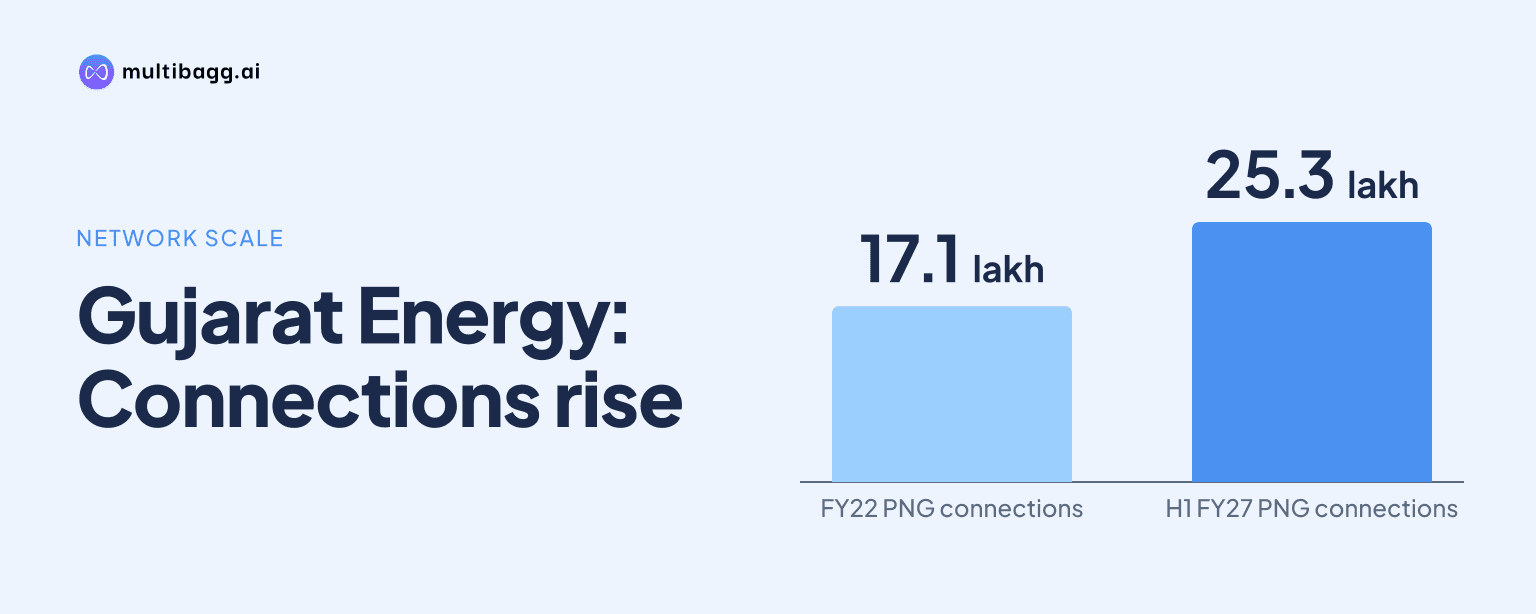
Gujarat Energy Limited reached 857 compressed natural gas (CNG) stations and 25.3 lakh domestic piped natural gas (PNG) connections by H1FY27; its 590 Gujarat stations represented 54% of the state’s 1,096 CNG stations, based on Petroleum Planning & Analysis Cell data as of 31 August 2026.
Know Gujarat Energy inside out
Results, valuation, peers and who's buying, in one view.
How large was Gujarat Energy's CGD network in H1FY27?
Gujarat Energy operated a city gas distribution (CGD) footprint with 27 authorisations across six states and one union territory, covering 44 districts at H1FY27. Its infrastructure included about 46,690 kilometres of pipeline and 857 CNG stations, which connect gas supply to vehicle, household, commercial and industrial customers.
Gujarat Energy’s PNG base at H1FY27 comprised 25.3 lakh domestic connections, 17,091 commercial customers and 4,529 industrial customers. The presentation describes a supply chain in which domestic gas and regasified liquefied natural gas (LNG) move through city gate stations for pressure control, metering and odorisation before entering steel and polyethylene distribution pipelines.
Gujarat accounted for 21 of the 44 covered districts. Outside Gujarat, Punjab accounted for nine districts, Madhya Pradesh five, Rajasthan four, Maharashtra two and Haryana two, while Dadra & Nagar Haveli was the union-territory presence. This geographic spread sits behind Gujarat Energy’s 27 CGD authorisations.
How did Gujarat Energy's network change from FY22?
Gujarat Energy added 8.2 lakh domestic PNG connections, 146 CNG stations and 13.9 thousand kilometres of pipeline between FY22 and H1FY27. Domestic connections increased from 17.1 lakh to 25.3 lakh, while the pipeline network increased from 32.8 thousand kilometres to 46.7 thousand kilometres.
Gujarat Energy’s additions were uneven across customer segments in the latest displayed interval. From FY26 to H1FY27, domestic connections rose by 1.1 lakh and commercial customers increased by 1,060, compared with 62 additional industrial customers; the company also added 18 CNG stations and 1.4 thousand kilometres of pipeline.
The CNG network was unchanged at 808 stations in FY23 and FY24, before rising to 828 in FY25, 839 in FY26 and 857 in H1FY27. Domestic PNG connections rose in every displayed period, moving from 19.3 lakh in FY23 to 21.2 lakh in FY24, 22.7 lakh in FY25 and 24.2 lakh in FY26.
Where are Gujarat Energy's CNG stations located?
Gujarat Energy had 590 of its 857 CNG stations in Gujarat at H1FY27, while 267 stations were outside the state. The Gujarat count increased by 15 from 575 in FY26, compared with a three-station increase outside Gujarat from 264 to 267.
Gujarat Energy’s 590 Gujarat stations equalled 54% of the 1,096 CNG stations in the state operated by all providers, according to the presentation’s Petroleum Planning & Analysis Cell data dated 31 August 2026. The presentation identifies Surat, Rajkot, Thane, Bhavnagar and Valsad as CNG growth-driver locations.
The operating-model mix also changed between FY26 and H1FY27. The category with 666 stations remained Gujarat Energy’s largest at H1FY27, while stations operated through oil marketing companies increased from six to 20; the company’s other reported categories were 63 company-operated stations and 108 franchisee stations.
Got a follow-up? Ask IRIS
What drove Gujarat Energy's CGD volumes in Q2FY27?
Gujarat Energy reported CGD volume of 10.7 million metric standard cubic metres per day (MMSCMD) in Q2FY27, up 23.7% year on year from 8.7 MMSCMD in Q2FY26. PNG industrial volume rose 39.2% to 6.1 MMSCMD from 4.4 MMSCMD, making industrial demand the principal contributor to the reported increase.
CNG volume increased 10.6% year on year to 3.7 MMSCMD in Q2FY27 from 3.3 MMSCMD. Domestic PNG volume was 0.8 MMSCMD, down 3.9% year on year, while commercial PNG volume remained 0.2 MMSCMD after growing 18.1% year on year.
Gujarat Energy’s quarterly sales-mix presentation reports 10.71 MMSCMD of CGD sales, of which PNG accounted for 7.04 MMSCMD, or 66%, and CNG accounted for 3.67 MMSCMD, or 34%. Industrial customers used 6.05 MMSCMD, compared with 0.80 MMSCMD for domestic customers and 0.19 MMSCMD for commercial customers.
Q2FY27 total volume was below Q1FY27’s 12.3 MMSCMD, while the H1FY27 average was 11.5 MMSCMD. Industrial PNG averaged 6.9 MMSCMD in H1FY27 after recording 7.7 MMSCMD in Q1FY27 and 6.1 MMSCMD in Q2FY27; CNG was 3.8 MMSCMD in Q1FY27 and 3.7 MMSCMD in Q2FY27.
Which areas does Gujarat Energy identify for further CGD growth?
Gujarat Energy identifies Surendranagar, Rajkot, Dadra & Nagar Haveli, Kutchh (W) and Ahmedabad Rural as growth-driver areas for industrial PNG. Its reported industrial PNG presence includes Morbi, Bharuch-Ankleshwar and Valsad, where industrial demand represented 6.05 MMSCMD of Q2FY27 CGD sales.
For domestic and commercial PNG, Gujarat Energy identifies Surat, Bharuch-Ankleshwar, Rajkot and Gandhinagar as key urban zones in western India. These two customer segments together accounted for 0.99 MMSCMD of Q2FY27 volume, comprising 0.80 MMSCMD of domestic PNG and 0.19 MMSCMD of commercial PNG.
The presentation does not provide a numerical target for future station additions, domestic connections, pipeline length or CGD volume. It does, however, identify five CNG growth-driver locations and five industrial PNG growth-driver areas across a network that had 267 CNG stations outside Gujarat at H1FY27.
Conclusion
Gujarat Energy’s H1FY27 data shows a CGD network anchored in Gujarat but extending across 44 districts in six states and one union territory. The company reached 857 CNG stations, 25.3 lakh domestic PNG connections and about 46,690 kilometres of pipeline, while industrial PNG volume increased 39.2% year on year to 6.1 MMSCMD in Q2FY27.
What to watch next is whether the areas identified by management translate into additions beyond the 857-station and 25.3 lakh-connection base. As the presentation gives no numerical expansion target, subsequent disclosures on station growth, pipeline additions, customer additions and industrial PNG volumes will provide the measure of execution.