










GEL targets 4 MTPA LNG book to regain Morbi customers from 2028
Key highlights
- GEL is targeting a net LNG portfolio of close to 4 MTPA, including contracts that will expire.
- GEL has approved 0.8 MTPA of Henry Hub-linked LNG agreements with tenures of up to 10 years.
- Management estimates the new LNG supply could cost $7 to $9 per MMBtu on a DES basis.
- Morbi gas volumes fell from about 8 MMSCMD in Q1 FY 27 to around 1 MMSCMD at the November 2026 call.
powered by IRIS
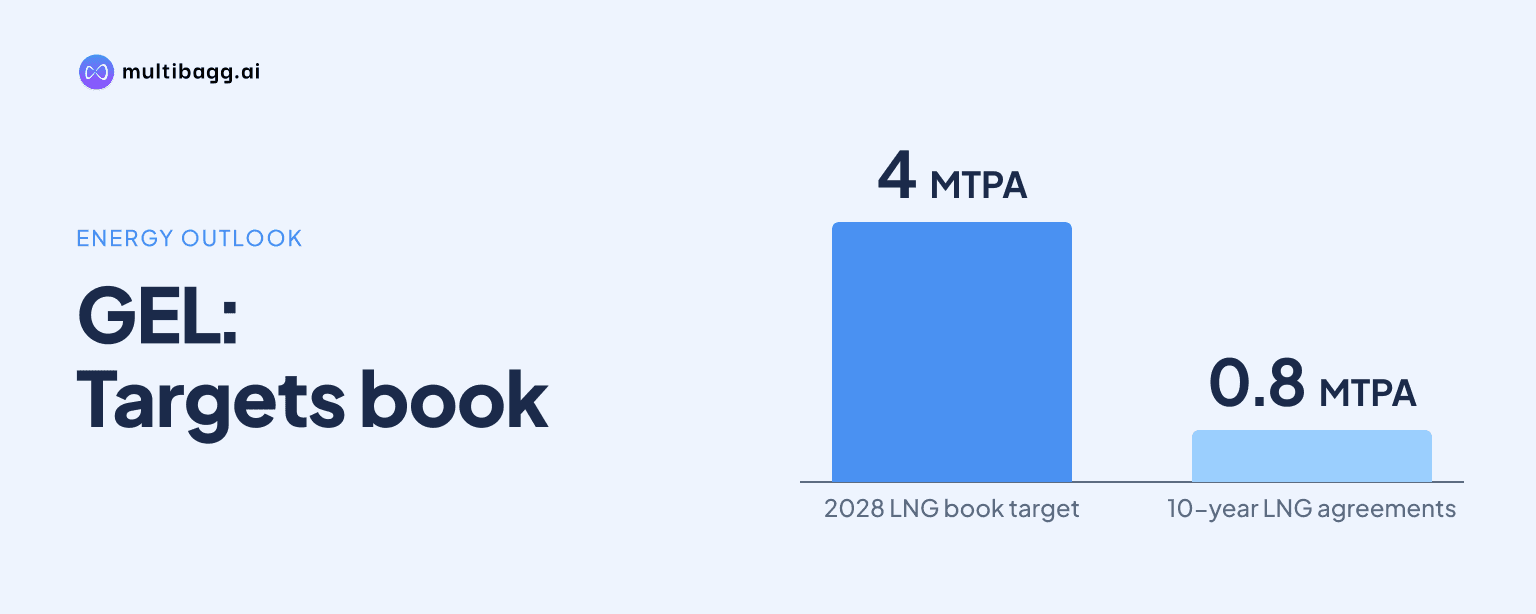
Gujarat Energy Limited is targeting a net liquefied natural gas (LNG) portfolio of 4 million tonnes per annum (MTPA), using 0.8 MTPA of new Henry Hub-linked supply to seek the return of Morbi customers from 2028. Management estimates the contracted supply could cost $7 to $9 per million British thermal units on a delivered basis.
Know Gujarat Energy inside out
Results, valuation, peers and who's buying, in one view.
What LNG portfolio is GEL targeting?
GEL is targeting a net LNG book of close to 4 MTPA, including contracts that are due to expire. Management said it was targeting two more contracts, while clarifying that 4 MTPA is the total portfolio objective rather than additional volume on top of existing contracts.
The Board has approved two long-term Henry Hub-linked agreements aggregating 0.8 MTPA for tenures of up to 10 years. Management estimated a delivered ex-ship (DES) price of $7 to $9 per million British thermal units (MMBtu), based on a Henry Hub assumption of $3 to $3.5 per MMBtu. Under DES terms, the seller delivers LNG to the Indian port and bears freight and insurance costs.
Management described the Shell, Qatar, Uniper and TotalEnergies supply as a portfolio for both gas trading and city gas distribution (CGD). It said allocation between businesses would be decided later according to the customer mix and demand for the contracted volumes.
How will GEL use the new 0.8 MTPA LNG supply?
GEL said it is sourcing the 0.8 MTPA primarily to regain customers lost in Morbi, the ceramic cluster where propane has become the dominant fuel. Management said it wants to offer Morbi buyers a stable long-term gas price that is competitive with propane rather than earmark the LNG for incremental compressed natural gas demand.
Morbi volume trends show the scale of the recovery management is seeking. Demand was about 8 million metric standard cubic metres per day (MMSCMD) in the first quarter (Q1) of financial year (FY) 27, fell to 3.8 MMSCMD in Q2 FY 27, and was around 1 MMSCMD at the November 6, 2026 call.
Management said Morbi volumes had risen as high as 8.5 MMSCMD before declining, while the wider market also faced higher freight costs and other issues. It expects the sourcing strategy to be more relevant from 2028, when it believes LNG from its contracts can compete with propane.
Can GEL hedge the difference between LNG and propane prices?
GEL said it cannot fully hedge the LNG-to-propane price difference because Saudi CP, the monthly propane price announced by Saudi Aramco, is set only one month before supply begins. Management said it had tried to manage this exposure previously but found no predictable mathematical relationship that would support a straightforward hedge.
Management said an LNG linkage of about 11% to 12% of oil would be sufficient to compete with propane. That is management’s assessment rather than a contractual outcome, and residual basis risk remains because the new 0.8 MTPA contracts are Henry Hub-linked while Morbi competition is determined by propane economics.
GEL is seeking to manage the exposure with a range of price references. Management said it already has four Brent-linked contracts, comprising Shell, two Qatar agreements and Uniper, alongside the Henry Hub-linked agreements. Its stated objective is for 40% to 60% of long-term contracted volumes to be split between Brent and Henry Hub pricing.
Got a follow-up? Ask IRIS
How much of GEL’s gas business will remain exposed to spot markets?
GEL wants 60% to 70% of total sales covered through long-term contracts, which means part of its portfolio will continue to use short-term and spot procurement. Management confirmed that spot volumes would remain in the portfolio even as it expands long-term LNG supply toward 4 MTPA.
In Q2 FY 27, spot LNG accounted for close to 50% of GEL’s sourcing mix, compared with its longer-term coverage objective. Its overall sourcing portfolio comprised about 55% imported gas, 29% other domestic gas and regasified LNG, 10% administered price mechanism gas, and 6% new-well gas.
GEL’s gas-trading vertical sourced 12.31 MMSCMD in Q2 FY 27, supplying 7.63 MMSCMD to CGD and selling 4.67 MMSCMD to external customers. Direct allocations of 3.08 MMSCMD of administered price mechanism, new-well and other gas supported CGD sales of 10.71 MMSCMD, while total company gas sales reached 15.38 MMSCMD.
What does the LNG plan mean for GEL’s CGD margins and industrial mix?
GEL’s LNG plan is intended to improve industrial competitiveness in Morbi, but management did not indicate that it would eliminate near-term margin variability. Management set CGD earnings before interest, tax, depreciation and amortisation (EBITDA) guidance at Rs 5 to Rs 6 per standard cubic metre, excluding other income, compared with its earlier Rs 5.5 to Rs 6.5 range. Q2 FY 27 CGD EBITDA was Rs 4.7 per standard cubic metre.
Morbi’s decline reduced industrial volumes, although GEL said sourcing margins partly offset the volume effect. Industrial piped natural gas volumes rose 39% year-on-year to 6.1 MMSCMD in Q2 FY 27, while total CGD volume increased 24% to 10.7 MMSCMD. The company is also seeking industrial demand in Rajkot, Surendranagar, Surat, Bharuch, Ankleshwar, Valsad, Dadra and Nagar Haveli.
Gas-trading margins also reflected sourcing conditions during the period. Management said margin was about 7% in the first half of FY 27 after a higher Q1 and about 4% in Q2 FY 27, while retaining 5% to 6% guidance. It attributed the Q2 movement partly to force majeure disruptions to Qatar contract volumes, which required spot replacement purchases.
Conclusion
GEL’s plan is to use a larger LNG portfolio to rebuild Morbi demand, rather than treat the 0.8 MTPA Henry Hub-linked agreements as general-purpose supply. The strategy combines a 4 MTPA net-book target, 60% to 70% long-term sales coverage and a Brent-Henry Hub pricing mix, while retaining spot procurement and allocation flexibility between trading and CGD.
The next test is the 2028 start of the new supply, including whether it reaches management’s indicated $7 to $9 per MMBtu DES range and competes with propane in Morbi. Management is also targeting further LNG contracts, continues to evaluate propane infrastructure, and said it expects to connect again for Q3 FY 27 results in the first week of February 2027.