










Geojit recurring income reaches 40% as revenue mix shifts
Key highlights
- Geojit said recurring income reached 40% of total income in H1 FY27, up from 25% in FY23.
- Recurring-revenue assets rose to Rs 26,737 crore in H1 FY27 from Rs 23,230 crore at FY26-end.
- Mutual fund assets under management, excluding the joint venture, stood at Rs 18,449 crore at September-end.
- PMS and AIF assets under management reached Rs 2,018 crore at September-end, up 39% from Rs 1,449 crore at March-end.
powered by IRIS
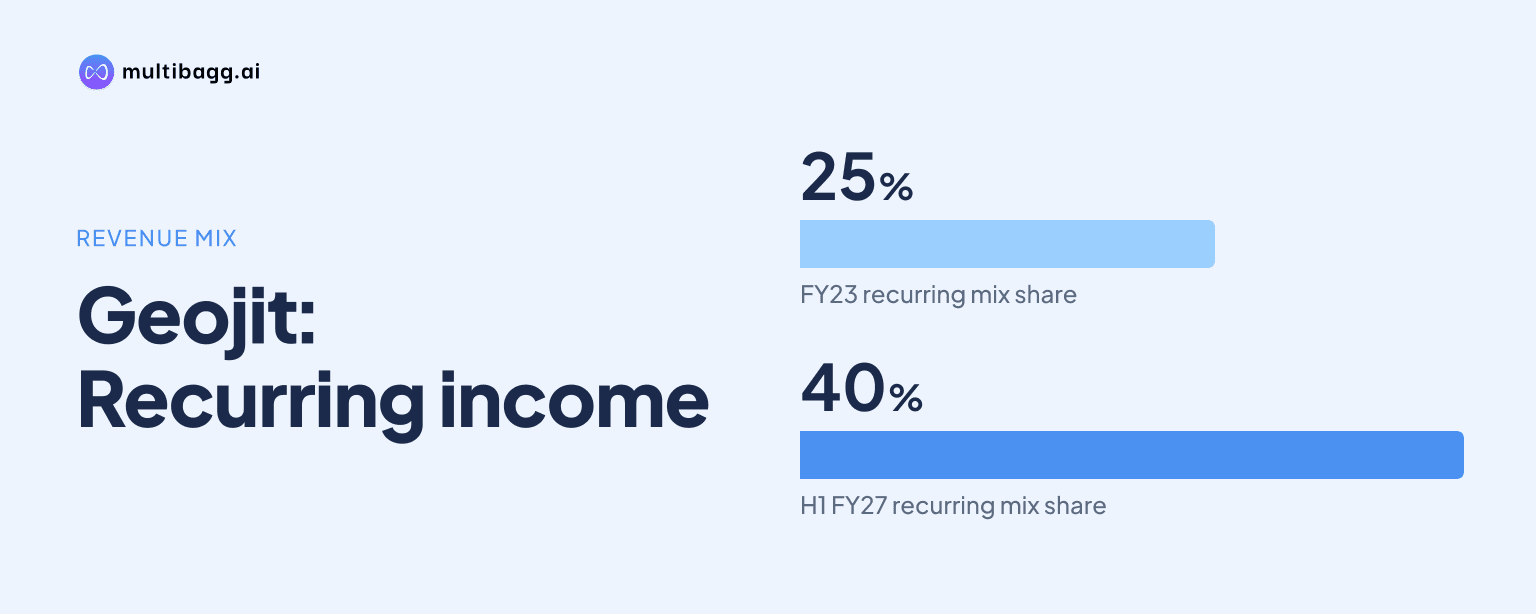
Geojit Financial Services Limited said recurring income represented 40% of total income in H1 FY27, up from 25% in FY23, as its recurring-revenue assets under management reached Rs 26,737 crore, compared with Rs 23,230 crore at the end of FY26. The increase came as subdued cash-market activity weighed on transaction-linked income.
Know Geojit Financial Services inside out
Results, valuation, peers and who's buying, in one view.
How has Geojit shifted income beyond brokerage?
Geojit increased recurring income to 40% of total income in H1 FY27 from 25% in FY23, a rise of 15 percentage points. Management linked the change to mutual funds, overseas assets under management, Smartfolio, portfolio management services and alternative investment funds rather than to a one-quarter movement in brokerage income.
The recurring-revenue asset base rose by Rs 3,507 crore from Rs 23,230 crore at FY26-end to Rs 26,737 crore in H1 FY27. Management described the September quarter as challenging for capital markets because volatility and corrections reduced cash-market activity, making distribution income and fee-earning assets more relevant to the reported revenue mix.
The 40% figure measures recurring income as a share of total income, while Q2 FY27 revenue from operations was Rs 165.82 crore. Geojit said subdued cash-market activity affected transaction-linked income, while distribution income and growth in fee-earning assets supported revenue during the quarter.
Which businesses are building Geojit’s recurring-income base?
Geojit’s mutual fund, wealth, asset-management and insurance businesses are the disclosed sources of recurring-income expansion. Mutual fund assets under management, excluding the joint venture, stood at Rs 18,449 crore at September-end, and 79% of mutual fund income came from clients associated with Geojit for five years or more.
The systematic investment plan, or SIP, book reached Rs 156 crore, serving about 1.78 lakh SIP clients. Management said SIP participation and the distribution network supported customer engagement, although it also noted that market valuations can change quarter-end assets independently of new investment flows.
Portfolio management services, or PMS, and alternative investment fund, or AIF, assets under management rose to Rs 2,018 crore at September-end from Rs 1,449 crore at March-end, an increase of 39%. Asset-management net inflows were Rs 322 crore in Q2 FY27, compared with Rs 71 crore in the year-earlier quarter, while H1 inflows were Rs 408 crore.
Geojit Yield Plus, its Category III AIF with an absolute-return strategy, held Rs 248 crore of assets at September-end, compared with Rs 22 crore a year earlier. The company also recorded Rs 175 crore of insurance gross premium in Q2 FY27 and described insurance as a cross-selling component of its wealth offering.
How did market activity affect Geojit’s earnings?
Geojit reported Q2 FY27 revenue from operations of Rs 165.82 crore, up 2.5% year on year and 3.38% sequentially, but said lower cash-market activity reduced transaction-linked income. Earnings before interest, tax, depreciation and amortisation, or EBITDA, were Rs 36.7 crore, while profit before tax was Rs 20.62 crore.
For H1 FY27, revenue from operations rose 6.72% and EBITDA was Rs 78.23 crore. Management said higher operating costs and weaker transaction-linked activity affected profitability, while distribution income and fee-earning assets provided an offset rather than fully removing market-related pressure.
Employee benefit expense increased Rs 8.17 crore year on year. Geojit attributed the increase to more sales personnel, recruitment for its Dubai International Financial Centre, or DIFC, subsidiary, a larger information-technology team supporting technology transformation, and higher incentives associated with distribution-business growth.
Management said it would be cautious on employee additions while cash-market delivery volumes remain subdued. It said hiring would be selective, with the near-term priority being higher productivity from the existing field force and review of employee-related costs.
Got a follow-up? Ask IRIS
What do Geojit’s customer assets and inflows indicate?
Geojit’s customer assets stood at Rs 1.12 lakh crore at September-end and were broadly stable sequentially despite healthy gross inflows. Management said a 6% market decline in September had a larger effect on reported assets than H1 net inflows of more than Rs 1,400 crore, which represented about 1.4% of a Rs 1 lakh crore base.
The mutual fund business illustrated the valuation effect. Management said mutual fund assets had reached about Rs 20,000 crore around August-end or early September before declining to about Rs 18,500 crore at September-end, despite positive inflows, because of market movements.
Geojit operated 529 offices at September-end, compared with 525 at the end of Q1 FY27, and had 17.25 lakh clients after adding 61,657 clients during H1 FY27. Its lending book was Rs 780 crore, compared with Rs 735 crore a year earlier, comprising margin trading facilities and loans against shares and mutual funds.
Can Geojit deepen cross-selling among existing clients?
Geojit said close to 20% of its clients held more than one product, mainly brokerage and mutual funds. Management said life-insurance penetration was below 5% of clients and health-insurance penetration below 3%, leaving scope to increase product adoption within its existing customer base.
The wealth business reported annual recurring revenue, or ARR, net flows of Rs 583 crore in Q2 FY27 and Rs 1,189 crore in H1 FY27. Management said the measure comprises net flows in mutual funds, third-party products and insurance, and should be considered alongside gross inflows, redemptions and market-related valuation changes.
Management said mutual funds are the first cross-selling focus, followed by wider life and health-insurance penetration. Executive Chairman C.J. George said the plan is to increase recurring income further as part of a long-term strategy intended to address cyclicality in cash flows.
Conclusion
Geojit’s H1 FY27 disclosures show that recurring income reached 40% of total income, up 15 percentage points from FY23, while recurring-revenue assets expanded by Rs 3,507 crore from FY26-end. Mutual funds, PMS and AIFs, SIPs, insurance and wealth products are the identified mechanisms reducing reliance on transaction-linked brokerage income.
The next measures to watch are mutual-fund and SIP additions, asset-management net flows and product penetration among the roughly 80% of clients who do not yet hold more than one product. Management plans to expand recurring income, cross-selling, technology capability and field-force productivity, but gave no asset-under-management target for DIFC or Barjeel AMC.