










Geojit slows hiring as higher costs pressure FY27 margins
Key highlights
- Geojit’s employee benefit expense increased Rs 8.17 crore year on year in Q2 FY27.
- Geojit’s Q2 FY27 revenue from operations rose 2.5% year on year to Rs 165.82 crore.
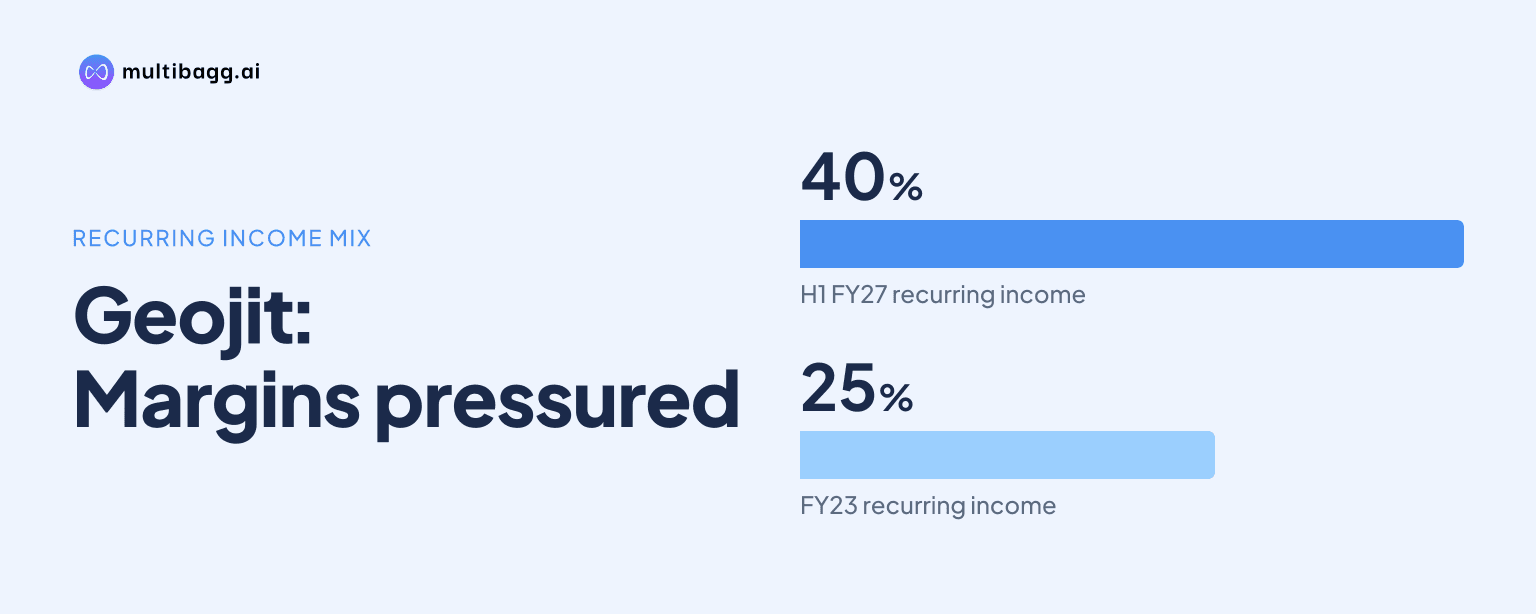
- Geojit’s recurring income was 40% of total income in H1 FY27, compared with 25% in FY23.
- Geojit reported a 15% improvement in customer-conversion speed from early technology initiatives.
powered by IRIS
Geojit Financial Services Limited said in Q2 FY27 it will curb broad hiring and prioritise employee productivity and cross-selling after employee benefit expense increased Rs 8.17 crore year on year, while revenue from operations rose 2.5% to Rs 165.82 crore amid subdued cash-market activity.
Know Geojit Financial Services inside out
Results, valuation, peers and who's buying, in one view.
Why is Geojit slowing hiring in FY27?
Geojit is slowing broad hiring because higher employee and technology spending coincided with subdued capital-market and cash-market delivery activity in Q2 FY27. Management said additions to the retail sales force would be relatively muted and employee recruitment would be selective until market sentiment, brokerage activity and cash-market volumes improve.
The employee-cost increase reflected planned investments rather than a single exceptional item. Employee benefit expense rose Rs 8.17 crore year on year, driven by higher sales-force headcount, recruitment for the Dubai International Financial Centre, or DIFC, subsidiary, expansion of the information-technology team for the transformation programme, and higher incentives linked to distribution-business growth.
The spending rose faster than revenue in the quarter. Revenue from operations increased 2.5% year on year and 3.38% sequentially to Rs 165.82 crore, while earnings before interest, tax, depreciation and amortisation, or EBITDA, was Rs 36.70 crore and profit before tax was Rs 20.62 crore. Management attributed the gap to higher operating costs and lower transaction-linked income from the cash market.
What will Geojit use instead of broad headcount growth?
Geojit will seek higher productivity from its existing field force and expand cross-selling within its current customer base. Management said about 20% of clients use more than one product, mainly brokerage and mutual funds, giving the company scope to generate additional business without a matching increase in staff.
Mutual funds are Geojit’s first cross-selling priority, followed by insurance. Life-insurance penetration is below 5% of the client base and health-insurance penetration is below 3%, while insurance gross premium was Rs 175 crore in Q2 FY27. Management said insurance is less directly tied to capital-market sentiment than broking products.
The approach is supported by Geojit’s client and office base. The company had 17.25 lakh clients at September-end after adding 61,657 clients in H1 FY27, and its office network increased to 529 locations from 525 in Q1. Management said its investment in field staff and technology is intended to support customer engagement, systematic investment plan, or SIP, acquisition, and service delivery.
How does technology spending support productivity?
Geojit said its technology programme is improving onboarding, customer support and order processing, although it gave no cost-saving target or timetable. The company’s chief information officer reported a 15% improvement in the speed of customer conversion and final closure from early onboarding initiatives.
The programme includes digital onboarding, analytics, automation, cybersecurity and senior technology recruitment. Geojit said technology has increased ticket coverage and responses in customer support, helped teams identify high-priority cases faster, and uses artificial intelligence to some extent in customer-support and customer-success processes.
Technology is also being used in product distribution. Geojit has enabled dealer-assisted order creation for mutual funds and insurance and is adding WhatsApp alongside existing customer channels. Management said these tools offer clients more ways to submit investment or insurance requests while allowing the company to handle a greater volume of activity through its present operating base.
Got a follow-up? Ask IRIS
Can recurring income offset softer cash-market activity?
Geojit plans to increase recurring income to reduce the effect of transaction-linked market cycles on cash flows. Recurring income represented 40% of total income in H1 FY27, up from 25% in FY23, as mutual funds, overseas assets under management, Smartfolio, portfolio management services, or PMS, and alternative investment funds, or AIFs, expanded.
Recurring-revenue assets under management, or AUM, reached Rs 26,737 crore in H1 FY27, compared with Rs 23,230 crore at the end of FY26. Mutual-fund AUM, excluding the joint venture, was Rs 18,449 crore at September-end, while combined PMS and AIF AUM reached Rs 2,018 crore, up 39% from Rs 1,449 crore at end-March.
Asset-management flows rose despite the market correction. Asset-management net inflows were Rs 322 crore in Q2 FY27, compared with Rs 71 crore in the year-earlier quarter, and totalled Rs 408 crore in H1. Management said these inflows were primarily broad-based, although the business also received some high-ticket investments.
What does Geojit’s revenue mix mean for margins?
Geojit said EBITDA margins could remain subdued for the next one or two quarters if capital-market activity stays weak. Management identified staff costs and technology-transformation spending as the main controllable cost pressures, while the timing of a recovery in cash-market transaction income remains dependent on market conditions.
Broking revenue remains concentrated in cash-market delivery business. Management said derivatives contribute about 20% of total income and cash-market activity contributes about 80%, with around 90% of cash-market income coming from delivery transactions. More than 50% of cash-market volumes are delivery-based, consistent with Geojit’s focus on long-term investing rather than intraday or futures-and-options trading.
Market movements also limited the reported growth in customer assets. Customer assets were broadly stable at Rs 1.12 lakh crore at September-end despite H1 inflows of more than Rs 1,400 crore, because the market fell about 6% during September, management said. Mutual-fund AUM had reached about Rs 20,000 crore around August-end or early September before declining to about Rs 18,500 crore at September-end.
Conclusion
Geojit’s response to Q2 FY27 cost pressure is to reduce the pace of broad recruitment, improve field-force output and increase product penetration among its 17.25 lakh clients. The strategy combines technology-enabled onboarding and service with recurring-income products, which accounted for 40% of H1 FY27 total income compared with 25% in FY23.
The next indicators are whether cash-market delivery activity improves, whether the reported 15% onboarding-conversion improvement is sustained, and whether cross-selling lifts mutual-fund and insurance penetration. Management said it may reconsider employee expansion when market sentiment and brokerage activity recover, while it expects productivity and recurring-revenue growth to remain its immediate focus.