










RNFI Services Limited Says Regulatory Changes Ended PaySprint
Key highlights
- RNFI Services Limited said PaySprint discontinued BC and DMT activity during H1 FY27 after regulatory changes affected DMT.
- RNFI reported almost 48% H1 FY27 revenue growth despite the PaySprint-related performance shortfall.
- Insurance EBITDA grew close to 100%, while RNFI said its delinquent-loan business increased almost five to six times.
- Q2 FY27 PAT rose almost 100% from Q1 FY27 and EBITDA rose almost 65%, according to management.
powered by IRIS
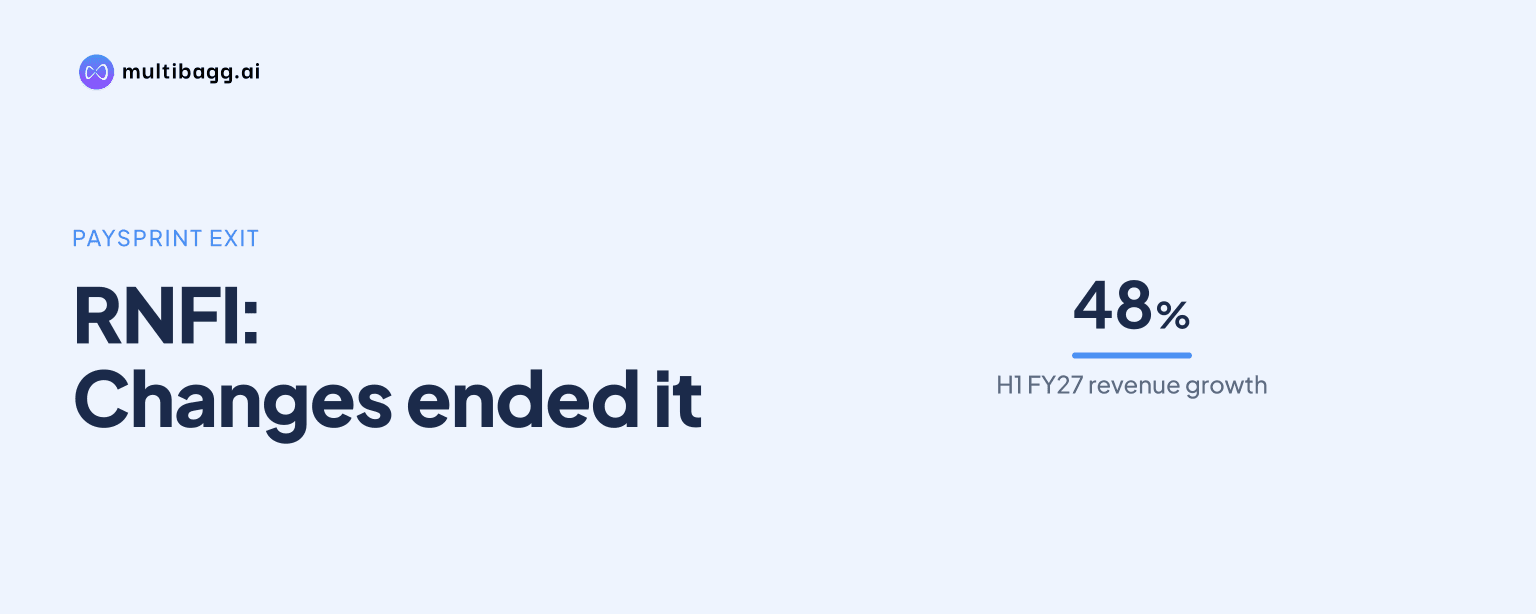
RNFI Services Limited said on November 13, 2026 that regulatory changes led PaySprint to discontinue its business-correspondent, or BC, and domestic money transfer, or DMT, activity, but H1 FY27 revenue still rose almost 48%. Management said insurance EBITDA grew close to 100% and the delinquent-loan business increased almost five to six times, cushioning the shortfall.
Know RNFI Services inside out
Results, valuation, peers and who's buying, in one view.
Why did RNFI discontinue PaySprint’s BC and DMT business?
RNFI said PaySprint discontinued its BC business, including DMT, during H1 FY27 because DMT was largely affected by regulatory changes in the market. Management also said some other PaySprint products performed below its expectations, meaning the discontinued activity and weaker performance in other products created a shortfall in the group’s overall business performance.
The November 13, 2026 call did not identify the specific regulation, regulator, implementation date or transaction volumes affected by the DMT withdrawal. RNFI said the regulatory changes occurred in FY26, while describing the PaySprint discontinuation as taking place during the H1 FY27 period.
How did the PaySprint disruption affect RNFI’s H1 FY27 performance?
RNFI said H1 FY27 revenue rose by almost 48%, although management said the DMT decline resulting from regulatory changes in FY26 affected performance. It added that, without the DMT disruption, growth in the relevant metric would have been closer to 25% and absolute growth would have been close to 50%, but it did not define the metric or provide underlying rupee amounts.
Management said EBITDA, or earnings before interest, tax, depreciation and amortisation, and PAT, or profit after tax, margins were below their H1 FY26 levels. It attributed the year-on-year margin outcome to investments in strengthening on-ground distribution and building the delinquent-loan and insurance-broking businesses.
The Q2 FY27 comparison with Q1 FY27 showed improving sequential profitability despite the H1 margin comparison with FY26. RNFI said Q2 gross profit increased by almost 30%, EBITDA by almost 65% and PAT by almost 100%, and it also said both Q2 EBITDA and PAT were higher than in the corresponding quarter of FY26.
Got a follow-up? Ask IRIS
Which businesses cushioned RNFI after the PaySprint exit?
RNFI said insurance broking and delinquent-loan operations cushioned the performance shortfall after PaySprint discontinued BC and DMT activity. Management cited close to 100% growth in insurance EBITDA and almost five-to-six-times growth in the delinquent-loan business, saying earlier investments in both newer operations had begun to produce results.
RNFI also said its Payworld and Ambition acquisitions had both become EBITDA-positive by H1 FY27. Management presented this as evidence of progress in integrating acquired businesses and improving their performance, although the November 13 call gave no standalone revenue, EBITDA or acquisition-date figures for Payworld or Ambition.
RNFI described diversification as a core element of its model, citing traditional BC operations, electronic monthly instalment collection with banks, non-bank financial companies and microfinance institutions, insurance broking, delinquent-loan collection and a verification suite. The company also cited a payments platform and a prepaid payment instrument, or PPI, licence as part of its future business mix.
What is RNFI planning after the PaySprint regulatory disruption?
RNFI said it has received a PAP licence, which management said permits it to begin deploying payment-acceptance products in the market. The company did not disclose the licence date, rollout timetable, expected investment or revenue target, but said on November 13 that it expected to provide updates on licences received in the recent past.
RNFI’s stated plan is to add products and enterprise relationships to its Sahayak distribution network while improving operating efficiency on the ground. Management said it would scale newer verticals, improve the quality of revenue and optimise the business mix by using its technology platform and distribution network.
Management linked its distribution investment to the remaining two quarters of FY27. It said investment in on-ground distribution, processes, delinquent-loan collection and insurance broking was continuing, and it expects the distribution investment to contribute more clearly in Q3 and Q4, which is a management expectation rather than a reported result.
Conclusion
RNFI’s H1 FY27 call describes a regulatory-led withdrawal from PaySprint’s BC and DMT operations alongside growth in newer businesses. Almost 48% H1 revenue growth and sequential Q2 increases in gross profit, EBITDA and PAT occurred while H1 margins remained below FY26 levels, as management continued to fund distribution, insurance broking and delinquent-loan collection.
The next evidence point is RNFI’s Q3 and Q4 FY27 performance, when management expects its distribution investment to contribute more clearly. Investors can also watch for management disclosures on payment-acceptance product deployment under the PAP licence, PaySprint’s remaining products and the financial contribution of Payworld and Ambition.