










RNFI broadens Ambition credit distribution after acquisition
Key highlights
- RNFI said Ambition started with 2 bank relationships and has added 1 NBFC tie-up.
- Ambition’s one-time sourcing fee might be around 1% of the loan amount, subject to renegotiated lender terms.
- RNFI said Ambition earns both sourcing fees and collection-linked revenue across EMI tenures.
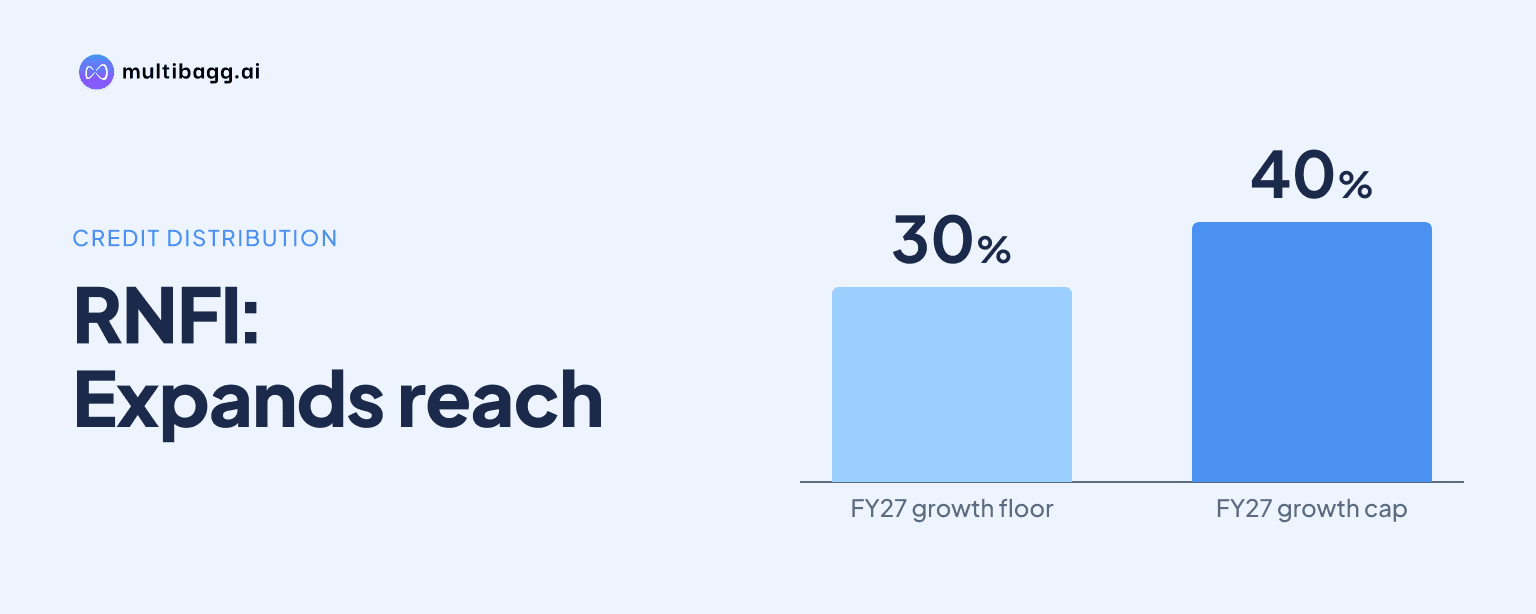
- Management said RNFI reported 25% revenue growth in the first half and is targeting 30% to 40% FY27 growth.
powered by IRIS
RNFI Services Limited said after taking control of Ambition in July, it is broadening the credit-distribution platform from two bank relationships into more lender and loan categories, while a current sourcing fee of about 1% of loan value and selective first-loss default guarantee exposure remain subject to revised partner terms.
Know RNFI Services inside out
Results, valuation, peers and who's buying, in one view.
How is RNFI expanding Ambition’s credit-distribution business?
RNFI is expanding Ambition through additional lending partners, a broader product mix and branch growth over the next six months. Management said Ambition had two bank relationships when RNFI acquired it, and has since tied up with one non-banking financial company, or NBFC. It is also in talks with a large NBFC operating in gold loans.
The operating platform includes a loan management system, or LMS, covering the lending lifecycle, according to management. RNFI said Ambition was earnings before interest, tax, depreciation and amortisation, or EBITDA, positive in the quarter discussed. Management did not disclose Ambition’s loan disbursals, number of borrowers, branch count or product-level revenue.
RNFI’s stated plan is to add branches during a six-month expansion period rather than announce a single new lending product immediately. The company said its wider near-term focus includes technology for prepaid payment instruments, or PPI, Authorised Dealer Category II, or AD-II, remittances, and mutual funds. For Ambition, the stated priority is scaling the existing LMS-backed distribution operation.
Which loan products will RNFI distribute through Ambition?
RNFI said Ambition’s product range includes loan against property, or LAP, joint-liability-group, or JLG, unsecured loans, and working-capital loans for Sahayaks through an NBFC. Management also said it was in discussions on two-wheeler loans. The mix means Ambition is seeking distribution income across secured, unsecured and business-oriented credit categories.
The company has not disclosed a launch date for two-wheeler loans, lending targets or a split of volumes between LAP, JLG and working-capital products. Its discussion with a gold-loan NBFC also remains a potential relationship rather than a confirmed tie-up. The confirmed partner addition disclosed on the call was one NBFC beyond the two inherited bank relationships.
Management said certain products require a first-loss default guarantee, or FLDG, while it did not say that every loan category carries this requirement. FLDG can require the distributor to bear an agreed first-loss portion under a lender arrangement. RNFI specifically said FLDG compliance on the LAP side had been relatively high because of Ambition’s credit history before the acquisition.
How will RNFI earn revenue from Ambition’s loan business?
RNFI said Ambition earns both a one-time sourcing fee and collection-linked revenue. Management indicated that the one-time loan-processing fee might currently be around 1% of the loan amount. It said that estimate should not be treated as fixed because the commercial arrangements with banks are being renegotiated after RNFI’s entry.
The second revenue stream is generated from collections over the borrower’s equated monthly instalment, or EMI, tenure. RNFI said Ambition shares collection-related revenue with banks, allowing income to accrue after initial sourcing. Management did not disclose the collection-revenue share, average EMI tenure, collection rates or the share of total income generated upfront.
RNFI said it does not undertake direct lending on its own books in this model, and management said this reduces margins compared with lending directly. It also said Ambition was acquired in a weak condition and that the company is working with banks to improve inherited commercial terms. Management expects to have a clearer view of the business’s exact margins by year-end.
Got a follow-up? Ask IRIS
When will Ambition affect RNFI’s reported results?
RNFI said it took control of Ambition in July, with formalities completed in the first week of September. Management said it received COC approval in October and was completing the steps required to finalise the acquisition. Until September, Ambition was treated as an associate company despite RNFI working closely with its former promoters on operations.
Management said the fuller benefit of the acquisition should begin appearing in RNFI’s consolidated balance sheet after completion of the process. It distinguished that reporting timing from Ambition’s operating position, describing the business as EBITDA positive in the quarter. RNFI did not provide a separate revenue, profit or balance-sheet contribution from Ambition.
The integration comes as RNFI reported 25% revenue growth for the first half, according to management, despite disruption to domestic money transfer, or DMT, activity from regulatory developments. Management also said RNFI was working toward its earlier FY27 expectation of 30% to 40% year-on-year growth, although it gave no separate FY27 target for Ambition.
What will determine RNFI’s credit-distribution economics?
RNFI’s credit-distribution outcome will depend on lender terms, the product mix and the FLDG requirement attached to individual products. Management said processing fees depend on sharing arrangements with banks, while collection income depends on revenue-sharing arrangements over EMI tenures. The indicated 1% sourcing fee could therefore move as negotiations proceed.
The scope of FLDG is another unresolved factor. Management confirmed that some products need an FLDG, and identified historically higher LAP-related compliance requirements, but did not quantify the guarantee amount or identify all affected products. This leaves the eventual balance between sourcing income, collection income and product-level risk dependent on contracts that were still being revised.
Management’s six-month branch-expansion plan provides a practical test of whether the larger lender and product bouquet can be scaled. The two inherited bank relationships, one new NBFC tie-up and talks with a gold-loan NBFC establish the starting point, but management has not provided targets for branches, disbursals or customers. Those disclosures would clarify the pace of the rollout.
Conclusion
RNFI is using Ambition to extend its presence in credit distribution across LAP, JLG unsecured, working-capital and prospective two-wheeler lending. The platform has two forms of income, an upfront sourcing fee and collection-linked revenue, but its financial contribution cannot yet be assessed from a single commission rate because bank revenue shares and FLDG obligations vary by product.
The next point to watch is management’s stated expectation of better visibility on Ambition’s exact margins by year-end. Investors can also monitor the planned six-month branch expansion, progress on the gold-loan NBFC discussion, revised bank terms and the point at which the completed acquisition is reflected more fully in RNFI’s consolidated reporting.