










Pushpa Jewellers Limited: Gold inflation and costs cut H1 EBITDA margin
Key highlights
- Pushpa Jewellers’ H1 FY27 total income rose 82.85% year on year to Rs 314.16 crore.
- Pushpa Jewellers’ EBITDA margin declined to 8.50% from 9.72%, while EBITDA increased 59.79% to Rs 26.69 crore.
- Pushpa Jewellers reported gross profit of Rs 1,775 per gram and EBITDA of Rs 1,280 per gram in H1 FY27.
- Pushpa Jewellers’ Mumbai centre generated about Rs 65 lakh of H1 FY27 sales after opening on 4 August 2026.
powered by IRIS
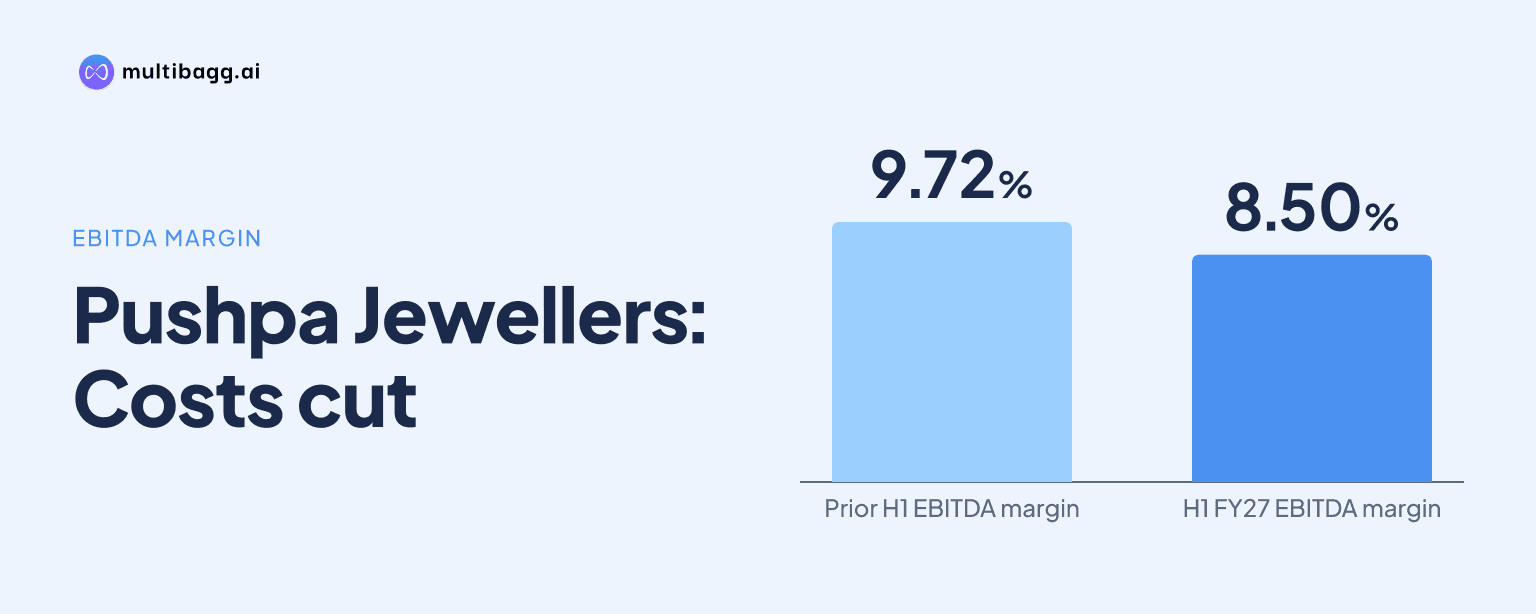
Pushpa Jewellers Limited reported Rs 314.16 crore of H1 FY27 total income, up 82.85% year on year, but EBITDA margin fell to 8.50% from 9.72% because gold prices rose 47%, lifting billed revenue faster than per-gram earnings, while employee, distribution and exhibition costs increased.
Know Pushpa Jewellers inside out
Results, valuation, peers and who's buying, in one view.
How fast did Pushpa Jewellers grow in H1 FY27?
Pushpa Jewellers increased total income by 82.85% to Rs 314.16 crore in H1 FY27 from Rs 171.82 crore in H1 FY26. Management said higher gold prices increased the billed value of sales, while demand from jeweller partners remained healthy. It also said the company operates the business internally in kilograms and does not provide numerical guidance for revenue or margins.
EBITDA rose 59.79% year on year to Rs 26.69 crore, a slower rate than income growth, producing the lower 8.50% EBITDA margin. Net profit increased 83.27% to Rs 20.21 crore, while net profit margin remained at 6.43%. The contrast between EBITDA and net-profit margins shows that the disclosed margin movement was concentrated at the operating-profit level.
Pushpa Jewellers added more than 2,000 designs during H1 FY27, according to management. Its catalogue focuses on lightweight 22-karat and 18-karat jewellery, which uses less gold while retaining the appearance of traditional pieces. Each design has a unique code, allowing jeweller customers to reorder products as gold prices remain elevated.
Why did Pushpa Jewellers’ H1 FY27 EBITDA margin decline?
Pushpa Jewellers’ EBITDA margin declined by 122 basis points because a 47% increase in gold prices enlarged sales revenue more quickly than its earnings per gram, while costs rose with expansion. A basis point is one-hundredth of a percentage point. The margin was 8.50% in H1 FY27, compared with 9.72% in H1 FY26.
Management said gold is billed at the prevailing rate plus a design-specific wastage percentage, after which the company pays karigars, or jewellery artisans. Making charges were about 10% of gold value and were slightly lower than in the previous year as Pushpa Jewellers grew with larger buyers. This meant the higher gold value increased the revenue denominator faster than making-charge income.
Employee costs rose to Rs 3.74 crore in H1 FY27 from Rs 2.62 crore in H1 FY26. Other expenses increased to Rs 6.62 crore from Rs 3.71 crore, with management identifying karigar labour, courier charges and exhibition costs as the principal items. Management also cited the opening of Mumbai and Vijayawada centres and the larger design catalogue as growth-related cost drivers.
Did Pushpa Jewellers earn more on every gram of jewellery sold?
Pushpa Jewellers earned more in rupee terms on every gram sold despite the lower reported EBITDA percentage. Management said gross profit per gram increased to Rs 1,775 in H1 FY27 from Rs 1,332 in H1 FY26. EBITDA per gram rose to Rs 1,280 from Rs 1,000 over the same periods.
The per-gram improvement and the percentage-margin decline measure different parts of the business. Per-gram gross profit rose by Rs 443 and per-gram EBITDA by Rs 280, but the 47% rise in gold prices increased the metal value included in revenue. As a result, billed sales grew faster than the making-charge and profit amounts generated per gram.
Management said sales volume grew 25% in H1 FY27. It attributed the growth to both volume and higher realization, while noting that making charges were slightly lower because of the mix of larger buyers. The company’s explanation indicates that the H1 margin change reflected pricing mechanics and operating costs rather than a reduction in disclosed rupee profit per gram.
Got a follow-up? Ask IRIS
What expansion spending affected Pushpa Jewellers’ H1 results?
Pushpa Jewellers incurred costs for new distribution capacity, customer acquisition and systems during H1 FY27. The Mumbai business-to-business trade fulfilment centre commenced operations during the half, bringing the company closer to regional retail and corporate clients. Management specifically linked the new Mumbai and Vijayawada centres to the higher cost base.
The Mumbai centre opened on 4 August 2026 and generated about Rs 65 lakh of sales in H1 FY27. Management said it had contributed for only about two months and was not yet a major contributor to company revenue. Ahmedabad and Kozhikode were identified as the next expansion locations during the call.
Pushpa Jewellers also built inventory during H1 FY27 for the festive and wedding months in the second half. It is implementing an enterprise resource planning system to strengthen process integration, financial controls and approval workflows as volumes increase. Its board has authorised a Committee of Directors to identify and acquire commercial premises for the next phase of expansion.
What margin outlook did Pushpa Jewellers give for the future?
Pushpa Jewellers said it plans to maintain its current margin level over the long term, although management said the outcome depends on market conditions. It added that, based on the market environment and lower gold prices at the time of the call, it expected margins to continue at those levels.
Management does not intend to use inventory to speculate on gold prices. When a customer fixes the rate on a sale, it said Pushpa Jewellers buys a similar quantity of inventory to maintain stock. This mechanism is intended to limit gains or losses from gold-price movements rather than create trading profit from the metal.
The company entered H2 FY27 with inventory prepared for festive and wedding demand, while its expansion programme added operating costs in H1 FY27. Management’s stated focus is to serve seasonal demand, widen distribution, add lightweight designs and improve operating efficiency. These actions are the disclosed basis for its expectation that the current margin level can continue.
Conclusion
Pushpa Jewellers’ 82.85% increase in H1 FY27 income to Rs 314.16 crore combined higher gold values with healthy demand and a 25% rise in volume, but the sales increase did not translate proportionately into EBITDA margin. Gold prices rose 47%, making charges were slightly lower with larger buyers, and employee, karigar, courier, exhibition and centre costs increased. Even so, gross profit per gram reached Rs 1,775 and EBITDA per gram reached Rs 1,280.
The next disclosed markers are H2 FY27 festive and wedding demand, which inventory was built to serve, and the development of the Mumbai centre beyond its initial Rs 65 lakh of H1 sales. Management has also identified Ahmedabad and Kozhikode for expansion, is implementing an enterprise resource planning system, and has board approval to identify commercial premises for future growth.