










GKSSL broadens tertiary care beyond its renal-urology base
Key highlights
- GKSSL reported 2,740 cumulative endourology procedures through FY26, including 850 in FY25.
- GKSSL established the Gujarat Heart Care Unit in Vadodara in 2019 for invasive cardiac procedures.
- GKSSL reported 125 doctors as of March 31, 2026, compared with 91 in FY25.
- GKSSL disclosed doctor attrition of 2.40% to 2.99% across FY25 and FY26.
powered by IRIS
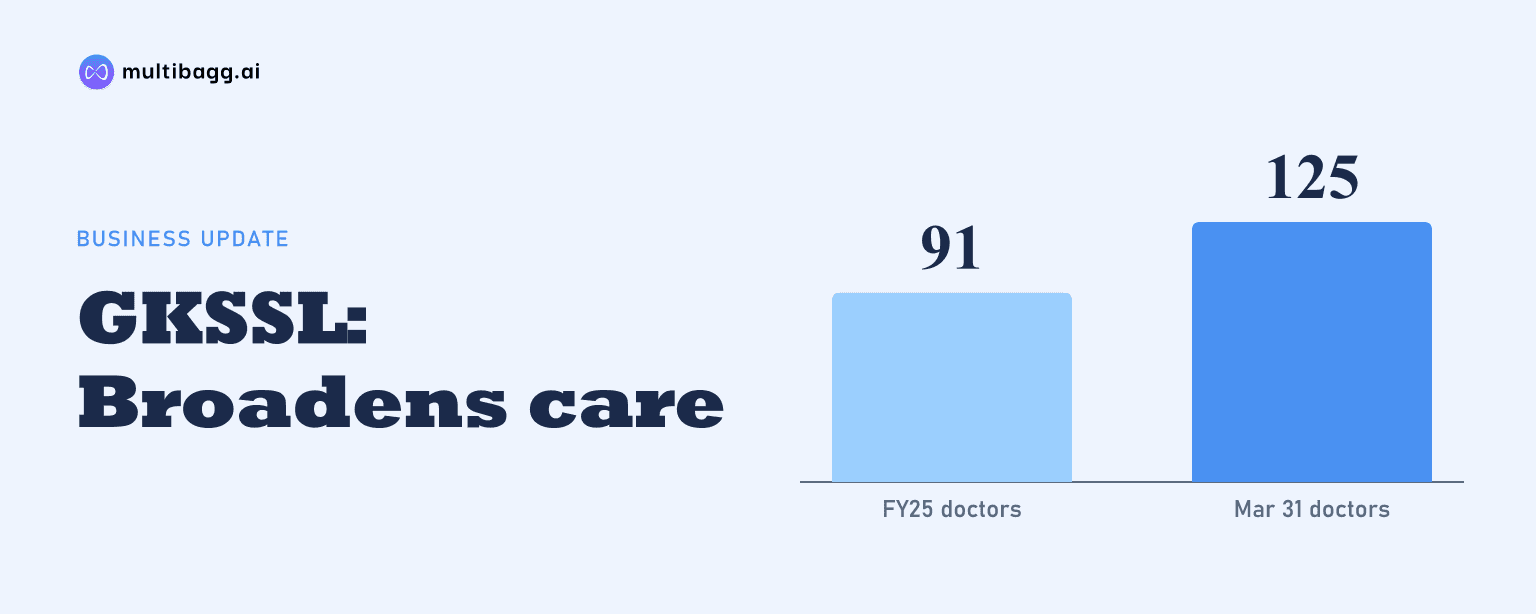
Gujarat Kidney & Superspeciality Hospital is extending its renal-sciences and urology platform into cardiology, oncology and orthopaedics, supported by 2,740 cumulative endourology procedures through FY26 and 125 doctors reported as of March 31, 2026. The presentation positions this expansion within an integrated hospital model spanning consultation, diagnostics, inpatient care, surgery and follow-up.
Know Gujarat Kidney & Super Speciality inside out
Results, valuation, peers and who's buying, in one view.
How established is GKSSL's renal-urology base?
GKSSL's renal-urology base includes 2,740 endourology procedures, 200 urologic-oncology procedures, 202 laparoscopic-urology procedures and 35 renal transplants reported through FY26. Its listed renal and urology sub-specialities include endourology, urologic oncology, paediatric urology, reconstructive urology, renal transplant and laparoscopic urology.
Endourology was the largest disclosed procedure category in each reported year, at 840 procedures in FY23, 838 in FY24, 850 in FY25 and 212 in FY26. Urologic oncology rose from 58 procedures in FY24 to 65 in FY25 before declining to 17 in FY26, while renal transplants were 27 in FY24, compared with five in FY25 and one in FY26. The presentation does not explain the changes between years.
GKSSL also describes minimally invasive capability at Gujarat Multispeciality Hospital in Godhra. In 2023, that hospital performed its first laparoscopic nephrectomy, ureterolithotomy and retrograde intrarenal surgery, or RIRS. The presentation says the scope later included laparoscopic vesicovaginal fistula repair, ureteric re-implantation, pyeloplasty, radical prostatectomy, hysterectomy and lymph-node dissection.
Which tertiary-care capabilities is GKSSL adding?
GKSSL identifies cardiology, oncology and orthopaedics as tertiary-care expansion areas alongside renal sciences and urology. Its integrated business model also includes obstetrics and gynaecology, or OBGY, and general surgery, while the wider super-speciality list includes neurology, neurosurgery, gastroenterology, hematology, vascular surgery and spine surgery.
Cardiology is the expansion area with the clearest dated development. GKSSL established the Gujarat Heart Care Unit at its Vadodara hospital in 2019 to provide angiography, angioplasty, pacemaker implantation and paediatric cardiac interventions. Its Vadodara and Godhra hospitals have interventional cardiology departments, while the other hospitals provide non-interventional cardiac care.
GKSSL says its hospitals also perform onco-surgery, gynaecology, orthopaedics and joint replacement, neurosurgery, and plastic and reconstructive surgery. However, unlike the renal-urology table covering FY23 through FY26, the presentation provides no procedure volumes for cardiology, oncology or orthopaedics. The disclosed evidence therefore documents the service offering rather than the scale of these newer specialities.
Got a follow-up? Ask IRIS
How will GKSSL deliver broader care across its hospitals?
GKSSL's model is designed to retain more stages of the patient journey within its hospital network, from outpatient consultation and diagnostics to inpatient department, or IPD, and intensive care unit, or ICU, treatment, surgery, pharmacy and follow-up. Pathology, radiology and imaging are identified as the diagnostic components of this pathway.
Management says broader specialist capabilities can support higher case mix, better outcomes and sustainable growth, but these are stated objectives rather than reported results. The presentation does not disclose specialty-level revenue, patient conversion, occupancy, average revenue per occupied bed or profitability for the integrated-care model.
The network model combines two leased facilities with majority stakes in four established hospitals. The leased facilities are Gujarat Kidney & Superspeciality Hospital in Vadodara and Gujarat Multispeciality Hospital in Godhra; the controlled-facility ownership range is 51% to 90%. GKSSL describes the structure as a way to extend geographic reach without relying solely on greenfield projects.
Can GKSSL recruit and retain staff for specialist expansion?
GKSSL reported 125 doctors and 350 nurses as of March 31, 2026, and disclosed doctor attrition of 2.40% to 2.99% across FY25 and FY26. Visiting-doctor attrition was stated as 2.10% and 0.00%, while nurse attrition was 0.85% and 0.00% for those two financial years.
The company attributes specialist attraction and retention to its multidisciplinary tertiary-care model, training and research, continuing medical education programmes, localised hiring and flexible engagement models. Those models include minimum-guarantee and fee-for-service arrangements. It also says Gujarat Kidney Hospital is registered with the Kidney Transplant Center under the Human Organs Transplantation Act, 1994.
The staff table shows doctor numbers of 106 in FY23, 106 in FY24, 91 in FY25 and 125 in FY26. Other staff increased from 288 in FY23 to 450 in FY26, while nurses increased from 303 in FY25 to 450 in FY26. The FY26 staff table's nurse count of 450 differs from the accompanying March 31, 2026 narrative figure of 350 nurses.
The FY26 doctor count was 34 higher than FY25 after the prior-year decline to 91, and the table records a 147 increase in nurses from FY25. Separately, GKSSL reported a consolidated workforce of 670 employees, including 89 full-time and 238 visiting consultants, as of November 9, 2025. The presentation does not reconcile that November 2025 measure with the FY26 staff categories.
Conclusion
GKSSL's disclosed strategy combines a renal-urology procedure base with broader tertiary-care capabilities, particularly a cardiology unit established in 2019 and stated offerings in oncology and orthopaedics. The 2,740 cumulative endourology procedures are the presentation's clearest measure of clinical activity, while the integrated model sets out a mechanism for delivering consultation, diagnostics, surgery and follow-up within the network.
What to watch next is whether GKSSL reports procedure volumes, revenue or utilisation for cardiology, oncology and orthopaedics, rather than only listing those services. Readers can also watch for reconciliation of the March 31, 2026 nursing figures of 350 in the narrative and 450 in the staff table, as well as further detail on staffing measures after FY26.