










Glass Wall Systems Targets 25% FY27 Revenue Growth, Margins
Key highlights
- Glass Wall Systems guided for about 25% year-on-year revenue growth in FY27.
- The company reported a ₹982 crore order book as of July 31, 2026, with 18-24 months of execution visibility.
- Q1 FY27 revenue was ₹107 crore, up 36% year-on-year, while EBITDA margin was 21.3%.
- Management expects its new glass-processing unit to improve margins by around 1-1.5 percentage points after commissioning.
powered by IRIS
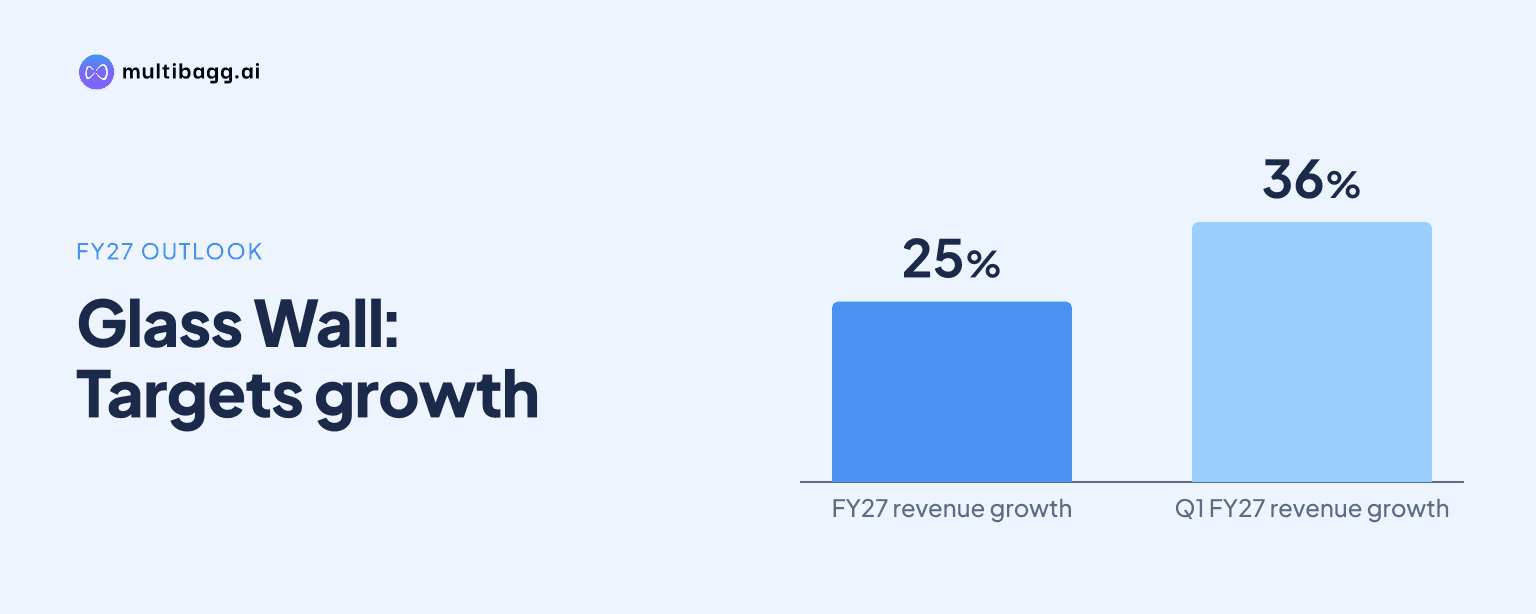
Glass Wall Systems (India) Limited expects about 25% revenue growth in FY27, supported by a ₹982 crore order book that management said provides 18-24 months of execution visibility. The company has guided for EBITDA margin of 23-25% and PAT margin of 18-20%, while progressing a ₹60 crore IPO-fund deployment plan.
Know Glass Wall Systems (India) inside out
Results, valuation, peers and who's buying, in one view.
What did Glass Wall Systems say about FY27 growth?
Glass Wall Systems said in its earnings-call summary that it expects revenue to grow by about 25% year-on-year in FY27. Management linked this outlook to its existing project pipeline and an order book of ₹982 crore as of July 31, 2026. The company said the order book was about twice its previous year's revenue and offered execution visibility over the next 18-24 months.
The guidance covers a business mix that includes facade projects, premium fenestration and exports. The company said domestic projects generally have an 18-24 month order cycle, while export projects can have a shorter cycle of about 12 months. It also stated that its manufacturing capacity can be deployed across business verticals, which gives it flexibility in fulfilling the project pipeline.
Management's margin guidance was EBITDA margin of 23-25% and PAT margin of 18-20% for FY27. These are stated targets rather than reported results. The company also said that a glass-processing unit under development is expected to be commissioned in about eight months and could improve margins by around 1-1.5 percentage points.
How did the latest reported quarter perform?
Glass Wall Systems reported Q1 FY27 revenue of ₹107 crore, up 36% year-on-year, according to the earnings-call summary filed on October 13, 2026. EBITDA for the quarter was ₹23 crore, up 9% year-on-year, while EBITDA margin stood at 21.3%.
The company separately disclosed domestic revenue of ₹62 crore in Q1 FY27, a 93% year-on-year increase. International revenue was ₹39 crore, down 12% year-on-year, and fenestration revenue was ₹6 crore, up 127% year-on-year. Management said some export revenue was expected to shift into the third and fourth quarters of FY27.
A November 3 announcement on Q2 FY27 and H1 FY27 results cited revenue of ₹239 crore, EBITDA of ₹60 crore and PAT of ₹46 crore, along with an order book of ₹957 crore. The announcement did not separately specify the period to which each headline figure applied in the information provided. Investors should therefore refer to the underlying financial statements for the precise quarterly and half-year comparison.
Why is the order book important for Glass Wall Systems?
The ₹982 crore order book is important because it provides the company with disclosed revenue visibility for 18-24 months. For a project-led facade business, the timing of execution, billing and revenue recognition can vary by project stage. The order book is therefore a measure of contracted work to be executed, not revenue already recorded.
Glass Wall Systems said it has an estimated domestic market share of 6-7% and described itself as the second-largest domestic player. Its order book includes work across multiple verticals, with the company seeking to balance domestic facade projects, exports and premium fenestration. This diversification matters because demand and completion schedules can differ across markets and product categories.
The company said exports and fenestration were introduced after the COVID-19 period and offer higher margins and faster realisation than some traditional projects. At the same time, Q1 international revenue declined year-on-year, which management attributed to a timing shift in export execution. It said it was exploring markets including Canada and Israel.
Got a follow-up? Ask IRIS
What are the capex and IPO-fund utilisation updates?
Glass Wall Systems disclosed that its glass-processing unit is expected to be commissioned within about eight months from the earnings-call discussion. Management estimated that the facility could add around 1-1.5 percentage points to margins. The unit is part of the company's effort to build processing capability alongside its existing facade and fenestration operations.
On November 3, the company filed a statement saying there was no deviation in the utilisation of ₹60 crore of IPO funds. This disclosure addresses the use of capital raised through the public issue and is relevant for shareholders tracking whether the company is deploying proceeds in line with its stated plans.
The company did not provide, in the supplied disclosures, a revised capital-expenditure total, commissioning date or project-level spending split for the glass-processing unit. That leaves the subsequent quarterly filings and management commentary as the key sources for updates on construction progress, commissioning and any financial effect from the new capacity.
How do exports and domestic operations affect the outlook?
Glass Wall Systems said it has shifted its export business to a delivered-duty-paid, or DDP, freight model, with freight costs fully passed on to clients. This arrangement is intended to limit the direct impact of freight expense on the company's export economics, although project timing and execution remain relevant to reported revenue in each quarter.
Domestic revenue growth was a notable part of Q1 FY27 performance, with revenue rising 93% year-on-year to ₹62 crore. The export business, meanwhile, recorded ₹39 crore of revenue, down 12% year-on-year. The disclosed figures show that the company's quarterly mix can move significantly depending on project milestones and overseas delivery schedules.
For investors, the main operating factors are the conversion of the order book into revenue, the stability of the guided 23-25% EBITDA margin range and progress at the new glass-processing unit. The company has provided targets and project updates, but actual financial performance will depend on execution across its domestic, export and fenestration businesses.
Conclusion
Glass Wall Systems has set out a FY27 framework of about 25% revenue growth, EBITDA margin of 23-25% and PAT margin of 18-20%. Its ₹982 crore order book gives the company a disclosed 18-24 months of execution visibility, while Q1 FY27 results showed revenue growth led by domestic operations and rapid growth in fenestration from a smaller base.
The next points to watch are the conversion of export projects expected in Q3 and Q4, the progress toward commissioning the glass-processing unit within the stated eight-month timeframe, and the detailed quarterly and half-year financial statements accompanying the November 3 results filing. Investors can also track future disclosures on the ₹60 crore IPO-fund utilisation and changes in the order book.