










Glass Wall Systems says capacity can exceed Rs 1,000 crore
Key highlights
- Glass Wall Systems said facilities at 55%-60% utilisation can support more than Rs 1,000 crore of revenue.
- Management said existing capacity can sustain around 22% year-on-year growth for four years.
- Glass Wall Systems plans a Rs 70 crore glass-processing project targeted for commissioning around July-August 2027.
- Management said it needs at least Rs 500 crore of job bookings in the next two quarters.
powered by IRIS
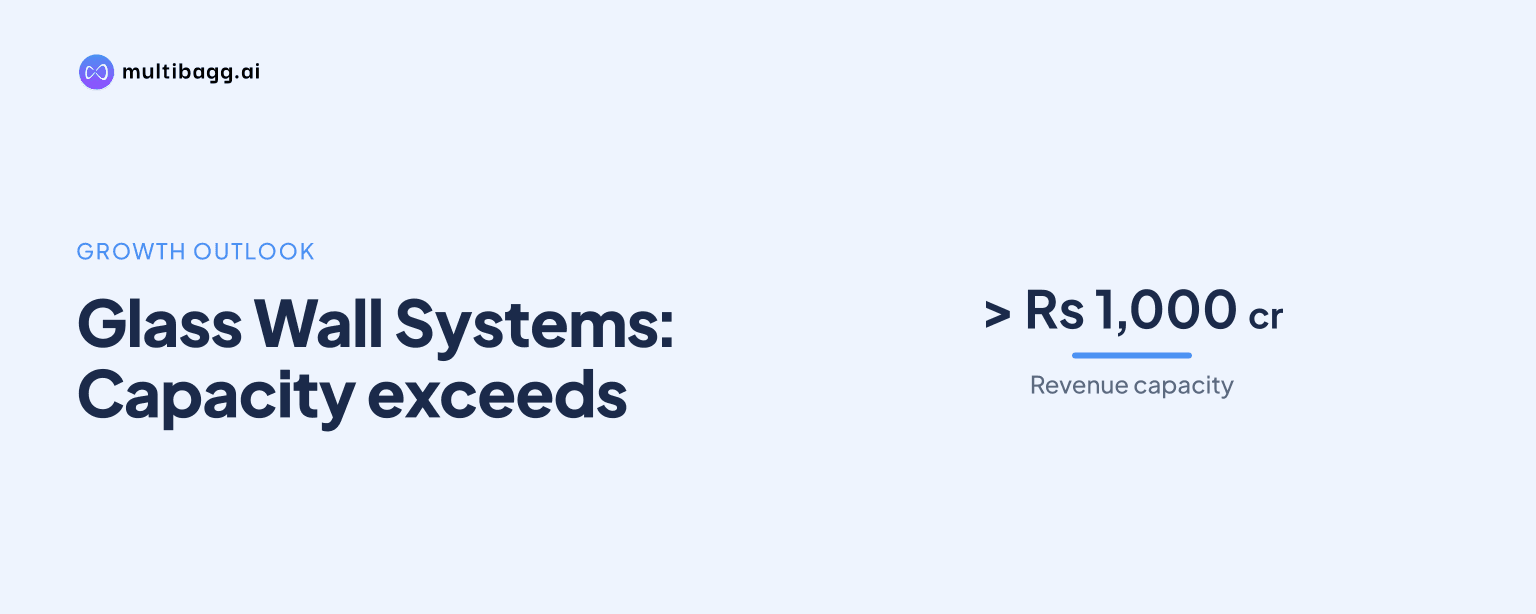
Glass Wall Systems said in the second quarter (Q2) of fiscal year 2027 (FY27) that facilities operating at roughly 55%-60% utilisation can produce more than Rs 1,000 crore of revenue without material new capital expenditure. Management said this headroom can support around 22% year-on-year growth for four years while it develops a Rs 70 crore glass-processing plant.
Know Glass Wall Systems (India) inside out
Results, valuation, peers and who's buying, in one view.
How much revenue can Glass Wall Systems produce from current capacity?
Glass Wall Systems said its existing facilities can produce more than Rs 1,000 crore of revenue at peak output without material new capital expenditure. Management put current capacity utilisation at around 55%-60%, indicating that the company can increase production and project execution through its present design and manufacturing base before requiring a broad expansion of facilities.
Management said the available capacity can sustain growth of around 22% year on year for the next four years. This is management's operating outlook rather than a revenue forecast for a specified fiscal year, and depends on Glass Wall Systems continuing to secure and execute projects across its business verticals.
The capacity calculation also reflects the company's milestone-driven project model. Management said project schedules determine when revenue is executed and recognised, so an order win need not translate into revenue in the same period. It aims to retain 18 to 24 months of execution visibility, which management described as the normal duration of project execution.
Glass Wall Systems said its growth discussion excludes freight because freight is a pass-through for customers. Management said lower container costs could reduce reported revenue even if the company wins additional jobs, which is why it assesses operating growth and margins net of freight rather than from gross billed revenue.
What capital expenditure is Glass Wall Systems planning?
Glass Wall Systems plans a Rs 70 crore glass-processing project as its principal capital investment, with commissioning targeted around July-August 2027. Management said funds for the project have already been raised and are held separately for deployment, distinguishing the processing plant from the capacity currently available in its existing facilities.
Beyond this project, management said it had bought a couple of machines and did not expect other capital expenditure to exceed Rs 20 crore over the next one-and-a-half to two years. It said this smaller expenditure would be financed through internal accruals, while the Rs 70 crore processing plant remains the dedicated investment programme.
This spending plan is not, according to management, a broad requirement to unlock the stated Rs 1,000 crore revenue capacity. Glass Wall Systems said existing facilities can reach that level before material new expenditure, while the glass-processing plant represents a specific investment in processing capability rather than an immediate response to fully utilised current capacity.
Management also said its design and manufacturing resources are fungible across three business verticals. It said this allows Glass Wall Systems to direct capacity towards domestic work if the United States market is temporarily slower, rather than retaining unused factory capacity because one geographic market has softened.
Got a follow-up? Ask IRIS
Can Glass Wall Systems sustain growth without exports?
Yes, management said domestic demand can absorb capacity if exports are temporarily slower. It described domestic opportunities as solid at good margins and said it expected some export jobs to come through in the third quarter (Q3) and fourth quarter (Q4), while retaining the option to execute domestic projects in the interim.
Management identified exports and fenestration as growth drivers over a three-year view. It described exports as a scalable product business and said fenestration had contributed more in the latest quarter because it is a higher-margin business. These comments set out management's view of future mix rather than a quantified target for revenue from either segment.
Management said order sizes have increased from roughly Rs 50 crore to Rs 60 crore around five years ago to jobs of Rs 80 crore to Rs 100 crore that it now considers normal. It said average order sizes are above Rs 60 crore to Rs 70 crore, and Glass Wall Systems is bidding for individual projects worth Rs 400 crore and Rs 500 crore.
The pipeline is not equivalent to secured revenue. Management said it could win a larger proportion of a Rs 3,000 crore pipeline by cutting prices, but does not use conversion rate as its primary measure. Instead, it said it needs to book at least Rs 500 crore of jobs in the next two quarters to maintain 18 to 24 months of project visibility.
What do utilisation and order plans mean for Glass Wall Systems' financial outlook?
Management expects around 22% growth from its historical base and said Q3 and Q4 should be strong. During the call, management agreed that an analyst's calculation of more than 30% top-line growth in the second half of FY27 was ballpark accurate, but it did not provide a specific full-year revenue target.
Management retained consolidated guidance of 23%-25% for earnings before interest, tax, depreciation and amortisation (EBITDA), and around 18%-20% for profit after tax (PAT). It said Q2 margins rose because escalation claims were recognised after their related costs had been recorded in earlier periods, and because fenestration made a larger contribution.
Working-capital days also varied significantly. Management said working-capital days were negative 19 days in the current period, compared with 44 days in the prior year, but asked investors to use around 45 days as the normal planning assumption. It added that customer advances against freight mean freight does not create additional working-capital blockage.
The comparison shows that available production capacity is only one part of the earnings outcome. Utilisation of 55%-60% provides room for additional work, but milestone timing affects revenue recognition, segment mix affects margins, and working-capital days can move from negative 19 days to management's planning assumption of about 45 days.
Conclusion
Glass Wall Systems is positioning existing capacity as sufficient for its near-term growth ambition, with more than Rs 1,000 crore of potential revenue from facilities that are currently only 55%-60% utilised. The company is pairing that headroom with targeted spending, rather than presenting the Rs 70 crore glass-processing plant as a prerequisite for reaching its stated capacity potential.
The next developments to watch are the plan to book at least Rs 500 crore of work over the next two quarters, management's expectation of stronger Q3 and Q4 activity, and the targeted July-August 2027 commissioning of the glass-processing project. The relative contribution from domestic projects, exports and fenestration will also affect execution and the guided 23%-25% EBITDA range.