










Glass Wall Systems domestic façade revenue rose 33% in H1
Key highlights
- Glass Wall Systems' domestic façade revenue rose 33% year on year to Rs 140 crore in H1FY27.
- Glass Wall Systems' international façade revenue fell 14% to Rs 76 crore in H1FY27.
- Glass Wall Systems' fenestration revenue grew 82% to Rs 22 crore in H1FY27.
- Glass Wall Systems reported an order book of Rs 957 crore as of September 30, 2026.
powered by IRIS
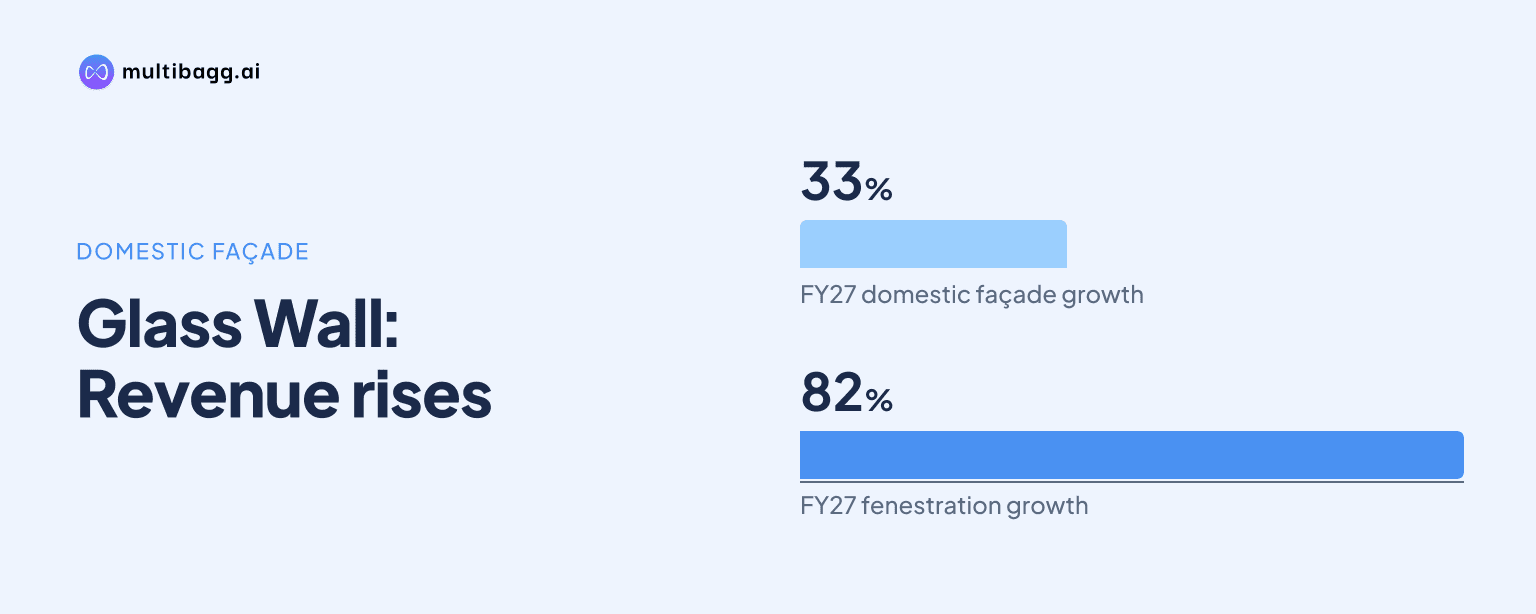
Glass Wall Systems (India) Limited reported 33% year-on-year growth in domestic façade revenue to Rs 140 crore in the first half of financial year 2027 (H1FY27), helping revenue from operations rise 15.8% to Rs 238.9 crore despite a 14% fall in international façade revenue to Rs 76 crore. Fenestration revenue increased 82% to Rs 22 crore.
Know Glass Wall Systems (India) inside out
Results, valuation, peers and who's buying, in one view.
Why did Glass Wall Systems' domestic façade revenue rise in H1FY27?
Glass Wall Systems said domestic façade revenue rose 33% year on year to Rs 140 crore in H1FY27 because of increased traction across sectors and sustained demand. Management described the domestic business as a strong performer for the half year, while total revenue from operations increased by Rs 32.5 crore, from Rs 206.4 crore in H1FY26 to Rs 238.9 crore in H1FY27.
The pace of domestic façade growth was lower in the second quarter of FY27 (Q2FY27) than across the first half. Q2FY27 domestic façade revenue increased 7% year on year to Rs 78 crore, compared with the 33% increase reported for H1FY27. The presentation does not identify the sectors, projects or customers behind the Rs 140 crore half-year total, so it does not quantify the sources of the change in growth rate.
How did Glass Wall Systems' international and fenestration businesses perform?
Glass Wall Systems' international façade revenue declined 14% year on year to Rs 76 crore in H1FY27, while its fenestration business grew 82% to Rs 22 crore. Management said the international business is project-driven, meaning execution timing and revenue recognition can vary between quarters, and said it considers a full-year assessment more appropriate for that business.
The Q2FY27 segment data showed the same contrast. International façade revenue fell 16% year on year to Rs 37 crore, whereas fenestration revenue grew 69% to Rs 16 crore. Domestic façade revenue of Rs 78 crore, international façade revenue of Rs 37 crore and fenestration revenue of Rs 16 crore together totalled Rs 131 crore in the quarter, close to consolidated revenue from operations of Rs 131.5 crore.
The three disclosed H1FY27 business-line revenues add to Rs 238 crore, compared with consolidated revenue from operations of Rs 238.9 crore. This comparison shows that the Rs 140 crore domestic façade business was the largest disclosed revenue line in the period, while the Rs 22 crore fenestration business expanded faster than either façade operation. The presentation does not provide prior-period revenue amounts for the three lines.
Got a follow-up? Ask IRIS
How did the business mix affect Glass Wall Systems' H1FY27 results?
Glass Wall Systems grew consolidated revenue from operations 15.8% to Rs 238.9 crore in H1FY27 from Rs 206.4 crore in H1FY26, despite the decline in international façade activity. Domestic façade growth of 33% and fenestration growth of 82% offset the 14% reduction in international façade revenue, meaning the reported half-year increase came from domestic façade and fenestration operations rather than international façade sales.
Gross profit rose 36.9% to Rs 145.3 crore in H1FY27 from Rs 106.1 crore in H1FY26, and gross profit margin increased to 60.8% from 51.4%. Earnings before interest, tax, depreciation and amortisation (EBITDA) increased 22.4% to Rs 60.5 crore from Rs 49.4 crore, while profit after tax rose 13.2% to Rs 45.9 crore from Rs 40.5 crore.
The comparative margins differed below EBITDA. EBITDA margin increased by 138 basis points to 25.3% from 23.9%, with one basis point equal to one-hundredth of a percentage point. Profit after tax margin declined by 43 basis points to 19.2% from 19.6%, while depreciation increased to Rs 3.2 crore from Rs 1.8 crore and tax rose to Rs 14.9 crore from Rs 12.9 crore.
What explains Glass Wall Systems' H1FY27 margin movement?
Glass Wall Systems said the expansion in H1FY27 EBITDA margin was primarily driven by escalation claims on receivables, for which the associated expenses had already been incurred. Reported EBITDA was Rs 60.5 crore and the reported margin was 25.3%, compared with Rs 49.4 crore and 23.9%, respectively, in H1FY26. The company did not specify the monetary value of the escalation claims.
A revised commercial agreement also changed the presentation of export freight. In H1FY26, customers paid those costs directly; in H1FY27, Glass Wall Systems paid the freight and subsequently recovered it from customers, recording the amounts in both revenue and other expenses. Excluding Rs 14 crore of export freight from both lines, management calculated an H1FY27 EBITDA margin of 26.9%, rather than the reported 25.3%.
The same mechanism applied in Q2FY27, when Rs 9 crore of export freight was included in both revenue and other expenses. Q2FY27 revenue from operations rose 3.3% to Rs 131.5 crore, but EBITDA increased 32.3% to Rs 37.5 crore and margin reached 28.5%, versus 22.3% a year earlier. On management's adjusted basis excluding freight from revenue and other expenses, Q2FY27 EBITDA margin was 30.6%.
Conclusion
The H1FY27 results show a shift in Glass Wall Systems' disclosed revenue mix toward domestic façade and fenestration activity, alongside lower international façade revenue. EBITDA rose 22.4% to Rs 60.5 crore and gross profit margin rose to 60.8%, but the reported EBITDA margin improvement was attributed partly to escalation claims and was also affected by the inclusion of Rs 14 crore of recoverable export freight in revenue and other expenses.
The next disclosed milestone is commissioning of the in-house Glass Processing Unit at Vile Bhagad, expected by August 2027. Management said the facility is expected over time to add about 100 to 150 basis points to EBITDA margin, reduce reliance on external processed-glass suppliers and improve supply-chain control; it also said the order book stood at Rs 957 crore on September 30, 2026, and expects significant FY27 revenue growth over FY26 with EBITDA margin broadly in line with the previous financial year.